How PI Law Firms Scale Case Volume With Pay Per Lead Marketing in 2026
Discover how personal injury law firms are scaling case volume in 2026 using pay per lead marketing, niche targeting, and intake automation to outgrow the referral ceiling.

Rafael Hernandez
CEO and Co-Founder of Great Marketing AI

I hope you find this useful. If you want our team to run your law firm's performance marketing, book a strategy call.
Author: Rafael Hernandez | CEO and Co-Founder of Great Marketing AI
Key Takeaways
- PI law firms that scale past the referral ceiling treat lead generation as a performance system with defined inputs, measurable outputs, and clear cost-per-case targets.
- Pay per lead marketing aligns agency incentives with law firm outcomes — you only pay for case inquiries that meet your defined criteria, not for ad spend, impressions, or effort.
- Niche dominance beats generalism: PI firms that focus on one case type and one geographic market in 2026 consistently outperform those that spread budget across multiple practice areas.
- Intake automation is the missing multiplier — speed-to-lead systems that contact claimants within seconds dramatically increase signed case rates without adding intake headcount.
- Bilingual Spanish-language marketing is the highest-ROI expansion move for PI firms in competitive markets where Hispanic communities are underserved by local attorneys.
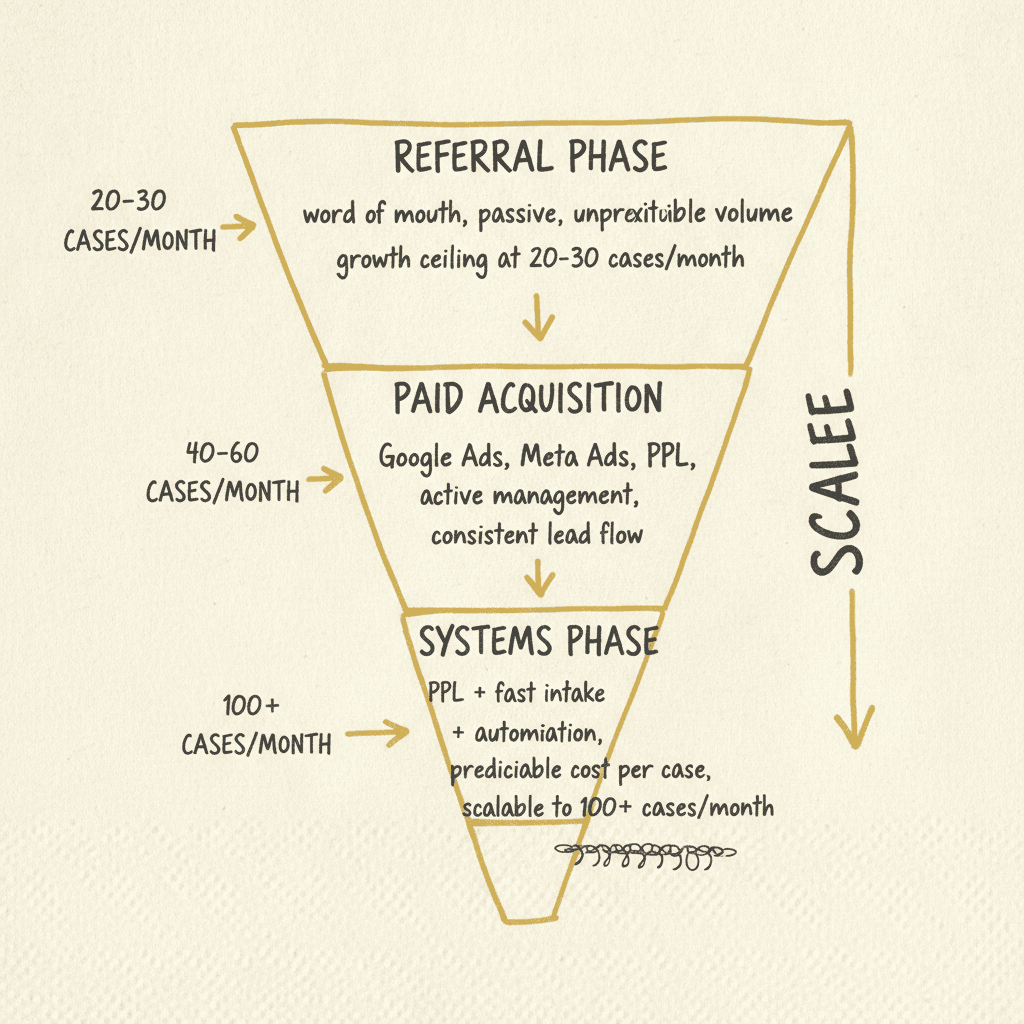
Every personal injury law firm hits the referral ceiling eventually. It usually arrives when the founding attorney has been in practice for five to seven years, the firm has a strong reputation, and word-of-mouth generates a comfortable but not growing volume of cases. Getting past that ceiling requires a different operating model — one that treats case lead generation as a managed performance system, not a passive activity.
The Performance Shift: From Referrals to Systems
PI firms that scale from 20 signed cases per month to 100 or more do not simply spend more on advertising. They change how they think about growth. The shift is from relying on relationship-based referrals and hoping the phone rings, to running a measurable acquisition system with defined inputs, predictable outputs, and a clear cost per signed case.
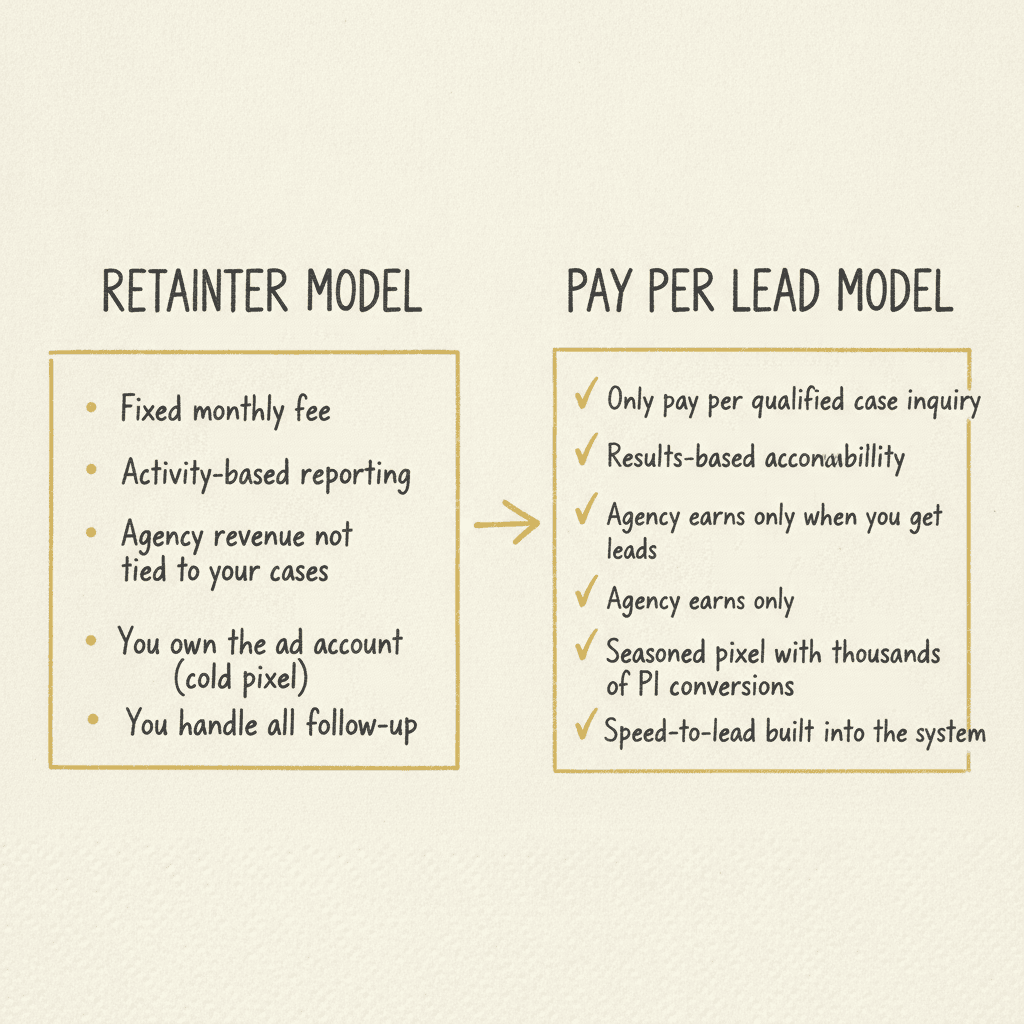
Pay per lead marketing is the engine of this shift for most PI firms in 2026. The model is straightforward: an agency delivers qualified case inquiries that meet your pre-defined criteria — practice area, geography, incident type, recency, and contact verification. You pay only for leads that meet the spec. The agency's revenue depends on delivering leads you will pay for, which aligns incentives in a way retainer relationships never can. Working with a personal injury law firm marketing agency that operates on performance-based pricing means growth is no longer capped by a fixed retainer budget.
According to industry data tracked by HubSpot, demand for performance-based pricing in digital advertising continues to grow rapidly as clients prioritize measurable ROI over activity-based billing. For personal injury firms with defined case value targets, the PPL model is the natural expression of that preference.
Niche Dominance: The Fastest Path to Scaling Case Volume
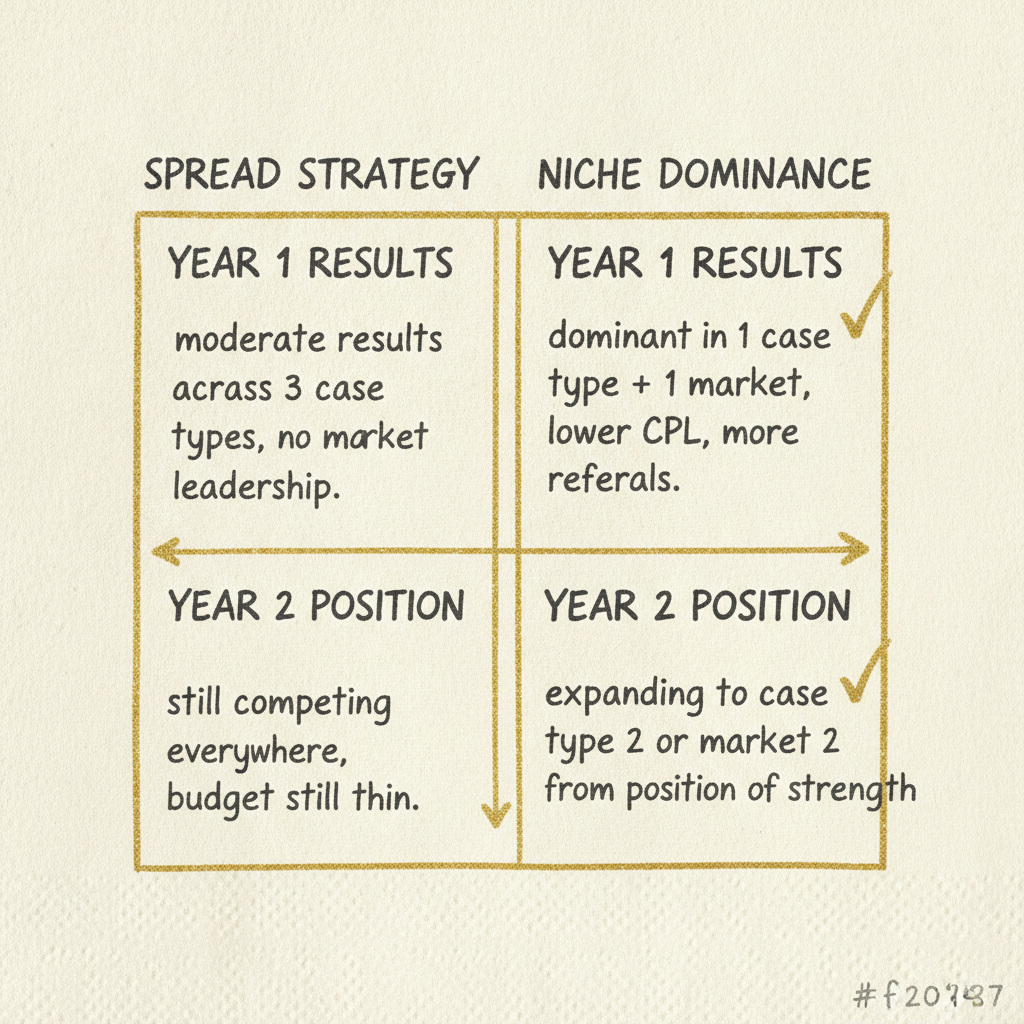
The most common mistake PI firms make when trying to scale is spreading budget across multiple practice areas and geographic markets simultaneously. A firm that runs Google Ads for car accidents, slip and fall, workers compensation, and medical malpractice in three different metro areas simultaneously is competing against specialists in every direction. Budget is thin everywhere, the pixel learns slowly in every category, and no single channel reaches critical mass.
The PI firms that scale fastest in 2026 focus on one case type and one geographic market until they dominate it, then expand. A firm that decides to own MVA cases in one specific city with a population of 500,000 can concentrate its budget, build landing pages for specific neighborhoods, target Spanish-language media for the Hispanic community in that market, and build a Google Business Profile with hundreds of five-star reviews from that city. Within 12 months, it is the obvious choice for accident victims in that market.
Once niche dominance is established, expansion becomes systematic: add a second case type in the same market, or replicate the dominant position in an adjacent city. The pixel data, the creative library, and the intake scripts all transfer. The learning curve for each expansion is dramatically compressed.
Intake Automation: The Multiplier Most PI Firms Ignore
The PI firms that see the biggest ROI jump from PPL marketing in 2026 are not spending more on leads. They are getting more signed cases from the same leads by fixing their intake speed. Research from the Harvard Business Review shows that firms contacting a lead within one hour are seven times more likely to qualify that prospect than firms that wait longer. For PI leads from accident victims who submitted a form, the window is even shorter.
An accident victim who fills out a form at 9 PM on a Friday after being told by the ER to contact an attorney is in a high-anxiety, time-sensitive state. If your firm reaches them within two minutes via SMS, they are available, relieved, and ready to book a consultation. If you reach them Monday morning when they have already talked to two other attorneys, you are starting from a difficult position.
Speed-to-lead automation solves this without requiring your intake team to be available around the clock. An automated system that sends a personalized SMS within 30 seconds of form submission, asks one qualifying question, and books a consultation on your intake calendar if the case meets criteria can double or triple signed case rates from the same lead volume. For PI firms scaling from 30 to 100 cases per month, this is the highest-leverage system investment available.
Bilingual Marketing: The Highest-ROI Expansion Move
For PI firms in markets with significant Hispanic communities, Spanish-language marketing is the single most underutilized scaling lever. In cities like Los Angeles, Houston, Miami, New York, and Chicago, the Spanish-speaking accident victim population is large, legal representation needs are acute, and the competition from Spanish-language PI marketing is thin compared to the English-language market.
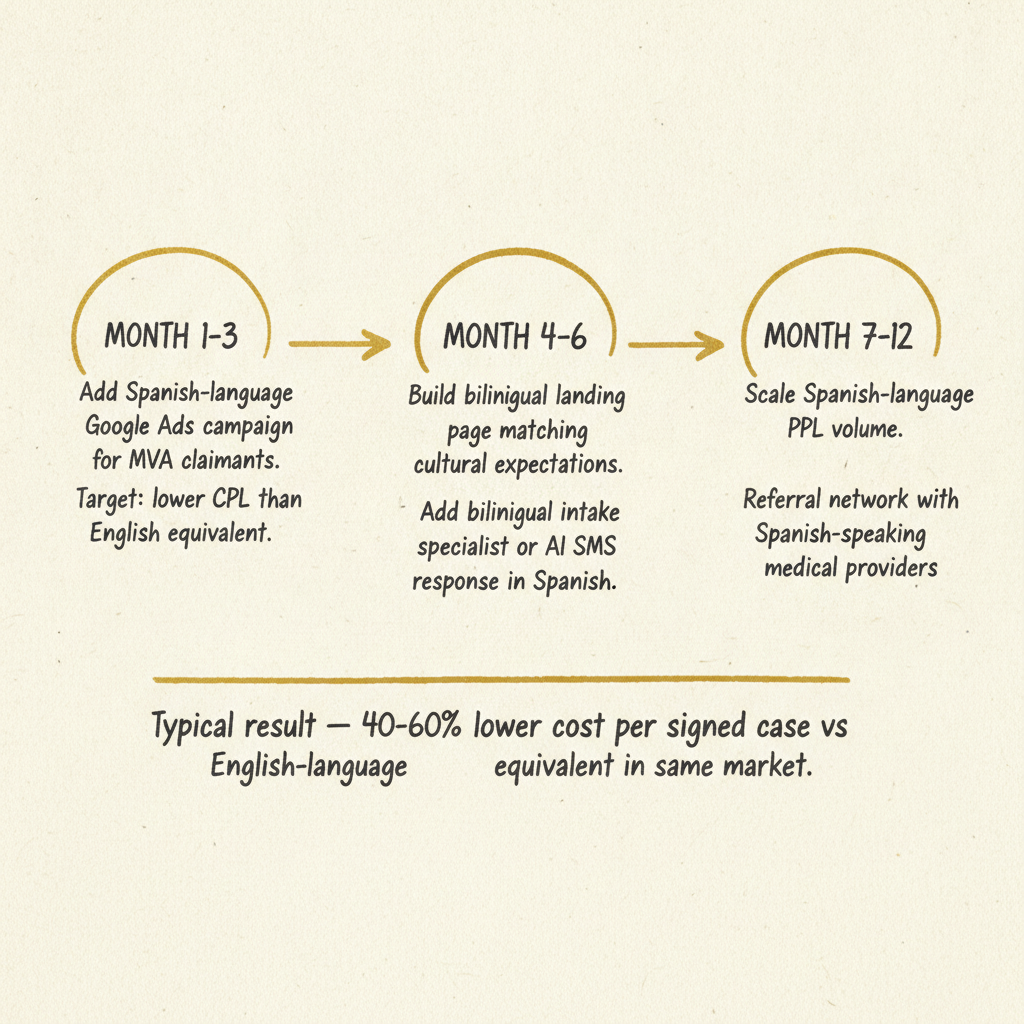
A PI firm that adds a Spanish-language Google Ads campaign targeting MVA claimants in Spanish, a landing page that matches the cultural and linguistic expectations of that audience, and a bilingual intake team member to handle calls converts Spanish-language leads at dramatically lower cost per signed case than English-language equivalents in the same market.
According to the U.S. Census Bureau, the Hispanic population in the United States is projected to grow to 111 million by 2060. In personal injury law markets, this represents a long-term structural advantage for firms that build bilingual capability now, before that market becomes as competitive as the English-language PI space.
Building the System: What Scaling Looks Like Month by Month
Scaling PI case volume through PPL marketing is not a single action. It is a sequence of system investments that compound over time. The firms that try to do everything at once — launch PPL, build bilingual campaigns, start intake automation, and open a new geographic market simultaneously — dilute their execution and see inconsistent results.
The practical sequence for most PI firms looks like this: start by fixing intake speed and qualifying the intake process. Then launch PPL at a volume your intake team can handle. Measure cost per signed case by source over 30 days. Once that baseline is established, expand lead volume proportionally. At 50 signed cases per month, add Spanish-language campaigns. At 75, evaluate whether a second geographic market makes sense.
The firms that reach 100+ signed cases per month from paid marketing do so by executing the fundamentals consistently, not by finding shortcuts. Niche focus, fast intake, and bilingual capability are available to every PI firm. The ones that scale are simply the ones that build each piece deliberately and measure results at every step.
Conclusion
Scaling personal injury case volume in 2026 is a systems problem, not a budget problem. The PI firms adding the most signed cases are not the ones spending the most on advertising — they are the ones who built the right acquisition, intake, and qualification system and then scaled it deliberately. Pay per lead marketing provides the aligned incentive structure; niche focus provides the depth; intake automation provides the conversion multiplier; and bilingual capability provides the market expansion.
For a detailed breakdown of how PPL agencies generate and price their leads, and what to demand before signing a contract, read our pay per lead marketing agency guide.
If you want to see how our pay per lead for personal injury lawyers model works in your specific market, what case volume to realistically expect, and how to sequence the system investments that will get you there, schedule a strategy call with our team. We work exclusively with PI firms and will build you a market-specific scaling plan before you spend anything.
Turn Ad Spend Into Signed Cases
We blend AI-driven testing with proven performance strategy to attract qualified traffic and turn it into revenue—fast, trackable, and scalable.
- PI Lead Generation — exclusive, AI-qualified leads across MVA, slip & fall, med mal, and more.
- Facebook & Instagram Ads — reach customers where they scroll.
- Google Ads — capture people actively searching for you.
- Website Design — turn visitors into buyers with high-converting sites.
- AI Automations — save hours and never miss a follow-up.
- Email Marketing — nurture leads and close sales on autopilot.
- SEO — get found by customers searching for what you sell.
FAQs

About the author
Rafael Hernandez
CEO and Co-Founder of Great Marketing AI
Rafael Hernandez is the Founder of Great Marketing AI and a former Microsoft Engineer. He specializes in performance marketing for personal injury law firms, managing over $10M in ad spend to help attorneys generate signed cases across every PI case type. His strategies focus on exclusive lead generation, AI-powered qualification, and eliminating wasted budget.
About Great Marketing AI
Great Marketing AI: Performance marketing for personal injury law firms
We help personal injury law firms scale with exclusive, AI-qualified leads across every PI case type: MVA, slip & fall, medical malpractice, and wrongful death. Native English and Spanish campaigns, enterprise-grade Meta + Google ad management, and AI lead qualification before every intake.
100% Exclusive Leads
Never shared between firms. Territory-protected.
Native Spanish & English Campaigns
Built by native speakers, not Google Translate.
AI Lead Qualification
Pre-qualified before they ever reach your intake team.