Escaping the Retainer Treadmill: Why PI Law Firms Should Switch to Pay Per Lead
Tired of paying a marketing retainer with no guaranteed cases? Learn why personal injury law firms are switching to pay per lead and how it changes your ROI.

Rafael Hernandez
CEO and Co-Founder of Great Marketing AI

I hope you find this useful. If you want our team to run your law firm's performance marketing, book a strategy call.
Author: Rafael Hernandez | CEO and Co-Founder of Great Marketing AI
Key Takeaways
- A retainer-based marketing agency charges a fixed monthly fee regardless of how many cases you sign — pay per lead aligns agency incentives with your results.
- Under a pay per lead model, you only pay for real case inquiries that meet your defined criteria, eliminating wasted spend on brand awareness with no measurable return.
- Consolidated ad account data in a PPL agency means your campaigns benefit from a seasoned pixel trained on thousands of PI conversions, not a fresh account starting from zero.
- Pay per lead is especially powerful for personal injury firms because MVA and slip and fall cases have high enough case values to justify premium lead prices.
- Speed to lead is built into a properly run PPL system — AI-powered follow-up tools contact new leads within seconds, solving the conversion gap retainer clients struggle with.
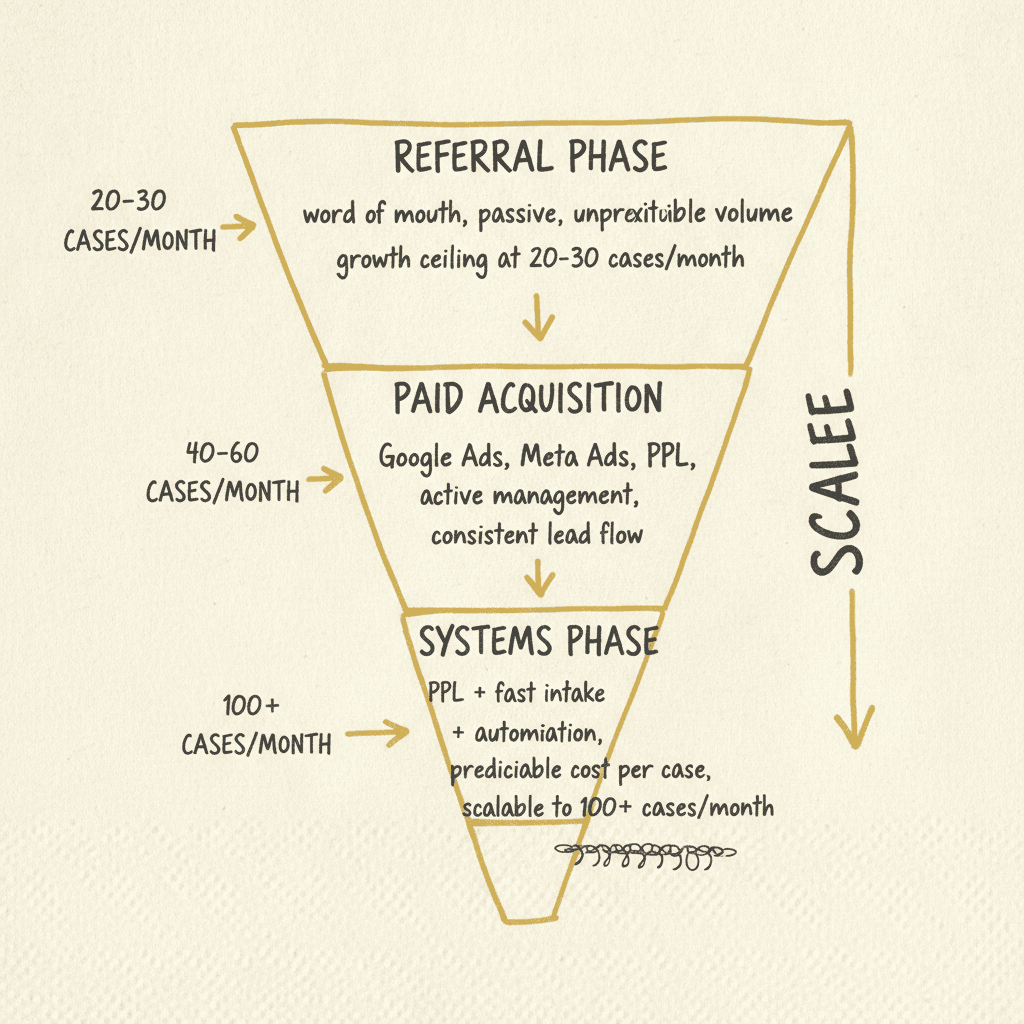
Most personal injury law firms have been on the retainer treadmill at least once. You pay a marketing agency a fixed monthly fee. They run some ads, produce a report full of impressions and clicks, and leave you wondering how many of those turned into signed cases. When you ask, the answer is hard to pin down. That is the fundamental problem with retainer-based marketing for PI firms: it rewards activity, not outcomes.
The Problem With the Retainer Model for PI Law Firms
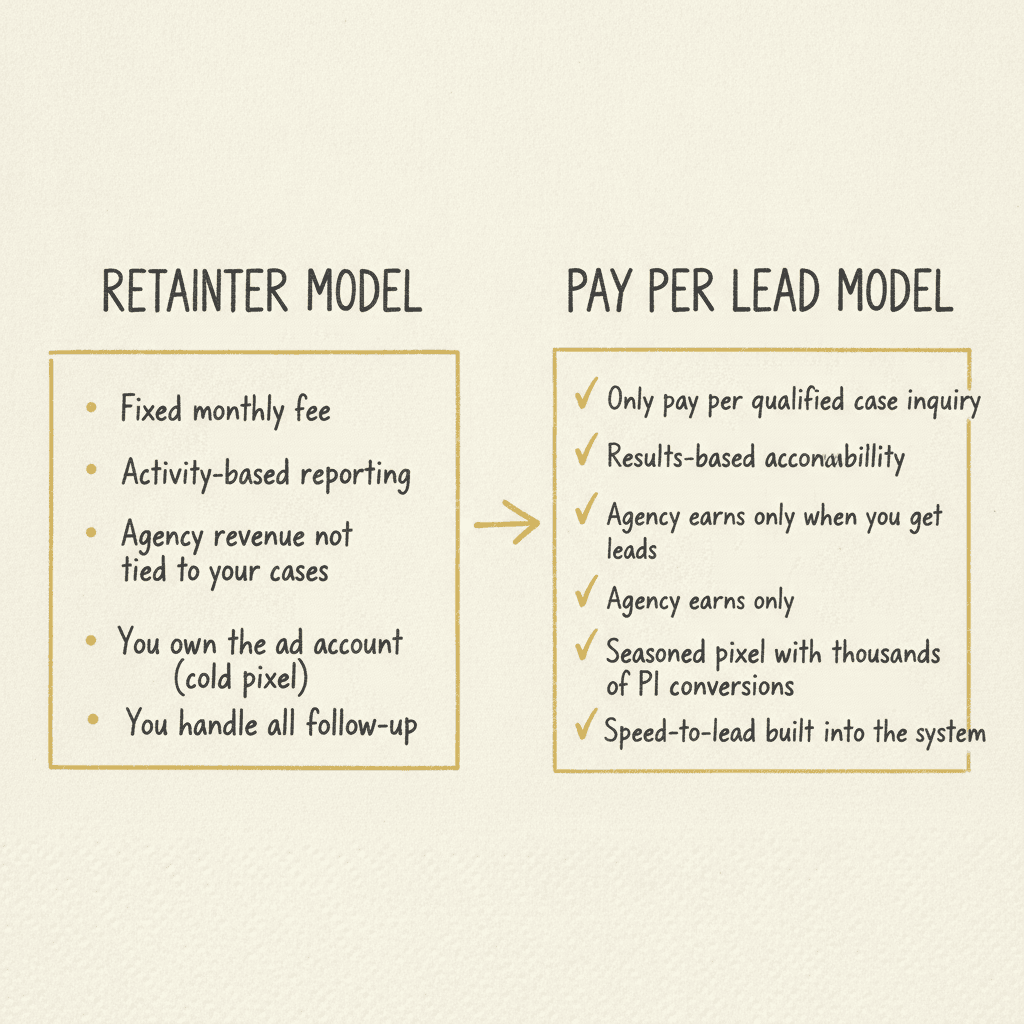
When you hire a retainer-based marketing agency, you are paying for their time and expertise regardless of your results. If the campaigns underperform, the invoice still arrives. If your intake team gets flooded with unqualified calls, you still pay. The agency's revenue is not connected to your caseload. That misalignment is the root cause of most law firm marketing frustrations.
Retainer agencies also tend to manage your ad account in isolation. Your campaigns benefit only from your own pixel data, which means it takes months of spend before the algorithm learns what a signed PI client looks like. Meanwhile, a pay per lead agency running campaigns across dozens of law firms in the same vertical has a seasoned pixel that already knows exactly who converts.
According to the Clio Legal Trends Report, 74 percent of legal clients expect to hear back from a law firm within 24 hours of their first contact. Retainer agencies rarely own the follow-up process. They deliver the lead and step away. PPL agencies with built-in speed-to-lead automation close that gap.
Why Pay Per Lead Changes the Equation
The core advantage of pay per lead for personal injury firms is that incentives finally align. The agency only earns revenue when it delivers a lead that meets your pre-agreed criteria. If the leads stop coming, the agency fixes the system. You are no longer paying for effort — you are paying for results.
Under a PPL model, you define the lead criteria in writing before you pay for anything: practice area, geographic location, incident type, minimum case timeline, and contact information requirements. Every lead delivered must meet those specs. If it does not, you dispute it and do not pay. That accountability structure simply does not exist in a retainer relationship.
The Consolidated Data Advantage
One of the most underappreciated advantages of a pay per lead agency is the consolidated ad account structure. Instead of running separate campaigns for each law firm client, a PPL agency runs all its PI campaigns through a master ad account. This means its Meta pixel and Google conversion tracking accumulate data from dozens of firms, thousands of leads, and hundreds of signed cases.
The result is a pixel that knows exactly what a qualified MVA claimant looks like: demographic patterns, behavioral triggers, device types, time of day, and geographic concentration. A retainer agency managing your standalone account starts fresh and spends months learning what your PPL agency already knows from day one.
This data moat is the reason top PPL agencies can deliver lower cost-per-lead over time: they are not building from scratch with your budget. They are deploying a proven system that has already found the best converting audiences across the PI vertical.
Speed to Lead: The Conversion Gap Retainer Agencies Leave Open
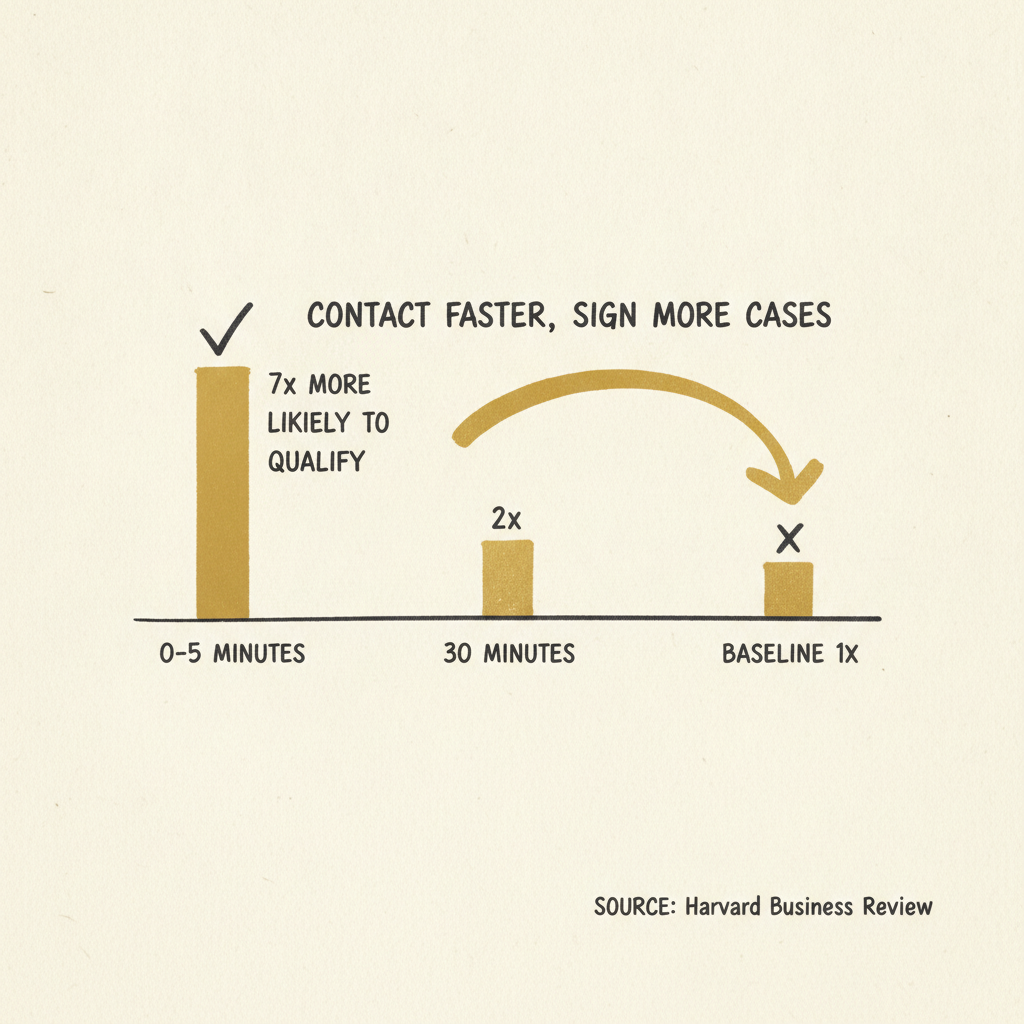
Generating the lead is only half of the equation. The other half is how fast someone contacts that claimant after they submit a form. Research from the Harvard Business Review shows that firms contacting leads within one hour are seven times more likely to qualify that prospect than firms that wait longer.
Retainer clients are almost always left to handle follow-up on their own. If your intake team does not call within minutes, you lose the case to the first firm that does. A properly structured PPL system solves this with AI-powered speed-to-lead automation: a text or voice message reaches the claimant within seconds of submission, pre-qualifies them, and books them directly onto the intake calendar. You get a booked appointment, not just a form submission.
Which PI Case Types Work Best With Pay Per Lead
Not all practice areas are equally suited to the PPL model. The case types that work best share two characteristics: consistent search demand and high enough average case values to justify a premium lead price.
Motor vehicle accidents are the strongest PPL case type for personal injury firms. Demand is consistent year-round, intent is immediate (people search right after an accident), and average settlement values justify lead prices between $150 and $400 per qualified inquiry. Slip and fall, rideshare accidents, and truck accidents all perform well within the same structure.
High-complexity practice areas like medical malpractice are harder to run on PPL because the cases are less predictable and the intake qualification is more nuanced. These work better on retainer with a specialized PI marketing team that can handle the longer education cycle. For firms with mixed practices, a hybrid approach — PPL for MVA and retainer for complex matters — often delivers the best overall economics.
What to Demand From a Pay Per Lead Provider
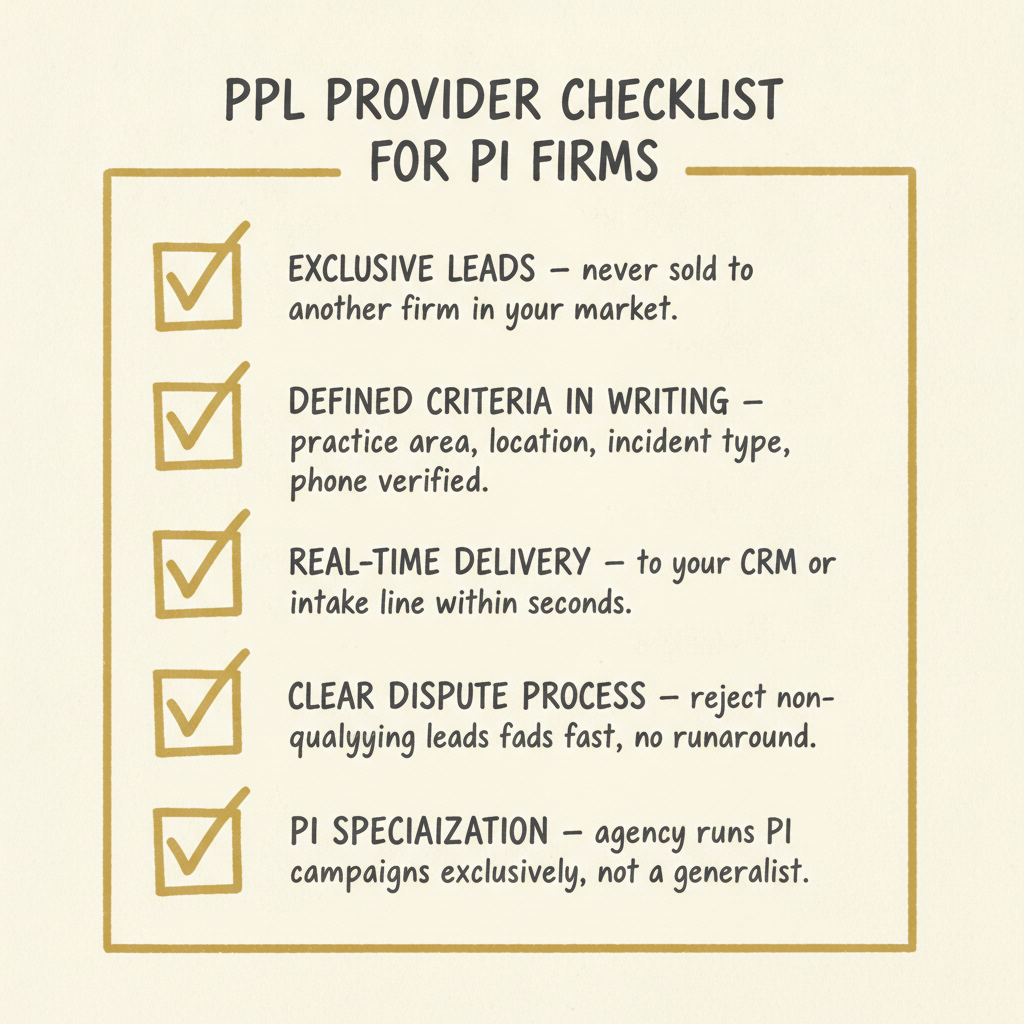
The PPL model is only as good as the provider's lead quality standards. Before committing to any pay per lead arrangement, get the following in writing:
Exclusive delivery. Your lead should never be sold to another PI firm in your market. Shared leads convert at a fraction of the rate of exclusive leads because the claimant is already being contacted by multiple attorneys.
Defined lead criteria. Practice area, geographic radius, incident type, minimum days since incident, and verified phone number should all be in the contract. If the lead does not meet the spec, you do not pay.
Real-time delivery. Leads delivered hours after submission have already been contacted by the claimant's next search result. Real-time delivery to your CRM or intake line is non-negotiable.
Dispute process. You need a clear, fast process for flagging and disputing leads that do not meet criteria. Providers without a dispute process are hiding their lead quality behind volume.
Conclusion
The retainer treadmill keeps law firms paying for marketing activity with no direct link to case outcomes. Pay per lead breaks that cycle by tying every dollar you spend to a qualified case inquiry. For personal injury firms where each signed case generates thousands of dollars in revenue, the math on a well-run PPL system is compelling: higher accountability, better-qualified leads, built-in follow-up automation, and no monthly fee for campaigns that underperform.
For a deeper look at how PPL agencies generate their leads and what their economics look like from the agency side, read our breakdown of how pay per lead marketing agencies work.
If you want to see how our pay per lead for personal injury lawyers model works and how it compares to your current retainer spend, schedule a strategy call with our team. We work exclusively with PI firms and will show you exactly what to expect in case volume before you spend a dollar.
Turn Ad Spend Into Signed Cases
We blend AI-driven testing with proven performance strategy to attract qualified traffic and turn it into revenue—fast, trackable, and scalable.
- PI Lead Generation — exclusive, AI-qualified leads across MVA, slip & fall, med mal, and more.
- Facebook & Instagram Ads — reach customers where they scroll.
- Google Ads — capture people actively searching for you.
- Website Design — turn visitors into buyers with high-converting sites.
- AI Automations — save hours and never miss a follow-up.
- Email Marketing — nurture leads and close sales on autopilot.
- SEO — get found by customers searching for what you sell.
FAQs

About the author
Rafael Hernandez
CEO and Co-Founder of Great Marketing AI
Rafael Hernandez is the Founder of Great Marketing AI and a former Microsoft Engineer. He specializes in performance marketing for personal injury law firms, managing over $10M in ad spend to help attorneys generate signed cases across every PI case type. His strategies focus on exclusive lead generation, AI-powered qualification, and eliminating wasted budget.
About Great Marketing AI
Great Marketing AI: Performance marketing for personal injury law firms
We help personal injury law firms scale with exclusive, AI-qualified leads across every PI case type: MVA, slip & fall, medical malpractice, and wrongful death. Native English and Spanish campaigns, enterprise-grade Meta + Google ad management, and AI lead qualification before every intake.
100% Exclusive Leads
Never shared between firms. Territory-protected.
Native Spanish & English Campaigns
Built by native speakers, not Google Translate.
AI Lead Qualification
Pre-qualified before they ever reach your intake team.