Bilingual Answering Service for Law Firms: Stop Losing Spanish-Speaking MVA Cases After Hours
A bilingual answering service captures the after-hours Spanish-speaking accident calls most PI firms lose to voicemail. See the cost-per-signed-case math.

Rafael Hernandez
CEO and Co-Founder of Great Marketing AI

I hope you find this useful. If you want our team to run your law firm's performance marketing, book a strategy call.
Author: Rafael Hernandez | CEO and Co-Founder of Great Marketing AI
Key Takeaways
- A bilingual answering service answers, qualifies, and books your prospective-client calls in English and Spanish when your own staff cannot, most critically nights and weekends when motor vehicle accidents spike.
- Every after-hours Spanish-speaking accident call that hits voicemail is a lead you already paid to generate and then handed to a competitor. The right benchmark is not the monthly fee, it is cost per signed case.
- Clio found 35% of calls from prospective clients to law firms go unanswered, and 79% of legal consumers hire the first attorney who responds. A monolingual voicemail loses on both counts with Spanish-speaking claimants.
- Human legal answering services run roughly $300 to $800 per month. For a PI firm, a single signed MVA case worth $5,000 or more usually pays for a full year of coverage.
- The make-or-break feature is the handoff: insist on native-fluent Spanish intake, accident-specific qualification, and direct CRM plus Meta Conversion API tracking, not a more expensive voicemail.
A bilingual answering service is an outsourced intake team, human or AI, that answers your prospective-client calls in both English and Spanish when your own staff cannot, then qualifies the caller, collects the accident details, and either books a consultation or routes an urgent matter to an attorney. For a personal injury firm chasing Spanish-speaking motor vehicle accident clients, its single most valuable job is covering the hours your office is dark, because that is when most accident calls actually arrive and when almost no firm answers in Spanish. Here is the money-leak in one sentence: every after-hours Spanish-speaking accident call that hits your voicemail is a lead you already paid to generate, and then quietly handed to a competitor.
The math is what makes this urgent. Clio's research found that 35% of calls from prospective clients to law firms go unanswered, and 79% of legal consumers hire the first attorney who responds to them. A Spanish-speaking claimant who reaches an English-only voicemail loses on both counts: no live answer, and no answer in their language. If a signed MVA case is worth $5,000 to $50,000 in fees to your firm, and a bilingual answering service costs roughly $300 to $800 per month, recovering even one otherwise-lost case usually pays for a full year of coverage. This guide breaks down what the service does, what it costs against cost per signed case, how to choose one, and why bilingual coverage is the highest-leverage intake fix for firms in Hispanic markets. It is the bilingual companion to our broader law firm answering service guide.
What a Bilingual Answering Service Actually Does for a PI Firm
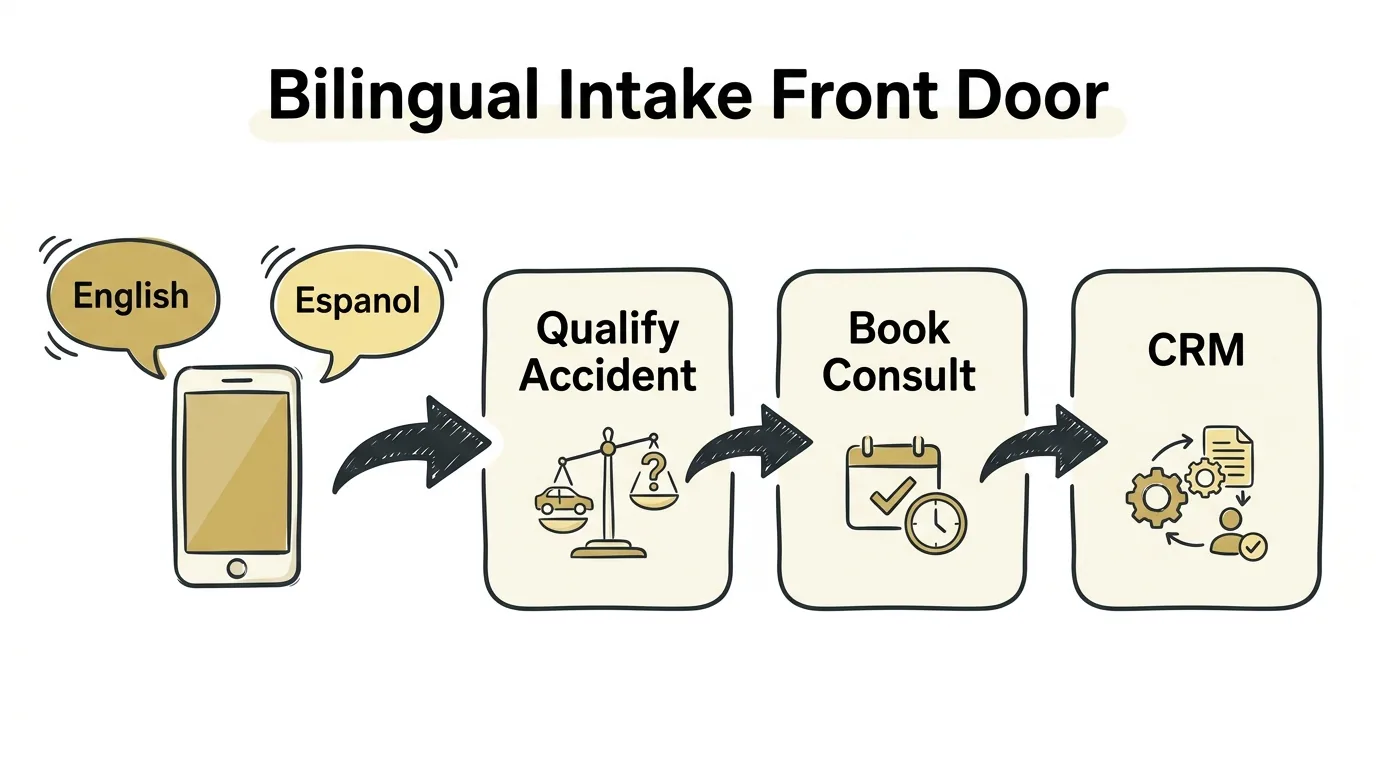
A bilingual answering service is the front door to your firm for callers who are more comfortable in Spanish. A traditional answering service in any language mostly takes a message and forwards it. A bilingual service built for legal intake does the work that converts a panicked accident victim into a signed client. It answers live in the caller's language, projects that your firm understands them, runs a qualification script for the case type, and captures the facts your attorneys need.
For a personal injury firm, that means greeting a Spanish-speaking caller without a language barrier, collecting the date of the accident, the nature of the injuries, the at-fault party, and whether the prospect has already hired a lawyer, then either booking a consultation or escalating an urgent matter. The difference between a generic answering service and a bilingual legal answering service is the difference between a voicemail and an intake. A true Spanish answering service does not just translate, it qualifies the case in the caller's language. One records that someone called. The other starts the attorney-client relationship in the moment it matters most.
Why After-Hours Coverage Is the Highest-Leverage Hour
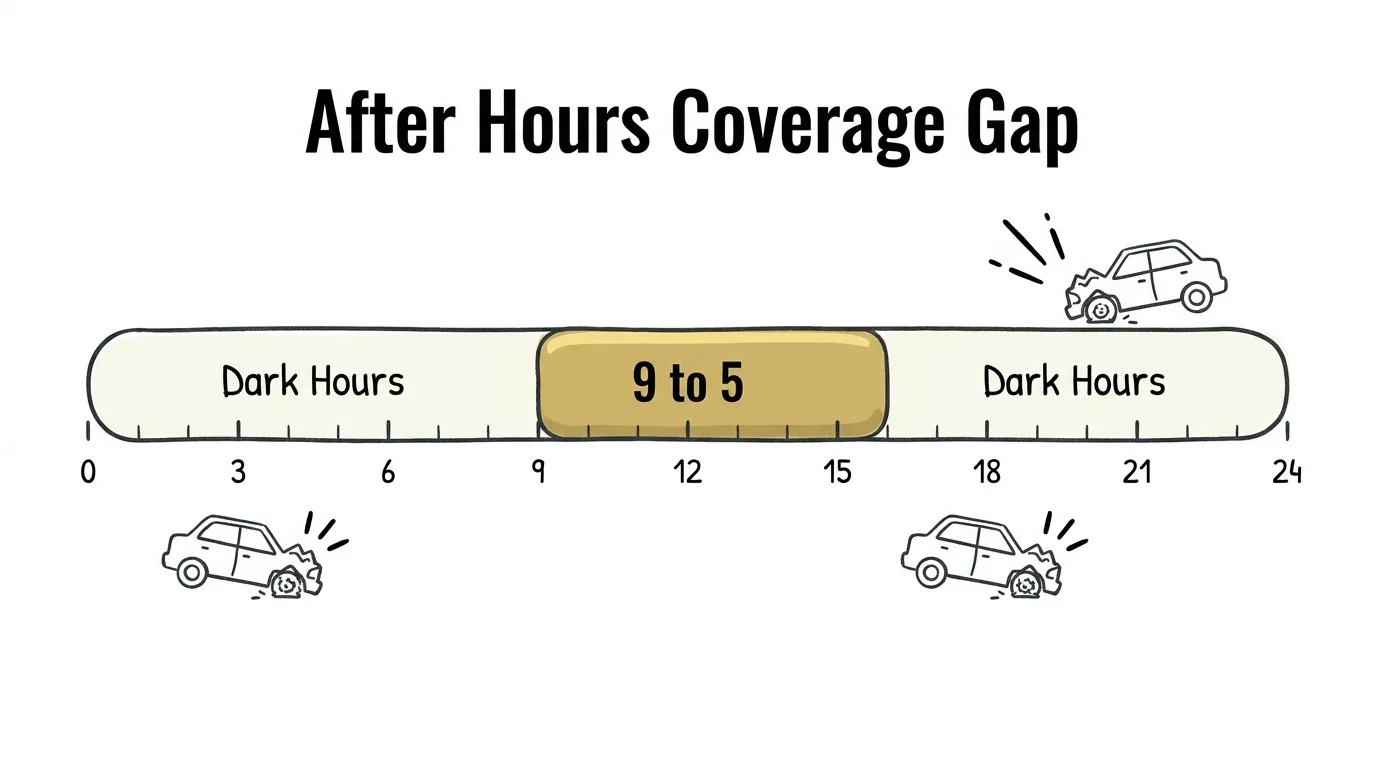
Motor vehicle accidents do not keep office hours. National crash data shows fatal and serious crashes concentrate in the afternoon-to-evening hours and spike on weekends, exactly the window when most firms have zero live intake. According to the National Safety Council's Injury Facts data on crashes by time of day and day of week, fatal crashes are more frequent on weekends and peak on Saturday, and the Insurance Institute for Highway Safety reports that about half of crash deaths occur on Friday, Saturday, or Sunday. That is when the calls come in, and it is when the after-hours coverage gap costs firms the most.
Now stack the language barrier on top. A Spanish-speaking driver rear-ended at 9 PM on a Saturday is in distress, searching on a phone, and calling whichever firm answers. If your office is closed and your overflow line answers only in English, you do not just lose speed to lead, you lose the caller entirely. Bilingual after-hours coverage closes both gaps at once: a live answer, in the right language, in the hour the lead is actually generated. That is why first-call response, not ad budget, is often the real ceiling on a firm's case volume.
The Money Leak: Cost Per Signed Case, Not Cost Per Month
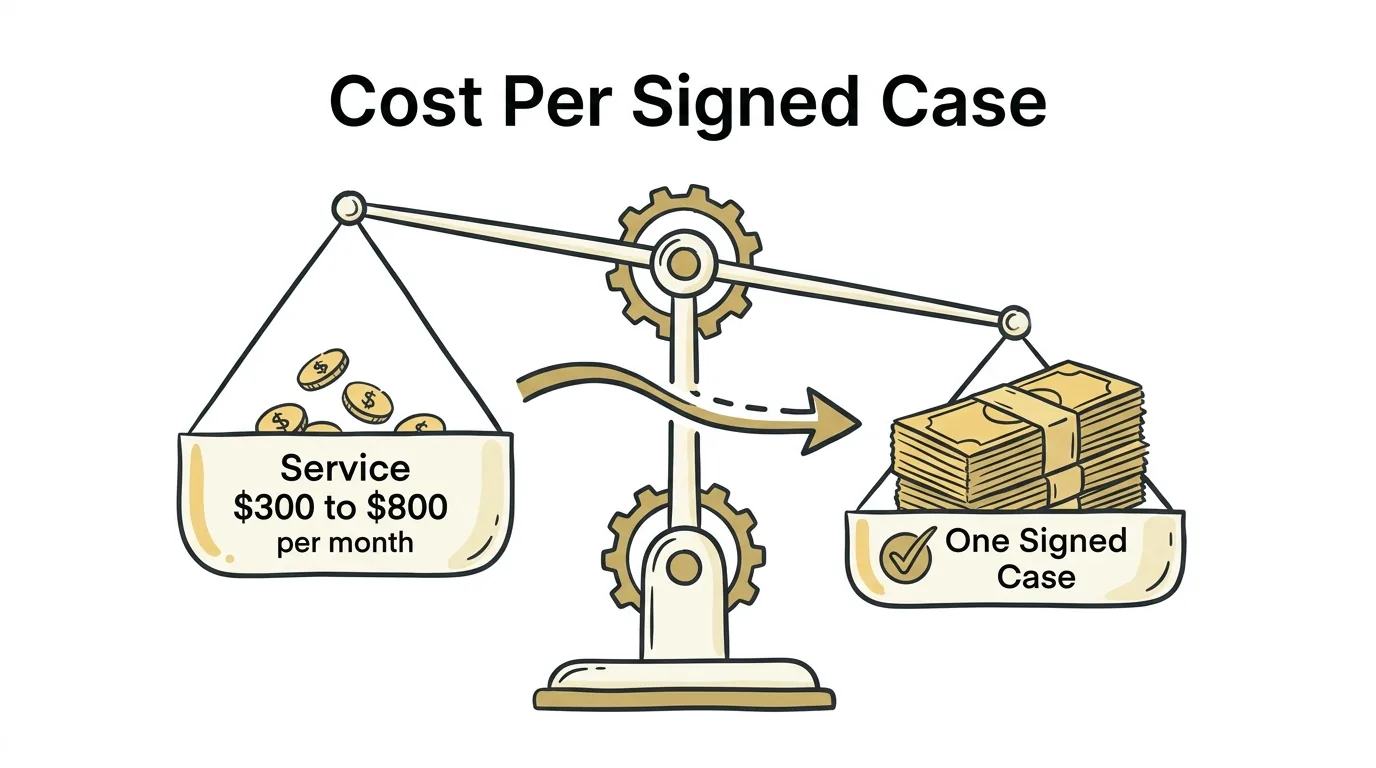
Most firms evaluate an answering service by its monthly price. That is the wrong number. The right metric is cost per signed case, and once you frame it that way, the decision usually answers itself. Walk through the math with conservative figures.
Say your firm runs paid Spanish MVA campaigns and generates 60 calls a month, with 40% arriving after hours. That is 24 after-hours calls. If even a quarter of those are real cases and your in-house team misses them to voicemail, you lose roughly six qualified prospects a month. At a typical MVA sign rate, recovering just two of them is two signed cases that would otherwise have gone to a competitor. Against a $500 monthly service, your effective cost per recovered case is a few hundred dollars, while the case itself is worth thousands in fees.
This is the proprietary benchmark we use with clients to size the leak before they ever pay for coverage.
The Cost of a Missed Spanish-Speaking After-Hours Call
| Monthly paid Spanish MVA calls | After-hours share (40%) | Likely real cases missed | Signed cases lost per month* | Annual fee value lost** |
|---|---|---|---|---|
| 30 | 12 | 3 | 1 | $60,000+ |
| 60 | 24 | 6 | 2 | $120,000+ |
| 100 | 40 | 10 | 3-4 | $180,000+ |
| 150 | 60 | 15 | 5 | $300,000+ |
*Assumes a conservative one-in-three real-case-to-sign rate on missed after-hours calls. **Assumes an average signed MVA case fee of $60,000; adjust to your firm's true average case value.
The table is a model, not a promise, and your numbers depend on your true sign rate and case value. But the shape never changes: the annual revenue leaking through an after-hours language gap dwarfs the cost of plugging it. That gap is exactly why so many firms quietly bleed cases despite a healthy ad budget. The fix is the cheapest line item in the funnel.
Bilingual Intake: The Differentiator Most Firms Skip
In contested motor vehicle accident markets, bilingual capability is the single most overlooked differentiator. Most firms still cannot answer a Spanish call after 6 PM, which means the firm that can wins the case by default. A bilingual legal answering service paired with a Spanish-language follow-up sequence turns a missed-call problem into a competitive moat, capturing the exact prospects your competitors are letting slip to voicemail.
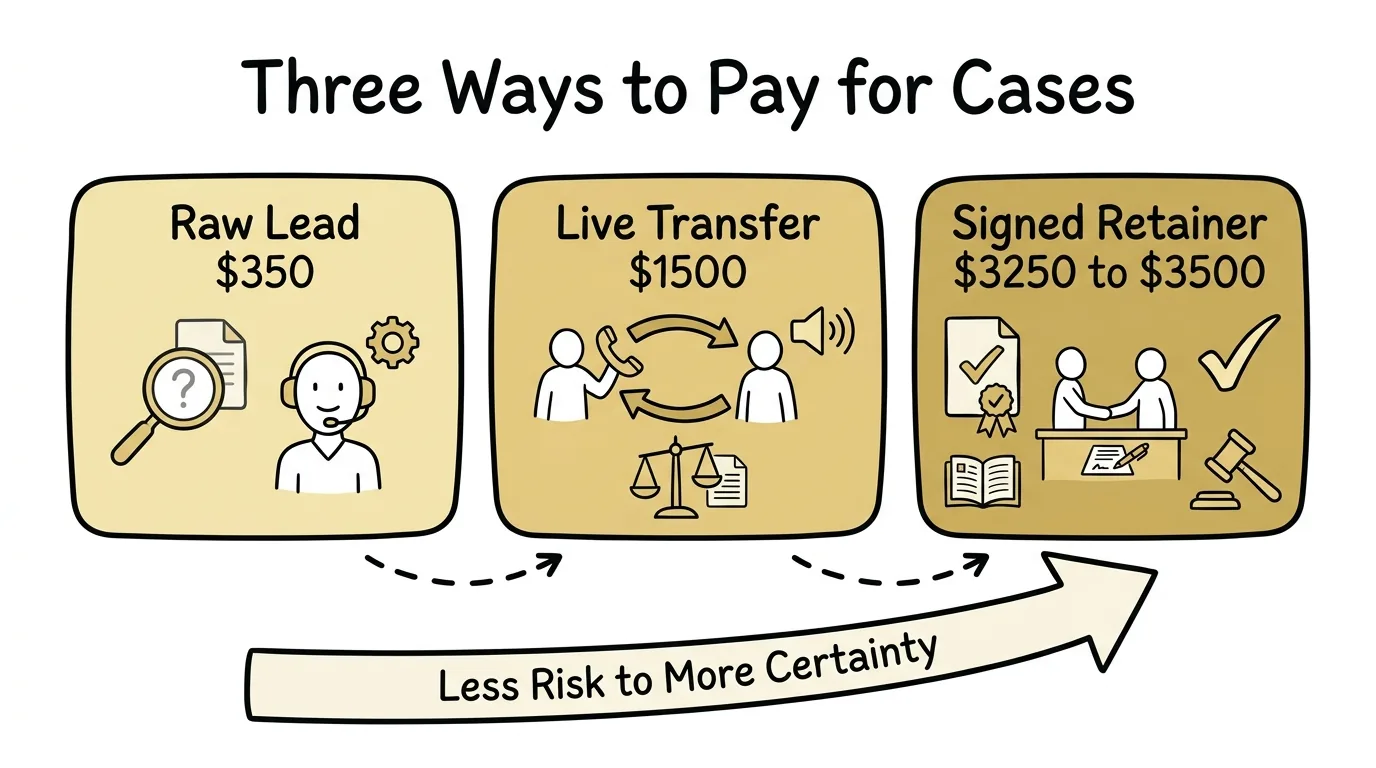
This is the philosophy behind how we run paid acquisition at Great Marketing AI: own the language, own the hour, and measure to the signed case. "We optimize campaigns against signed cases, not raw lead counts, and bilingual intake is where most firms hand back the money they spent acquiring the lead," says Rafael Hernandez, CEO and Co-Founder of Great Marketing AI. Because firms have different appetites for risk, we offer three transparent ways to pay for cases: a raw lead at $350, a live transfer at $1,500, and a signed retainer at $3,250 to $3,500, all tracked through the Meta Conversion API so you can see which campaigns produce real cases. If you want predictable bilingual case flow without building the system yourself, our pay-per-lead Spanish MVA leads model and our Spanish motor vehicle accident lead generation program are built for exactly this.
How to Choose a Bilingual Answering Service: Options and Checklist
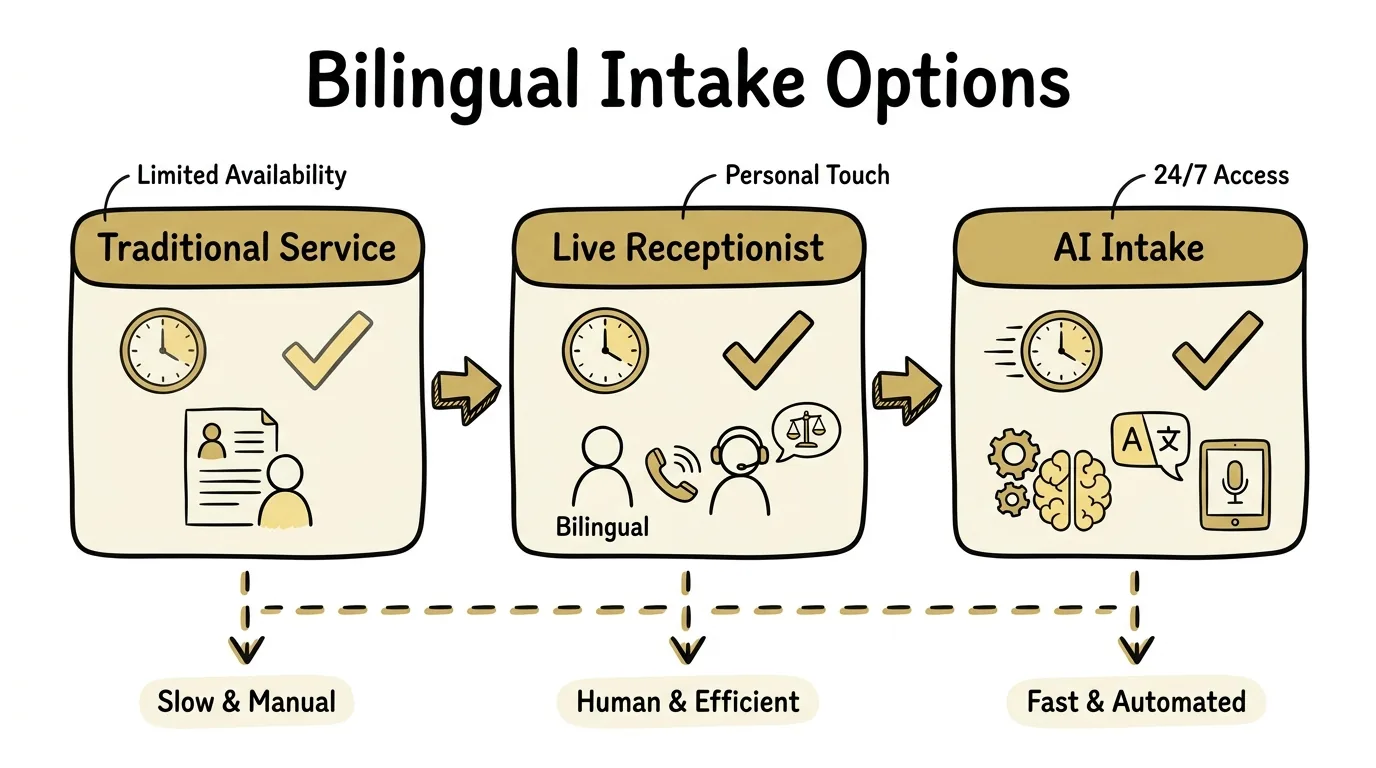
There are three realistic models for a bilingual virtual receptionist or intake setup, and they trade off cost, speed, and qualification depth. Compare them against how your firm actually receives calls.
| Bilingual Option | Typical Monthly Cost | Pickup Speed | Qualification Depth | Best For |
|---|---|---|---|---|
| Traditional bilingual answering service | $300-$800 | Fast | Low (message-taking in two languages) | Firms needing basic Spanish overflow and voicemail replacement |
| Live bilingual virtual receptionist | $360-$1,400 | Fast | High (native-fluent, scripted qualification) | Firms wanting human empathy on sensitive Spanish injury calls |
| AI bilingual intake | Lower per-minute, scalable | Under 5 seconds | Medium-high (scripted, CRM-synced) | Firms prioritizing 24/7 instant pickup and direct CRM routing |
Once you know the model, use this checklist of what to look for before you sign a Spanish answering service. These are the features that separate a real intake partner from a bilingual voicemail:
- Native-fluent Spanish, not translation software. An accident victim can hear the difference, and so can your sign rate.
- Accident-specific qualification scripts. Generic message-taking is not intake. The agent should collect date of loss, injuries, at-fault party, and prior representation.
- True 24/7 coverage. The whole point is the hours you do not staff. Confirm nights, weekends, and holidays are live, not voicemail.
- Direct CRM integration. Leads should land in your system with full context, not in an inbox someone reads the next morning.
- Conversion and call tracking. Insist on Meta Conversion API or equivalent server-side tracking so you can tie campaigns to signed cases.
- Spanish follow-up handoff. The service should trigger or feed a Spanish-language follow-up sequence, not end at the call.
- Transparent pricing and reporting. You should see call volume, qualification outcomes, and cost per booked consultation.
A firm that pursues Hispanic accident clients should treat bilingual intake as essential infrastructure, not a nice-to-have. For the surrounding strategy, our guide on marketing to Hispanic personal injury clients covers the language, culture, and trust signals that turn a bilingual answer into a signed retainer, and the right marketing agency for law firms can wire the whole system, from ad to bilingual intake to CRM, into one tracked funnel.
The Bottom Line
A bilingual answering service is not a luxury for a personal injury firm competing for Spanish-speaking motor vehicle accident cases, it is the patch on the most expensive leak in the funnel. You are already paying to generate the call. Letting it die in an English-only voicemail at 9 PM on a Saturday is the single most avoidable way to waste that spend. Frame the decision by cost per signed case, demand native-fluent Spanish, true after-hours coverage, accident-specific qualification, and CRM plus conversion tracking, and the service pays for itself with a single recovered case. Answer the call, in the right language, in the hour it comes in, and you stop donating cases to whichever competitor picks up first.
Turn Ad Spend Into Signed Cases
We blend AI-driven testing with proven performance strategy to attract qualified traffic and turn it into revenue—fast, trackable, and scalable.
- PI Lead Generation — exclusive, AI-qualified leads across MVA, slip & fall, med mal, and more.
- Facebook & Instagram Ads — reach customers where they scroll.
- Google Ads — capture people actively searching for you.
- Website Design — turn visitors into buyers with high-converting sites.
- AI Automations — save hours and never miss a follow-up.
- Email Marketing — nurture leads and close sales on autopilot.
- SEO — get found by customers searching for what you sell.
FAQs

About the author
Rafael Hernandez
CEO and Co-Founder of Great Marketing AI
Rafael Hernandez is the Founder of Great Marketing AI and a former Microsoft Engineer. He specializes in performance marketing for personal injury law firms, managing over $10M in ad spend to help attorneys generate signed cases across every PI case type. His strategies focus on exclusive lead generation, AI-powered qualification, and eliminating wasted budget.
About Great Marketing AI
Great Marketing AI: Performance marketing for personal injury law firms
We help personal injury law firms scale with exclusive, AI-qualified leads across every PI case type: MVA, slip & fall, medical malpractice, and wrongful death. Native English and Spanish campaigns, enterprise-grade Meta + Google ad management, and AI lead qualification before every intake.
100% Exclusive Leads
Never shared between firms. Territory-protected.
Native Spanish & English Campaigns
Built by native speakers, not Google Translate.
AI Lead Qualification
Pre-qualified before they ever reach your intake team.