Lead Arbitrage Explained: Turn $2 Clicks Into $45 Profit
Lead arbitrage turns $8 clicks into $300 PI leads. Learn how the model works, the math behind the margins, and why personal injury is the top-value vertical.

Rafael Hernandez
CEO and Co-Founder of Great Marketing AI


I hope you find this useful. If you want our team to run your law firm's performance marketing, book a strategy call.
Author: Rafael Hernandez | CEO and Co-Founder of Great Marketing AI
Key Takeaways
- Lead arbitrage is buying traffic at a lower cost and reselling the generated leads at a premium to businesses that need them — the margin between what you spend and what buyers pay is your profit
- The pay per lead model shifts risk from the law firm to the lead generator: you spend your own money to run ads and only get paid when you deliver a qualified lead
- For personal injury law firms, lead arbitrage makes economic sense because a single signed MVA case generates thousands in attorney fees against a lead cost of $150 to $400
- Quality beats volume in PI lead arbitrage — one valid, exclusive lead to an MVA claimant is worth more than ten unqualified form submissions
- Major companies like NerdWallet and LendingTree are built entirely on lead arbitrage principles, proving the model scales into sustainable businesses
- Scaling the model requires clean tracking, constant creative testing, and a reliable buyer relationship — the math only works when all three are running simultaneously
Lead arbitrage is the business model behind some of the largest companies on the internet: buy attention cheaply on platforms like Facebook, generate a qualified lead, and sell that lead to a business willing to pay a premium for it. The margin between what you spend and what the buyer pays is your profit. For personal injury law firms, this model is especially well-suited because a single signed MVA case generates $15,000 to $75,000 in attorney fees, which means a law firm can pay $200 to $400 for an exclusive qualified lead and still see a strong return.
Key Takeaways
- You are the hunter, the law firm is the chef. Your job is to find injured claimants and capture their information. The law firm's job is to convert them into signed cases.
- The math only works with quality leads. One exclusive, qualified MVA claimant is worth more than ten unverified form fills. Buyers stop purchasing when quality drops.
- Tracking is the foundation. You need to know your true cost per qualified lead before scaling spend. Scaling a leaky funnel amplifies losses, not profits.
- PI is one of the highest-value verticals. Legal services pay some of the highest rates per lead in the industry because the downstream value of a signed case is enormous.
- Creative testing is continuous. Click costs rise and creative fatigue sets in over time. A pipeline of new hooks is what keeps cost per lead stable as you scale.
- Direct buyer relationships outperform networks. A law firm that trusts your lead quality will increase volume commitments. Affiliate networks add a margin layer that reduces your profit on every lead.
What Is Lead Arbitrage?
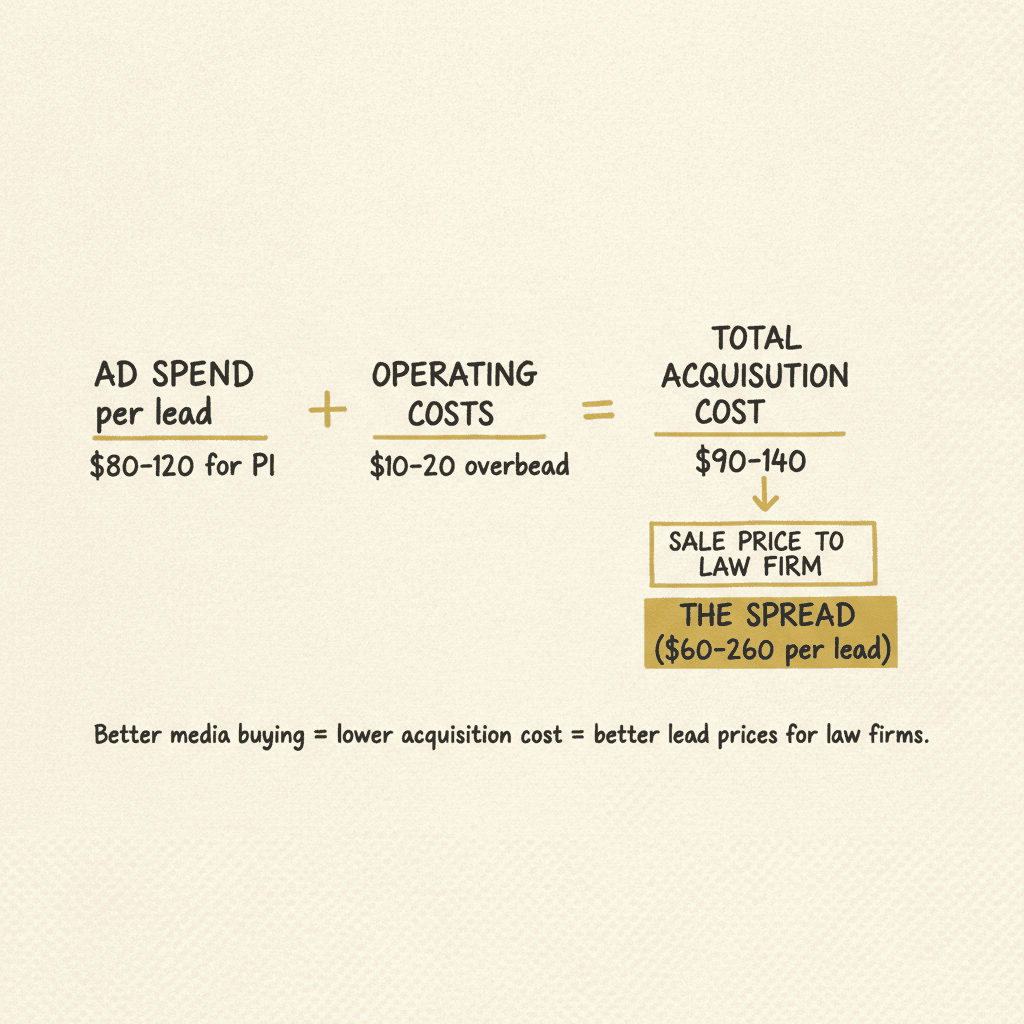
At its core, lead arbitrage is capitalizing on the difference between the cost of acquiring a potential customer and the value that a business places on that customer. It is the digital equivalent of day trading, except the asset is not a stock or currency. It is a qualified human being who needs a service.
In a traditional agency model, you charge a monthly fee to manage ads. In an arbitrage model, you take on the risk and the reward. You spend your own money to generate leads. If you spend $50 to get a person to fill out a form and a personal injury law firm pays you $250 for that exclusive lead, you keep the $200 profit. You repeat this cycle as many times as your ad campaigns and buyer capacity allow.
This model is powerful because it removes the ceiling on income. You are not trading time for money. You are trading qualified data for money. The better you get at acquiring the right attention cheaply, the higher your profit margins become.
How Lead Arbitrage Works in Personal Injury Law Firm Marketing
The pay per lead model for PI law firms follows a straightforward structure. Think of it as three roles:
- The Hunter (You): You run Facebook or Google ads targeting people who have recently been in accidents or are actively searching for legal help. Your job is to capture their information through a qualifying lead form.
- The Chef (The Law Firm): The law firm does not want to manage ad campaigns. They want qualified injury claimants who have consented to be contacted. They pay you a fixed price per lead so their intake team can focus on converting claimants into signed cases.
- The Network (Optional Middleman): Some lead generators use affiliate networks to connect with law firm buyers. Direct relationships are more profitable because they eliminate the network's margin cut.
Working with a marketing agency for personal injury law firms that has established buyer relationships and optimized PI lead funnels removes the trial-and-error phase that makes early-stage lead arbitrage expensive.
Real-World Lead Arbitrage Case Studies
Lead arbitrage is not a niche side hustle. Some of the largest companies on the internet are built entirely on this model.
Lower My Bills
Lower My Bills became famous for running "ugly" ads that drove enormous traffic. Their business model was straightforward: aggregate user data for loans and mortgages, then sell that data to banks and financial institutions. They had no product, no inventory, and no delivery operation. Just traffic and conversions. In 2005, Experian acquired Lower My Bills for over $330 million, demonstrating that a lead generation business built on arbitrage principles can scale into a nine-figure company.
NerdWallet and LendingTree
NerdWallet and LendingTree appear to be helpful financial comparison sites. Beneath the surface, they are lead arbitrage businesses at scale. When you click a "best credit card" recommendation or compare mortgage rates, the platform is selling your expressed interest to a financial institution. They act as the hunter, building audience trust through content, then selling that high-intent traffic to banks and lenders at a premium.
The same model applies directly to personal injury. A content site that helps accident victims understand their rights, then qualifies visitors through an intake form and sells those leads to PI law firms, is running the NerdWallet playbook for the legal industry.
The Math Behind the Money
The lead arbitrage model lives or dies on unit economics. You need to know your cost per lead, your sale price, and your margin before you scale a single dollar of ad spend.
Mortgage example (the classic arbitrage math):
| Metric | Value |
|---|---|
| Cost Per Click (Facebook) | $2.00 |
| Lead Form Conversion Rate | 10% |
| Cost Per Lead | $20.00 |
| Sale Price to Mortgage Broker | $65.00 |
| Profit Per Lead | $45.00 |
At 100 leads per day, that is $4,500 in daily profit on $2,000 in ad spend.
Personal injury example (higher stakes, higher value):
| Metric | Value |
|---|---|
| Cost Per Click (Facebook, PI audience) | $8.00 |
| Lead Form Conversion Rate | 8% |
| Cost Per Lead | $100.00 |
| Sale Price to PI Law Firm (exclusive) | $300.00 |
| Profit Per Lead | $200.00 |
The PI math works because the downstream value of a signed case is enormous. A law firm that converts 1 in 10 of your leads into a signed MVA case generating $30,000 in fees paid $3,000 for $30,000 in value. At that return, they will buy as many qualified leads as you can produce.
According to Rafael Hernandez, CEO of Great Marketing AI: "The firms that try to negotiate lead prices down without understanding the case economics are the ones who lose their best lead suppliers. If your lead costs $250 and converts to a $25,000 case, you should be paying more, not less, to lock up exclusive volume."
How to Scale and Optimize Your Campaigns
Scaling a pay per lead model is different from scaling a branding campaign. In branding, you want reach. In arbitrage, you want qualified data. The most common reason PI lead arbitrage fails is generating invalid or low-intent leads that buyers reject. When a law firm calls a lead and finds a wrong number or someone who does not remember filling out a form, they stop buying.
Optimization tactics that protect lead quality at scale:
- Creative testing: Continuously test new hooks to keep click costs down. Creative fatigue raises your cost per lead over time. A pipeline of 3 to 5 new concepts per week is the standard for a stable arbitrage operation.
- Form qualification: For PI leads, include 3 to 4 qualifying questions (injury type, at-fault driver, medical treatment, existing representation). This reduces volume but dramatically increases the percentage of leads a law firm considers valid.
- Phone verification: Automate phone number verification before delivering leads. A lead with an invalid phone number is worthless to an intake team.
- Speed-to-delivery: Deliver leads to the law firm within seconds of form submission. Lead value decays fast in PI intake. A claimant who submitted at 2 PM may have already spoken to another firm by 3 PM.
Lead Arbitrage vs Traditional Agency Retainers
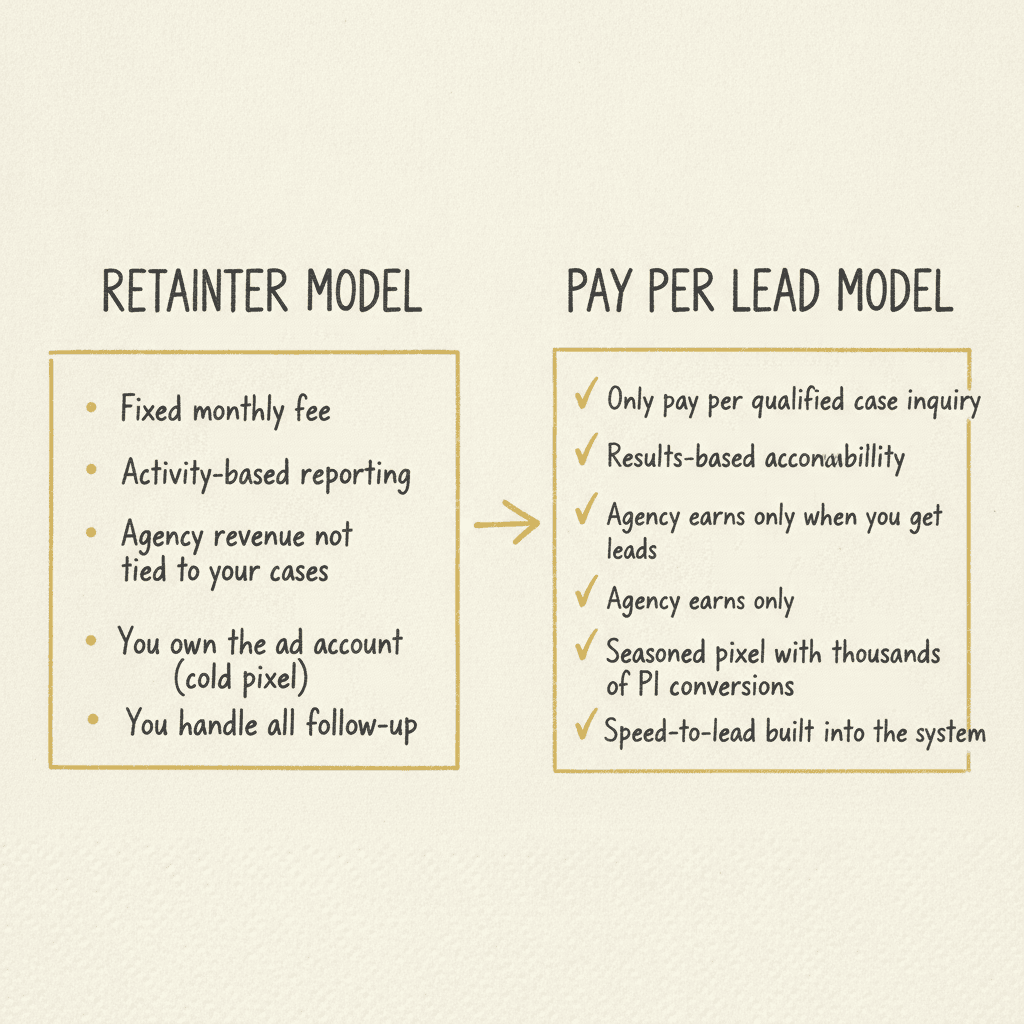
The traditional agency model provides stability but has a hard ceiling. You trade time for a flat monthly fee. Lead arbitrage is higher risk but has no ceiling.
| Model | Risk | Upside | Law Firm Perspective |
|---|---|---|---|
| Monthly Retainer | Low (agency) | Capped by hours available | Pay regardless of results |
| Pay Per Lead | High (lead generator) | Unlimited, scales with spend | Pay only for delivered leads |
| Hybrid | Medium | Balanced | Base fee plus performance component |
For PI law firms, the pay per lead model is often preferable to a retainer because the cost is directly tied to outcomes. For the lead generator, the model is preferable because there is no ceiling on earnings once a profitable campaign is identified and a reliable buyer is locked in.
The Best Niches for Lead Arbitrage
Legal services, especially personal injury, are among the highest-value verticals in lead arbitrage. Financial services, home improvement, insurance, and solar round out the top tier. What these industries share is a high lifetime value per customer, which justifies premium lead prices.
For motor vehicle accident leads specifically, the combination of high case values and a large Spanish-speaking claimant population that most law firms are not actively targeting creates a significant arbitrage opportunity. Facebook ad costs for Spanish-language PI audiences are substantially lower than English-language equivalents, while the sale price per lead remains comparable.
Conclusion
Lead arbitrage is not a shortcut. It is a performance-based business model that rewards clean tracking, consistent creative testing, and strong buyer relationships. The math works when every variable is optimized: your cost per lead stays below your sale price and your lead quality stays high enough that buyers keep purchasing.
For personal injury specifically, the model scales because the economics are compelling on both sides. Law firms pay $200 to $400 for a lead that could generate $25,000 in fees. Lead generators earn $100 to $300 per lead on top of their ad spend. When both sides win, volume grows.
For more on the platform strategies that drive PI lead arbitrage, explore how Facebook ads for law firms and Google ads for personal injury lawyers power the acquisition side of the model. If you want to discuss how a pay per lead arrangement would work for your PI firm, book a strategy call with Great Marketing AI.
Turn Ad Spend Into Signed Cases
We blend AI-driven testing with proven performance strategy to attract qualified traffic and turn it into revenue—fast, trackable, and scalable.
- PI Lead Generation — exclusive, AI-qualified leads across MVA, slip & fall, med mal, and more.
- Facebook & Instagram Ads — reach customers where they scroll.
- Google Ads — capture people actively searching for you.
- Website Design — turn visitors into buyers with high-converting sites.
- AI Automations — save hours and never miss a follow-up.
- Email Marketing — nurture leads and close sales on autopilot.
- SEO — get found by customers searching for what you sell.
FAQs

About the author
Rafael Hernandez
CEO and Co-Founder of Great Marketing AI
Rafael Hernandez is the Founder of Great Marketing AI and a former Microsoft Engineer. He specializes in performance marketing for personal injury law firms, managing over $10M in ad spend to help attorneys generate signed cases across every PI case type. His strategies focus on exclusive lead generation, AI-powered qualification, and eliminating wasted budget.
About Great Marketing AI
Great Marketing AI: Performance marketing for personal injury law firms
We help personal injury law firms scale with exclusive, AI-qualified leads across every PI case type: MVA, slip & fall, medical malpractice, and wrongful death. Native English and Spanish campaigns, enterprise-grade Meta + Google ad management, and AI lead qualification before every intake.
100% Exclusive Leads
Never shared between firms. Territory-protected.
Native Spanish & English Campaigns
Built by native speakers, not Google Translate.
AI Lead Qualification
Pre-qualified before they ever reach your intake team.