Law Firm Intake Optimization: How Top PI Firms Convert More Leads Into Signed Cases
Learn the intake optimization tactics that help personal injury law firms boost sign rates from 14% to 40%+. Data-backed guide covering response time, CRM, and after-hours coverage.

Rafael Hernandez
CEO and Co-Founder of Great Marketing AI


I hope you find this useful. If you want our team to run your law firm's performance marketing, book a strategy call.
Author: Rafael Hernandez | CEO and Co-Founder of Great Marketing AI
Key Takeaways
- The average personal injury law firm converts only 14% of leads into signed cases. Top-performing firms achieve 40-50% by fixing intake, not buying more leads.
- 79% of legal consumers hire the first attorney who responds, according to Clio's 2024 Legal Trends Report. Speed is the single highest-leverage intake variable.
- Firms that respond within 60 seconds see a 391% higher conversion rate than firms responding at the 30-minute mark (Hennessey Digital 2025 study).
- After-hours coverage alone captures 30-40% of PI leads that would otherwise go to competitors. Most firms have zero coverage after 6 PM.
- Fixing intake is cheaper than buying more leads. A structured intake system costs a fraction of what most firms spend on ads each month.
Most personal injury law firms have a lead problem they misdiagnose. They assume the issue is not enough leads and the path to how to get more personal injury cases is simply more ad spend. The actual problem, far more often, is that leads are entering the funnel and leaking out before anyone has a real conversation. Law firm intake optimization is the discipline of fixing those leaks.
The average PI firm converts 14% of inbound inquiries into signed cases, according to Lexgro's 2024 conversion benchmarking study. Top-performing firms hit 40-50%. That gap is not explained by lead quality. It is explained entirely by what happens after the lead arrives.
This law firm intake optimization guide covers the five highest-leverage intake changes that PI firms can implement to move conversion rates from average to top-quartile, with the data behind each tactic and a practical benchmark table you can use to audit your own process. If you are still deciding whether to run intake with your own staff or hire an outside team, start with our comparison of legal intake services before diving into the tactics below.
Key Takeaways
- The average PI law firm converts only 14% of leads into signed cases. Top-performing firms achieve 40-50% by fixing intake, not buying more leads.
- 79% of legal consumers hire the first attorney who responds (Clio 2024 Legal Trends Report).
- Firms responding within 60 seconds see a 391% higher conversion rate than firms responding at 30 minutes.
- After-hours coverage captures 30-40% of PI leads that would otherwise go to competitors.
- Fixing intake is cheaper than buying more leads. The tools cost a fraction of a monthly ad budget.
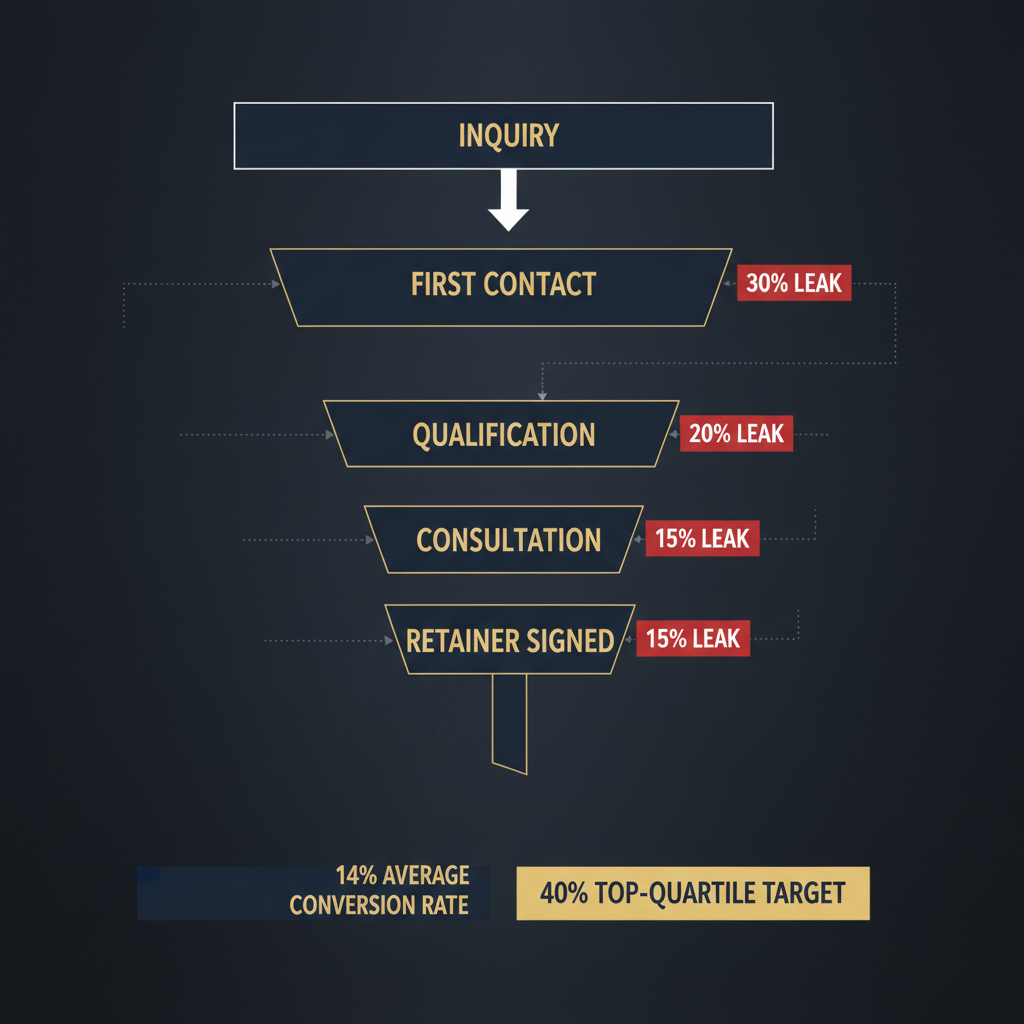
The Real Cost of a Slow Intake Response
Personal injury law firm intake is a speed game before it is anything else. Clio's 2024 Legal Trends Report found that 79% of legal consumers hire the first attorney who responds to their inquiry. Not the best attorney, not the most affordable, the fastest.
Hennessey Digital's 2025 Lead Form Response Time Study quantified exactly what that speed difference is worth:
| Response Time | Conversion Rate Lift vs. 30-Minute Baseline |
|---|---|
| Under 60 seconds | +391% |
| Under 5 minutes | +21x (relative) |
| Under 30 minutes | Baseline |
| 1-2 hours | -60% |
| Same day | -85% |
The Harvard Business Review's research, which tracked lead response across 2,000 companies, found that leads contacted within five minutes are 21 times more likely to convert than leads contacted after 30 minutes. In personal injury, where a prospect is often making simultaneous inquiries to three or four firms, the math is punishing: whoever calls first wins the case.
The median law firm response time to online leads is 13 minutes, per the Hennessey 2025 data. That 13-minute gap is where most of the 86% of unconverted leads disappear.
What this means in dollars: If your firm signs cases at an average value of $8,000 and converts 20 leads per month out of 100 inquiries, dropping your response time from 13 minutes to under 2 minutes could conservatively move you from 20 to 28 signed cases. That is $64,000 in additional monthly revenue from changing one process variable.
The benchmark we use at Great Marketing AI for PI firms on paid campaigns: two-minute response target for ad-generated leads during business hours, and a live qualified call within 30 minutes for all after-hours inquiries.
Intake Response Time Benchmark Table
Use this table to score your current intake process and identify your highest-leverage improvement.
| Intake Variable | Industry Average | Top-Quartile PI Firms | Revenue Impact |
|---|---|---|---|
| Response time (business hours) | 13 minutes | Under 2 minutes | +200-391% conversion |
| Response time (after hours) | Next business day | Under 30 minutes via answering service | Captures 30-40% lost leads |
| Lead-to-consultation rate | 35% | 60-70% | 2x consultation volume |
| Consultation-to-retainer rate | 40% | 65-75% | Direct revenue multiplier |
| Follow-up attempts per lead | 1-2 | 6-8 (automated sequence) | +15-20% recovery rate |
| After-hours coverage | None or voicemail | 24/7 live answering | $300-800/mo, pays for itself with 1 case |
This is Great Marketing AI's proprietary intake response time benchmark for law firm intake optimization, built from working with PI firms across California, Texas, and Florida. Individual results vary by market competition, case type mix, and marketing channel.
Five Law Firm Intake Optimization Changes That Move the Needle
1. Deploy Real-Time Response for Paid Traffic
Law firm lead conversion rate drops by more than half when response time exceeds 30 minutes. For paid ad leads, where you have paid $50-$500 for a single click, letting a lead go to voicemail is one of the most expensive decisions a firm makes.
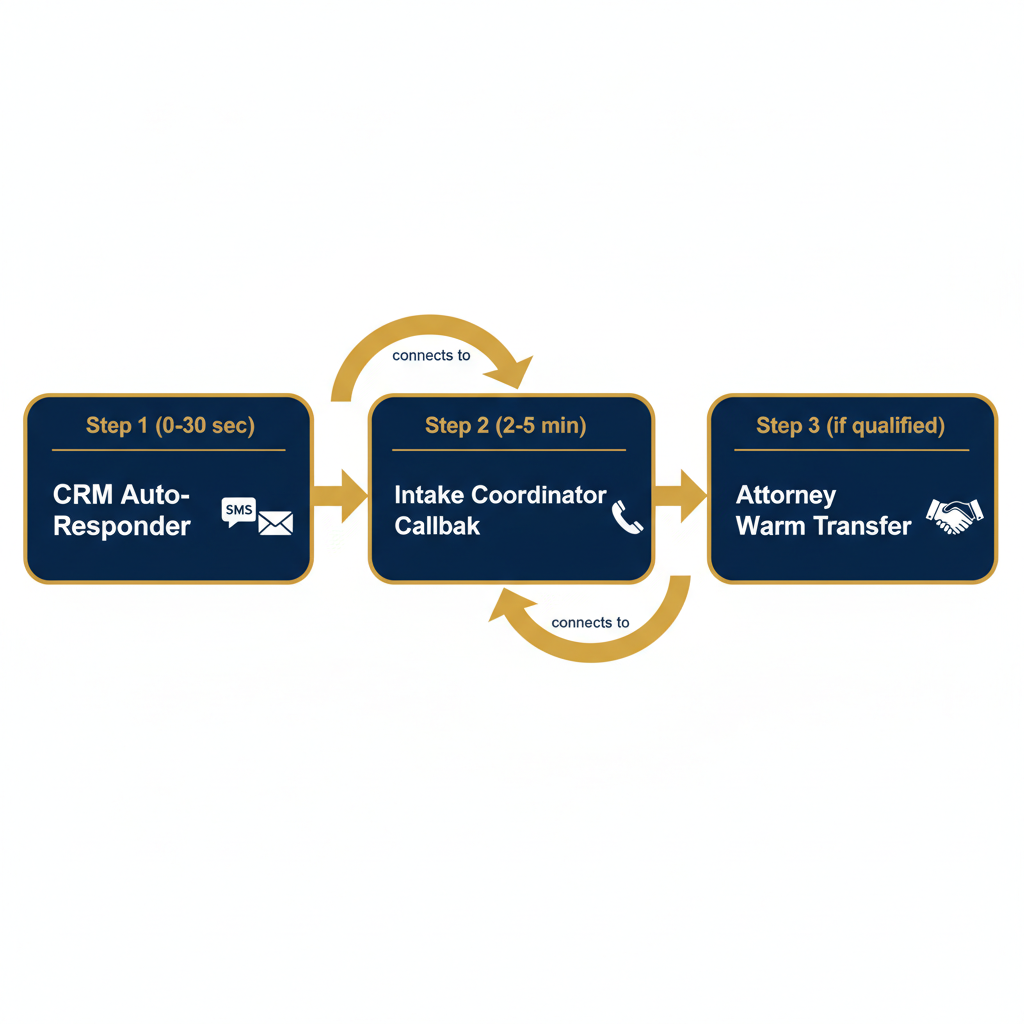
The solution is a tiered response system:
- CRM auto-responder (0-30 seconds): The moment a form submits, the lead gets an automated SMS and email confirming receipt and setting expectations. "Hi [Name], this is [Firm Name]. We received your inquiry about your accident and someone from our team will call you in the next few minutes." This stops the prospect from calling the next firm while you dial.
- Intake coordinator callback (2-5 minutes): A dedicated intake coordinator, not the attorney, makes the first outbound call. Their job is qualification, not legal consultation.
- Attorney warm transfer: If the prospect qualifies, the intake coordinator transfers them immediately. If the attorney is unavailable, a scheduled callback within two hours is confirmed before hanging up.
SimplyConvert research on personal injury intake found that firms with a dedicated intake coordinator and automated first-response sequence convert at 3.1 times the rate of firms where attorneys handle initial intake directly.
2. Capture After-Hours Leads Before Competitors Do
Car accidents do not follow business hours. A significant share of MVA incidents occur on Friday nights, Saturdays, and late evenings. A prospect injured on Saturday afternoon who searches for a personal injury client intake process on Sunday is making contact with multiple firms. The firm that answers wins.
Most law firms have zero live coverage after 6 PM. That represents 30-40% of their total inquiry volume going to a voicemail or, worse, to a competitor with an answering service.
Legal intake answering services, dedicated services that qualify prospects, collect accident details, and schedule consultations, typically cost $300-$800 per month. For a single PI case worth $5,000-$50,000, the ROI calculation requires only that the service captures one additional case per month. Most PI firms working with answering services capture three to five additional cases monthly.
The key requirement is proper handoff: the answering service should collect the date of accident, nature of injuries, whether the prospect has already hired an attorney, and contact information. That data must flow directly into your CRM so your intake coordinator has context before the morning callback. For a full breakdown of providers, pricing, and how to set one up, see our guide to choosing a law firm answering service.
3. Integrate CRM Automation Into Every Touchpoint
Personal injury law firm intake breaks down most commonly at the handoff between lead source and follow-up. A prospect fills out a form on a Facebook ad, the lead email goes to a shared inbox, and no one follows up until someone checks email the next morning. This happens constantly, even in well-run firms.
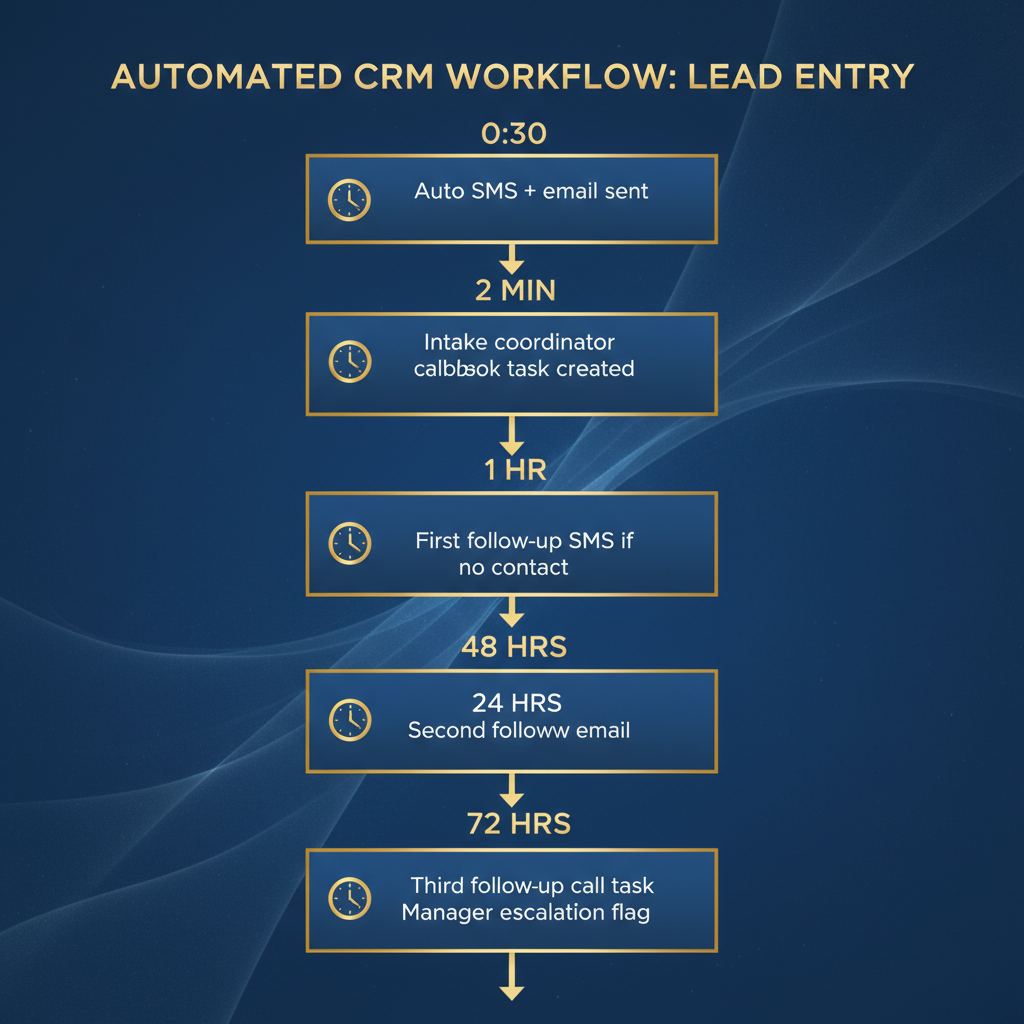
A CRM with automated intake workflows solves this at the infrastructure level. When a new lead enters the system, the CRM should:
- Assign the lead to a specific intake coordinator automatically
- Trigger an SMS and email sequence within 30 seconds
- Create a follow-up task in the coordinator's queue for the 2-minute callback
- Schedule automated follow-up messages at 1 hour, 24 hours, 48 hours, and 72 hours if no contact is made
- Flag the lead as "attempted contact" and escalate to a manager after six unreached attempts
According to MyCase's 2025 intake automation research, firms using automated intake workflows reduce average response time by 40% and increase law firm lead conversion rates by 35% compared to manual intake processes.
The most common mistake: buying a CRM and using it only as a contact database, not as an automated routing and follow-up engine. The database function is the least valuable part. If you are still choosing a platform, our law firm CRM buyer's guide compares the leading legal CRMs on intake speed, qualification, and bilingual support for PI firms.
4. Build a Qualification Script That Closes
Once you have a live conversation, the intake script determines whether that call becomes a signed retainer. Most law firm intake scripts are written to gather information, not to convert. Top-performing firms write intake scripts with both goals in mind.
A conversion-focused personal injury client intake process call has five phases:
- Acknowledgment (30 seconds): "I am sorry to hear about your accident. Let me make sure we get you the help you need." Empathy first, information second.
- Qualification questions (2-3 minutes): Date of accident, type of accident, injuries, at-fault party, whether they have spoken to insurance. These are asked conversationally, not as a checklist.
- Value statement (60 seconds): "Based on what you have described, this sounds like a strong case. Our firm handles [case type] cases for clients across [location], and we work on contingency, meaning you pay nothing unless we win."
- Next step offer (30 seconds): Offer the consultation immediately. "I can connect you with [Attorney Name] right now for a quick call, or I can schedule a 20-minute consultation at a time that works for you today."
- Objection bridge (as needed): Prepare scripted responses to the five most common objections: "I need to think about it," "I am talking to other firms," "I cannot afford it," "I do not think my case is worth much," and "I need to talk to my family first."
Recording and reviewing intake calls is essential. Attorney Assistant's research found that firms that review intake calls weekly identify specific scripting gaps within 30 days that, when fixed, produce measurable conversion rate improvement within 60 days.
5. Run a Structured Lead Recovery Sequence
Not every lead converts on the first contact attempt. Research from Legal Brand Marketing shows that 44% of law firms make only one contact attempt before abandoning a lead. Top-performing PI firms make six to eight contact attempts across multiple channels before marking a lead as lost.
A structured lead nurturing sequence for PI firms looks like this:
| Attempt | Timing | Channel | Message Type |
|---|---|---|---|
| 1 | Immediate | SMS + Email | Confirmation + callback time |
| 2 | 2-5 minutes | Phone | Live callback attempt |
| 3 | 1 hour | SMS | "Checking in" follow-up |
| 4 | 24 hours | Educational value (accident checklist) | |
| 5 | 48 hours | Phone | Second live callback |
| 6 | 72 hours | SMS | Last contact attempt |
| 7 | 7 days | "Still here if you need us" nurture |
The critical principle: every touch adds value rather than just asking for a decision. The 24-hour email with an accident checklist ("Things to do after a car accident in [State]") keeps your firm top of mind and builds trust while the prospect continues their research.
For firms that want to reach Spanish-speaking MVA prospects, every step in this sequence should exist in Spanish. The motor vehicle accident leads market is heavily contested in major markets, and Spanish-language follow-up sequences are one of the highest-leverage differentiators available.
The 12-Question Intake Audit: Find Your Biggest Leak
Before investing in new tools, audit your current intake process with these 12 questions. Each "No" answer is a specific revenue leak.
- Does every new lead receive an automated acknowledgment within 60 seconds?
- Is there a dedicated intake coordinator whose primary responsibility is converting leads?
- Does your intake coordinator have a written qualification script?
- Do you have live coverage from 8 AM to 8 PM, seven days a week?
- Do you have any after-hours coverage at all?
- Does your CRM automatically assign new leads to a specific person?
- Do you make at least six contact attempts before marking a lead as lost?
- Do you send follow-up value content (accident checklist, FAQ document) to unconverted leads?
- Do you review intake call recordings at least once per month?
- Do you track your lead-to-consultation conversion rate?
- Do you track your consultation-to-retainer rate?
- Do you have a Spanish-language intake path for Spanish-speaking inquiries?
Firms that answer "No" to five or more of these questions are converting at well below their potential. The biggest leak is almost always either response time (questions 1-3) or follow-up volume (questions 6-8).
How Intake Optimization Connects to Your Lead Generation Strategy
Intake optimization and lead generation are two sides of the same growth equation. Running more leads through a broken intake process amplifies the revenue lost at every stage. Fixing intake first means every dollar you currently spend on ads produces more signed cases immediately, without any additional media spend.
Our complete guide to lead generation for lawyers covers the eight channels ranked by cost per signed case. The key insight that connects to intake: paid channels like Google Ads and Facebook Ads produce leads that are extremely time-sensitive. These prospects are in immediate distress, searching for help right now. The intake speed benchmarks in this guide apply most critically to paid traffic.
For a personal injury law firm marketing agency working with PI firms, the consistent finding is that intake improvements produce faster ROI than channel additions. Fixing a 13-minute response time to under two minutes can double signed cases from existing ad spend within 30 days.
Law Firm Intake Optimization: What to Fix First
If you can only make one change this week, improve your response speed. Set up an automated CRM confirmation SMS that fires the moment a form submits. That single change, costing nothing beyond the CRM subscription you likely already have, keeps your firm in the prospect's consideration set while they wait for a call.
The sequence after that: dedicate a person or role to intake coordination, deploy an after-hours answering service, build your follow-up sequence to six touches, and then optimize your intake script through call recording review. Much of that follow-up runs on email, so pair these fixes with a deliberate attorney email marketing nurture sequence to keep prospects engaged between calls.
Every one of these changes compounds. A firm that improves response time, adds after-hours coverage, and builds a six-touch follow-up sequence does not move from 14% to 16%. It moves from 14% to 30-35%. That difference, on the lead volume most PI firms are already paying for, represents hundreds of thousands of dollars in annual case value.
For more law firm growth strategies, read our guide on marketing ideas for law firms.
Rafael Hernandez is the CEO and Co-Founder of Great Marketing AI, a performance marketing agency for personal injury law firms. Great Marketing AI specializes in Spanish-speaking MVA lead generation and has managed lead generation campaigns for PI firms across California, Texas, and Florida.
Turn Ad Spend Into Signed Cases
We blend AI-driven testing with proven performance strategy to attract qualified traffic and turn it into revenue—fast, trackable, and scalable.
- PI Lead Generation — exclusive, AI-qualified leads across MVA, slip & fall, med mal, and more.
- Facebook & Instagram Ads — reach customers where they scroll.
- Google Ads — capture people actively searching for you.
- Website Design — turn visitors into buyers with high-converting sites.
- AI Automations — save hours and never miss a follow-up.
- Email Marketing — nurture leads and close sales on autopilot.
- SEO — get found by customers searching for what you sell.
FAQs

About the author
Rafael Hernandez
CEO and Co-Founder of Great Marketing AI
Rafael Hernandez is the Founder of Great Marketing AI and a former Microsoft Engineer. He specializes in performance marketing for personal injury law firms, managing over $10M in ad spend to help attorneys generate signed cases across every PI case type. His strategies focus on exclusive lead generation, AI-powered qualification, and eliminating wasted budget.
About Great Marketing AI
Great Marketing AI: Performance marketing for personal injury law firms
We help personal injury law firms scale with exclusive, AI-qualified leads across every PI case type: MVA, slip & fall, medical malpractice, and wrongful death. Native English and Spanish campaigns, enterprise-grade Meta + Google ad management, and AI lead qualification before every intake.
100% Exclusive Leads
Never shared between firms. Territory-protected.
Native Spanish & English Campaigns
Built by native speakers, not Google Translate.
AI Lead Qualification
Pre-qualified before they ever reach your intake team.