Law Firm CRM: The 2026 Buyer's Guide to Client Intake Software for PI Firms
A law firm CRM turns paid leads into signed cases. Compare the best legal CRMs for personal injury firms on intake speed, automation, and bilingual support.

Rafael Hernandez
CEO and Co-Founder of Great Marketing AI


I hope you find this useful. If you want our team to run your law firm's performance marketing, book a strategy call.
Author: Rafael Hernandez | CEO and Co-Founder of Great Marketing AI
Key Takeaways
- A law firm CRM is the conversion layer between the leads you pay for and the cases you actually sign. For a personal injury firm, it is the difference between a 14% sign rate and a 40%+ sign rate on the same lead volume.
- The single highest-leverage CRM feature is automated speed-to-lead. Most legal consumers hire the first attorney who responds to them, and a CRM that auto-texts a new lead in under a minute captures that buyer before competitors call back.
- For PI firms, evaluate a `law firm crm` on five things: intake speed (auto-text and auto-call), case-type qualification, bilingual and Spanish-language intake, marketing attribution, and matter handoff. Generic sales CRMs miss most of these.
- Clio Grow, Lawmatics, CASEpeer, and Captorra lead the PI intake category. The right pick depends on case volume, whether you need full practice management attached, and how much of your traffic is Spanish-speaking.
- A CRM only pays off if the leads feeding it are real. The biggest sign-rate gains come from pairing a fast-intake CRM with a clean lead source, which is why we treat the CRM and the lead channel as one system, not two.
Last Updated: June 15, 2026
A law firm CRM is the software layer that turns the leads a personal injury firm pays for into signed cases. It captures every inquiry, stamps the exact second it arrived, fires an automated text or call within moments, qualifies the case type, and tracks the prospect all the way to a signed retainer. For a PI practice, that conversion layer is worth more than any other tool you own, because the bottleneck is almost never lead volume. It is what happens in the first five minutes after a lead comes in.
The numbers make this concrete. The average personal injury law firm converts only about 14% of its leads into signed cases, while top-performing firms convert 40% or more from the same traffic. The gap is intake, and intake runs on a CRM. Most legal consumers hire the first attorney who responds to them, and leads contacted within five minutes are 21 times more likely to convert than leads contacted 30 minutes later, per the Lead Response Management study led by Professor James Oldroyd. A law firm crm exists to win that first-response race automatically, every time, including nights and weekends when most firms have no live coverage at all.
This buyer's guide is written specifically for personal injury and motor vehicle accident firms. We cover what a crm for law firm intake actually needs to do, the five evaluation criteria that matter for PI, a comparison of the leading legal CRMs, a proprietary speed-to-lead benchmark you can use to size your own opportunity, and how to make sure the CRM pays for itself.

What a Law Firm CRM Actually Does
A law firm crm is not a contact list with reminders. For a personal injury firm it is the operating system for the pre-retainer stage of every case. The moment a lead arrives, from a Google Ad, a Facebook lead form, a website chat, or a phone call, the CRM records the source, the timestamp, and the contact details, then immediately starts working the lead before a human even sees it.
The core jobs are speed-to-lead automation, qualification, follow-up, and attribution. Speed-to-lead means an automated SMS and email go out within seconds and an intake task is assigned. Qualification means the system captures case type, date of accident, injuries, and representation status so non-cases get filtered out. Follow-up means a multi-day sequence keeps touching the prospect until they sign or opt out. Attribution means every signed case ties back to the exact channel and campaign that produced it. Practice management tools like Clio Manage and Filevine handle the matter after it is signed. The CRM is what gets it signed.
Why PI Firms Need a CRM Built for Intake, Not Sales
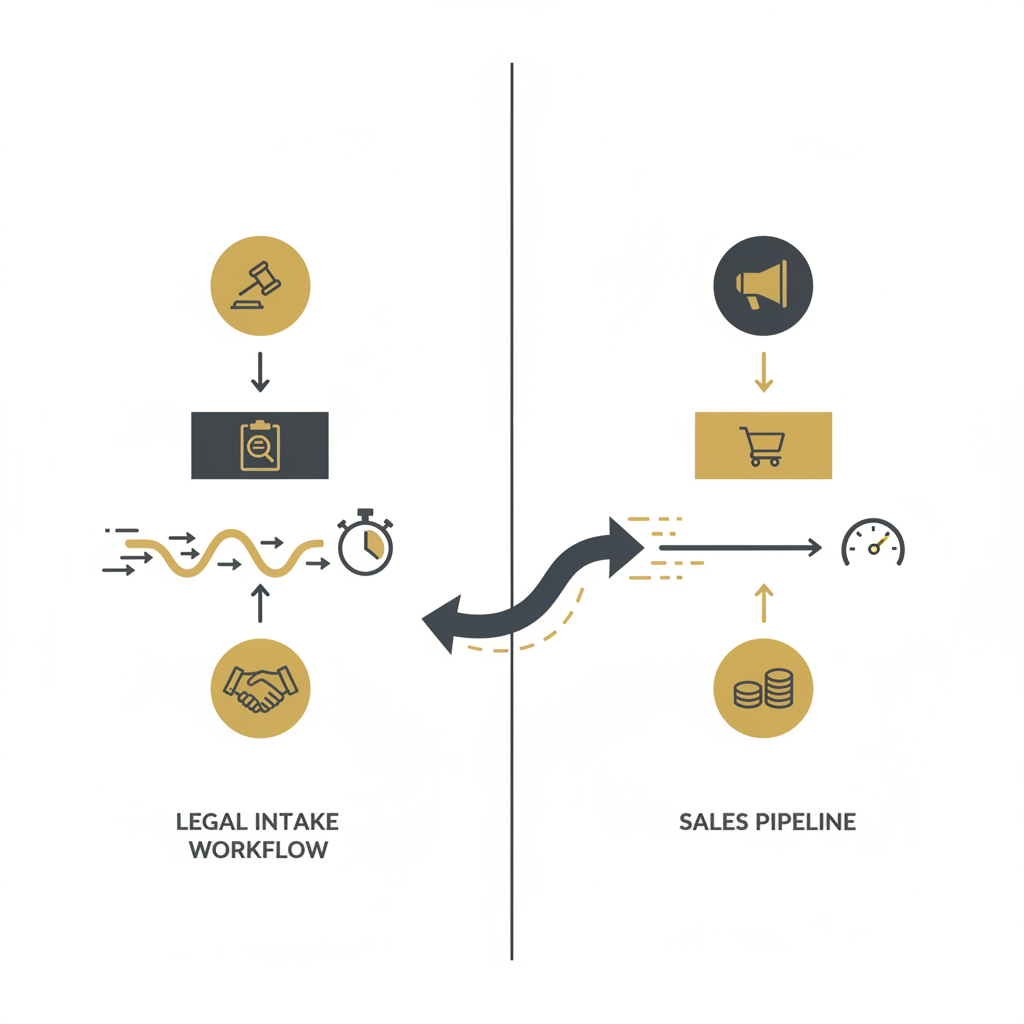
Generic sales CRMs like HubSpot, Salesforce, and Pipedrive are built around deals, pipelines, and sales quotas. A personal injury practice does not sell deals. It signs matters, runs conflict checks, and operates under bar rules on solicitation and fee agreements. A legal CRM models that world: it speaks in matters and clients, supports conflict checking, integrates e-signature for retainers, and structures intake around case type rather than deal size.
There is a second reason the distinction matters. Speed-to-lead is more brutal in legal than in almost any other industry because of the first-responder effect: the claimant usually signs with whichever firm replies first. An MVA claimant who fills out three firms' forms at 11 PM signs with whichever one texts back first. A sales CRM treats that lead like a B2B prospect to nurture over weeks. A legal intake CRM treats it like a fire to put out in seconds. That difference in design philosophy is exactly why firms that adopt a purpose-built law firm crm software see sign-rate gains a repurposed sales tool can never deliver.
The 5 Criteria That Matter for PI Firms
When you evaluate a crm software for law firms for a personal injury practice, score every option on these five dimensions. They are ordered by impact on signed cases.
- Intake speed. Can it auto-text and auto-call a new lead within seconds, with no human in the loop? This is the single biggest lever. Manual first-touch loses the first-responder advantage.
- Case-type qualification. Does it capture accident date, injury type, and representation status, and route or disqualify accordingly, so your intake team only works real MVA cases?
- Bilingual and Spanish-language intake. Can it send Spanish SMS and email sequences and route to a bilingual specialist? For Hispanic-heavy MVA markets this is the conversion bottleneck.
- Marketing attribution. Does it tie each signed case back to the channel and campaign, so you know your true cost per signed case and not just cost per lead?
- Matter handoff. Does it pass a signed client cleanly into your case management system without rekeying data?
A firm whose leads are mostly Spanish-speaking should weight criterion three far higher than a generic buyer's guide would. That is the whole reason a PI-specific lens beats a one-size-fits-all listicle.
The Best Law Firm CRMs for Personal Injury (2026)
The table below compares the leading legal intake CRMs on the criteria that matter for PI firms. Pricing reflects publicly listed entry tiers as of 2026 and should be confirmed with each vendor, since legal software is frequently quoted per firm.
| CRM | Best for | Native intake automation | PI case management | Bilingual intake | Starting price |
|---|---|---|---|---|---|
| Clio Grow | All-around legal intake, pairs with Clio Manage | Yes, auto-email and task workflows | Via Clio Manage add-on | Templates customizable | ~$59 / user / mo |
| Lawmatics | Heavy paid-lead and marketing automation | Yes, advanced multi-step + SMS | No, intake/CRM only | Yes, custom sequences | Quote-based, marketing tier |
| CASEpeer | PI-specific case management with intake | Yes, built for PI intake | Yes, purpose-built for PI | Limited | Quote-based, firm pricing |
| Captorra | High-volume PI and mass-tort intake | Yes, high-volume call + web intake | Intake-focused | Yes | Quote-based, enterprise |
| MyCase | Smaller firms wanting all-in-one | Yes, lead management module | Yes, full practice management | Limited | ~$39 / user / mo |
For a smaller PI firm that wants one system, MyCase or Clio (Grow plus Manage) keeps everything under one roof, a head-to-head we break down in our Clio vs MyCase comparison for personal injury firms. For a firm running aggressive paid campaigns where follow-up automation is the priority, Lawmatics is the strongest intake-and-marketing engine. For a high-volume MVA practice, CASEpeer and Captorra are built for the throughput. None of these, however, fixes a broken lead source, which is the next section.

Proprietary Benchmark: Speed-to-Lead vs Sign Rate

Here is the original analysis other guides leave out. We modeled the relationship between first-response speed and PI sign rate using the published research and the patterns we see managing intake for personal injury clients. The point of this table is not to claim a single universal number. It is to show the shape of the curve so you can locate your own firm on it and size the prize.
| First-response time | Relative likelihood to connect/convert | Typical PI sign-rate band | What is happening |
|---|---|---|---|
| Under 1 minute (automated) | Highest | 35-45% | CRM auto-text wins the first-responder slot |
| 1-5 minutes | About 21x stronger than 30-min (Oldroyd study) | 25-35% | Live intake reaches an engaged prospect |
| 5-30 minutes | Sharp drop-off begins | 15-25% | Prospect is now calling competitors |
| 30+ minutes | Conversion collapses | Under 15% | The first responder has likely already signed them |
| After-hours, no coverage | Effectively zero | Near 0% | Lead goes to a 24/7 competitor |
The anchor holds this table up. Leads contacted within five minutes are 21 times more likely to convert than leads contacted after 30 minutes, from the Lead Response Management study led by Professor James Oldroyd, and in legal the first firm to respond usually signs the client. The sign-rate bands reflect the 14% average versus 40%+ top-performer spread seen across PI intake data. The lesson for a PI firm is blunt: an automated, sub-minute first touch is worth more than any other CRM feature, and it is the one thing a law firm crm can guarantee that a human team cannot. If your firm would rather outsource the first-response race than staff it in-house, our guide to legal intake services for personal injury firms breaks down when a managed intake team beats software alone.
How to Roll Out a CRM Without Stalling Intake
The most common failure is buying a powerful CRM and never wiring it to the lead source, so leads still land in an inbox and the automation never fires. Avoid that with a tight rollout. First, connect every lead channel directly into the CRM by API or native integration, your Google Ads, Facebook lead forms, website forms, and tracked phone numbers, so nothing routes through a human inbox first. Second, build the sub-minute auto-text and auto-email before anything else, because that is where the sign-rate gain lives. Third, write Spanish-language versions of every sequence if you serve Spanish-speaking claimants. Fourth, wire attribution so each signed case reports its source campaign.
A CRM and an answering service together close the coverage gap completely: the CRM fires instant automated touches, and after-hours lead capture via a live or AI service handles the calls that need a human voice. The firms that win MVA cases are not the ones with the most leads. They are the ones whose first response is fastest and never sleeps. As a personal injury law firm marketing agency, we wire the CRM, the lead channel, and the follow-up into one revenue system rather than three disconnected tools.
The CRM Is Only Half the System

A law firm CRM is a conversion multiplier, and a multiplier applied to a weak lead source still produces weak results. If the leads feeding your CRM are shared, mispriced, or outside your case types, faster automation just gets you to a dead end quicker. This is the single most important thing a PI firm can understand about CRM ROI: the tool amplifies whatever you feed it.
That is why we treat the CRM and the lead channel as one system. Clean, exclusive lead generation for lawyers feeds a fast-intake CRM, and the combination is what moves a firm from a 14% sign rate to a 40%+ sign rate. A firm buying motor vehicle accident leads needs both the bilingual intake automation and the exclusive lead source pointed at the same pipeline. Get those two pieces working together and the CRM stops being a software expense and becomes the highest-ROI line item in the practice. For the firms we work with, the CRM is where marketing spend finally turns into signed cases.
"The firms that win in personal injury are not the ones that spend the most on ads. They are the ones whose intake answers first, qualifies fast, and never lets a lead sit. The CRM is where that discipline lives, and for Spanish-speaking MVA leads, bilingual automation is the whole ballgame." Rafael Hernandez, CEO and Co-Founder of Great Marketing AI
Conclusion
For a personal injury firm, a law firm crm is the most leverage you can buy per dollar, because it attacks the real bottleneck: the minutes between a lead arriving and someone responding. Choose on the five criteria that matter for PI, intake speed, case-type qualification, bilingual intake, attribution, and clean matter handoff, and you will end up with Clio, Lawmatics, CASEpeer, Captorra, or MyCase depending on your volume and your traffic mix. Wire it to a clean, exclusive lead source and the sign-rate math changes everything.
If you want a partner that builds the lead channel and the intake system as one machine, work with a personal injury law firm marketing agency that lives in this niche. We connect the leads, the CRM, and the follow-up so your spend turns into signed cases. Book a strategy call or reach out through our contact page to map out your intake system.
Turn Ad Spend Into Signed Cases
We blend AI-driven testing with proven performance strategy to attract qualified traffic and turn it into revenue—fast, trackable, and scalable.
- PI Lead Generation — exclusive, AI-qualified leads across MVA, slip & fall, med mal, and more.
- Facebook & Instagram Ads — reach customers where they scroll.
- Google Ads — capture people actively searching for you.
- Website Design — turn visitors into buyers with high-converting sites.
- AI Automations — save hours and never miss a follow-up.
- Email Marketing — nurture leads and close sales on autopilot.
- SEO — get found by customers searching for what you sell.
FAQs

About the author
Rafael Hernandez
CEO and Co-Founder of Great Marketing AI
Rafael Hernandez is the Founder of Great Marketing AI and a former Microsoft Engineer. He specializes in performance marketing for personal injury law firms, managing over $10M in ad spend to help attorneys generate signed cases across every PI case type. His strategies focus on exclusive lead generation, AI-powered qualification, and eliminating wasted budget.
About Great Marketing AI
Great Marketing AI: Performance marketing for personal injury law firms
We help personal injury law firms scale with exclusive, AI-qualified leads across every PI case type: MVA, slip & fall, medical malpractice, and wrongful death. Native English and Spanish campaigns, enterprise-grade Meta + Google ad management, and AI lead qualification before every intake.
100% Exclusive Leads
Never shared between firms. Territory-protected.
Native Spanish & English Campaigns
Built by native speakers, not Google Translate.
AI Lead Qualification
Pre-qualified before they ever reach your intake team.