Social Media Marketing for Law Firms: A Platform-by-Platform Playbook That Signs Cases in 2026
Social media marketing for law firms drives signed cases, not vanity reach. Platform-by-platform guide for PI firms and Spanish-speaking MVA audiences.

Rafael Hernandez
CEO and Co-Founder of Great Marketing AI

I hope you find this useful. If you want our team to run your law firm's performance marketing, book a strategy call.
Author: Rafael Hernandez | CEO and Co-Founder of Great Marketing AI
Key Takeaways
- Social media marketing for law firms is a case-acquisition channel, not a popularity contest, so measure it by signed cases and not by followers or likes
- Different platforms do different jobs: Facebook and Instagram drive signed PI cases, LinkedIn builds referrals and authority, YouTube earns long-term trust, and TikTok reaches younger and Spanish-speaking audiences
- For motor vehicle accident firms, Spanish-language social content is the single most underused advantage because few competitors produce it well
- Social rarely signs a case on the first touch, so connect it to fast intake, retargeting, and a CRM that nurtures prospects until they call
- Bar advertising rules apply to social posts, so avoid claims like best or specialist unless you can substantiate them
What Social Media Marketing for Law Firms Is and How It Signs Cases
Social media marketing for law firms is the practice of using platforms like Facebook, Instagram, LinkedIn, YouTube, and TikTok to build awareness, earn trust, and convert prospects into signed cases. For a personal injury firm, that means publishing helpful content about accident rights, insurance claims, and the legal process, then capturing and nurturing the people who engage until they are ready to call. The mistake most firms make is treating it as a popularity contest. Followers and likes are diagnostics. Signed cases are the outcome, and social media marketing for law firms only earns its budget when it is wired into intake the way a paid ad channel is.
The case for it is documented. According to the American Bar Association's Legal Technology Survey, 35 percent of attorneys who use social media for professional purposes have gained clients from it, and that figure climbs to 42 percent at small firms. This guide breaks the channel down platform by platform, shows which ones drive signed personal injury cases versus vanity reach, and explains why Spanish-language social content is the most underused advantage in motor vehicle accident marketing.
Key Takeaways
- Social is a case-acquisition channel, not a popularity contest. Measure it by signed cases and cost per signed case, never by followers or likes.
- Each platform does a different job. Facebook and Instagram drive signed PI cases, LinkedIn builds referrals and authority, YouTube earns long-term trust, and TikTok reaches younger and bilingual audiences.
- Spanish-language content is the moat. For MVA firms, bilingual social content reaches a high-intent audience that English-only competitors cannot serve.
- First touch rarely signs a case. Connect social media for lawyers to fast intake, retargeting, and a CRM that nurtures prospects until they call.
- Bar rules apply to every post. Avoid claims like best or specialist unless you can substantiate them, and keep records of promotional content.
Treat Social as a Channel, Not a Hobby
The fastest way to waste a social budget is to post for the sake of posting. A law firm social media strategy that produces signed cases starts with a job for each platform and a path from engagement to intake. Reach without a capture mechanism is just brand noise that never pays for itself.
The firms that win think in terms of a funnel. Social earns the first impression, content builds trust, a lead magnet or click captures contact information, and intake plus retargeting carry the prospect to a signed case. Most accident victims research for days before hiring, so the channel's real value is staying present across that window rather than converting on a single scroll. This is the same discipline behind every channel in a coherent law firm marketing strategy: every dollar maps to signed cases, not activity.
That framing also decides your metrics. Likes, shares, and follower counts are leading indicators at best. The number that funds the firm is cost per signed case, and social should be held to that standard from day one.

Facebook and Instagram: Where PI Cases Are Signed
For personal injury firms, Meta's platforms are the workhorses. Facebook and Instagram combine local targeting, video-friendly feeds, and a paid system mature enough to drive signed cases at predictable cost. According to the American Bar Association's data on law firm platform use, Facebook remains one of the most widely adopted channels among firms, and its reach across local communities is unmatched for accident-related demand.
The winning play is paid plus organic together. Organic posts build the credibility prospects check before calling, while paid campaigns put accident-focused offers in front of the right neighborhoods. Lead forms, click-to-call ads, and landing pages each capture intent at different friction levels. For the tactical breakdown of which format converts, our Facebook ads for personal injury lawyers service is built around lead forms, landing pages, and PI-specific cost benchmarks.
Instagram extends the same audience into a more visual, younger context. Short video, reels, and behind-the-scenes content humanize the firm and travel well in Spanish, which matters enormously for MVA case flow.
LinkedIn, YouTube, and TikTok: The Trust and Referral Layer
Beyond Meta, three platforms each handle a distinct job in a complete social media for lawyers program. None of them should be judged on the same timeline as paid Facebook.
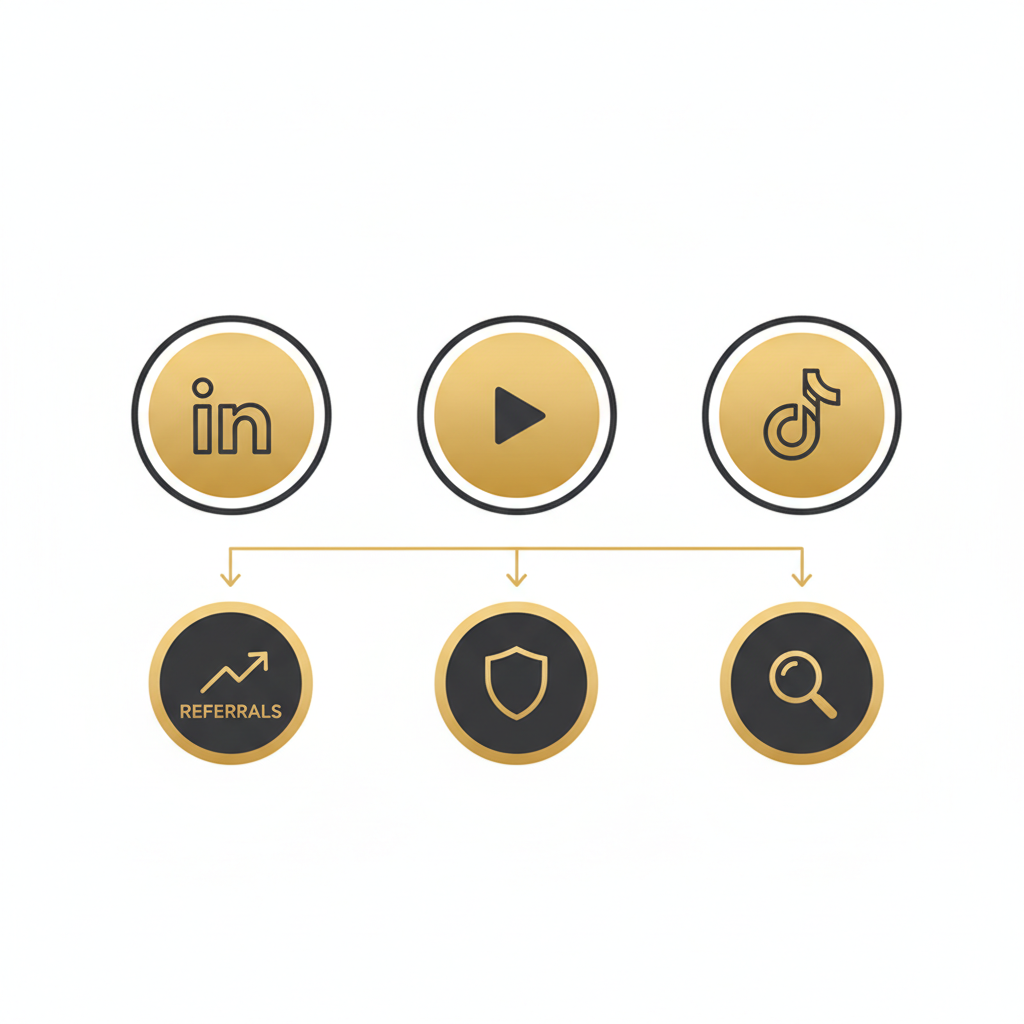
LinkedIn is the referral and authority engine, and it is where attorney-to-attorney referrals, co-counsel relationships, and professional credibility compound. YouTube is the long-term trust machine. Explainer video answering questions like how settlement value is calculated builds confidence text cannot, and it earns visibility in both Google and AI engines for months after upload. TikTok reaches younger and Spanish-speaking audiences researching accident questions in formats the older platforms miss.
| Platform | Primary Job | Format | Best For PI Firms |
|---|---|---|---|
| Drive signed cases | Paid ads, video, local reach | Direct case flow and retargeting | |
| Humanize and reach younger clients | Reels, short video, stories | Brand trust, bilingual content | |
| Referrals and authority | Articles, professional posts | Co-counsel and referral networks | |
| YouTube | Long-term trust | Explainer video | Compounding credibility and search |
| TikTok | Reach and discovery | Short vertical video | Younger and Spanish-speaking audiences |
The point is allocation. Put paid budget where cases sign, and put consistent organic effort where trust compounds.
The Spanish-Speaking MVA Advantage
The single largest underused opportunity in social media marketing for law firms is Spanish-language content for the Hispanic community. According to the U.S. Census Bureau, the Hispanic population reached 62.1 million in the 2020 Census, yet the volume of quality Spanish legal content on social platforms lags far behind that demand. For motor vehicle accident cases specifically, that gap is a competitive moat.
A firm that publishes genuinely useful Spanish content about accident rights, insurance dealings, and the claims process reaches a high-intent audience that English-only competitors cannot. This is not machine translation, which reads as inauthentic and erodes trust. It is content created for the cultural and linguistic context of Spanish-speaking accident victims, delivered on the platforms they already use.
This is exactly where a specialist matters. As a personal injury marketing agency focused on bilingual case acquisition, Great Marketing AI builds these campaigns for PI firms and turns the Spanish social advantage into signed MVA cases through our motor vehicle accident leads program.

Connect Social to Intake or Waste the Spend
Social media creates demand, but intake converts it. The most expensive mistake in a lawyers and social media program is generating engagement that no one follows up on fast enough. A viral reel that drives 200 inquiries into a slow intake desk simply burns the investment.
According to a widely cited Harvard Business Review study on lead response, firms that contact a lead within an hour are nearly seven times more likely to have a meaningful conversation than those that wait even 60 minutes longer. For injury leads, where prospects often message several firms at once, speed is decisive. Bilingual coverage matters just as much, since a Spanish-speaking prospect who reaches an English-only intake line often moves on.
Before scaling social, make sure intake can absorb it: fast response times, after-hours coverage, retargeting to recapture the people who engaged but did not call, and a CRM that nurtures the rest. For the operational framework, read our law firm intake optimization guide. Personal injury marketing companies that build this intake connection from day one see consistently lower cost per signed case than firms that treat social as a standalone effort.
Stay Compliant: Bar Rules Apply to Every Post
Social media is regulated as attorney advertising, and the rules apply to a casual reel the same way they apply to a billboard. Most state bars mirror the American Bar Association Model Rules of Professional Conduct on advertising, which prohibit false or misleading claims and bar most attorneys from calling themselves a specialist or the best without proper certification.
In practice that means a few guardrails. Do not guarantee outcomes or imply a result you cannot promise. Avoid superlatives like best, cheapest, or top unless you can substantiate them under your jurisdiction's rules. Many states require that promotional content be identifiable as advertising, and some require retaining copies of what you publish. Client confidentiality also applies, so never post case details, even anonymized, without informed consent.
As Rafael Hernandez, Founder and CEO of Great Marketing AI, puts it: "The firms that scale social safely are the ones that treat compliance as a feature, not a hurdle. Helpful, honest content that respects bar rules outperforms hype every time, because trust is what actually signs the case." When in doubt, check your state bar's social media guidance before posting.
Build the System, Then Pick Your Platforms
Social media marketing for law firms works when you stop chasing reach and start engineering case flow. Decide the job each platform plays, put paid budget where personal injury cases actually sign, run consistent organic effort where trust compounds, and lean into the Spanish-language advantage your competitors ignore. Then wire all of it into fast, bilingual intake so the demand you create turns into signed cases instead of missed calls.
If your firm wants a social program built around bilingual case acquisition for personal injury and MVA clients, book a strategy call with our team. Great Marketing AI is a personal injury lawyer marketing agency that builds exactly this system for PI firms across the United States. For the channel-by-channel context that puts social in its place, start with our law firm marketing strategy guide.
Turn Ad Spend Into Signed Cases
We blend AI-driven testing with proven performance strategy to attract qualified traffic and turn it into revenue—fast, trackable, and scalable.
- PI Lead Generation — exclusive, AI-qualified leads across MVA, slip & fall, med mal, and more.
- Facebook & Instagram Ads — reach customers where they scroll.
- Google Ads — capture people actively searching for you.
- Website Design — turn visitors into buyers with high-converting sites.
- AI Automations — save hours and never miss a follow-up.
- Email Marketing — nurture leads and close sales on autopilot.
- SEO — get found by customers searching for what you sell.
FAQs

About the author
Rafael Hernandez
CEO and Co-Founder of Great Marketing AI
Rafael Hernandez is the Founder of Great Marketing AI and a former Microsoft Engineer. He specializes in performance marketing for personal injury law firms, managing over $10M in ad spend to help attorneys generate signed cases across every PI case type. His strategies focus on exclusive lead generation, AI-powered qualification, and eliminating wasted budget.
About Great Marketing AI
Great Marketing AI: Performance marketing for personal injury law firms
We help personal injury law firms scale with exclusive, AI-qualified leads across every PI case type: MVA, slip & fall, medical malpractice, and wrongful death. Native English and Spanish campaigns, enterprise-grade Meta + Google ad management, and AI lead qualification before every intake.
100% Exclusive Leads
Never shared between firms. Territory-protected.
Native Spanish & English Campaigns
Built by native speakers, not Google Translate.
AI Lead Qualification
Pre-qualified before they ever reach your intake team.