Personal Injury Lawyer Advertising: TV, Billboards, Radio and Digital Compared by Cost Per Signed Case
Personal injury lawyer advertising compared by cost per signed case: TV, billboards, radio and digital, plus how to track offline spend and state bar rules.

Rafael Hernandez
CEO and Co-Founder of Great Marketing AI


I hope you find this useful. If you want our team to run your law firm's performance marketing, book a strategy call.
Author: Rafael Hernandez | CEO and Co-Founder of Great Marketing AI
Key Takeaways
- Personal injury lawyer advertising should be judged by cost per signed case (channel spend divided by retained clients), not by impressions, calls or cost per lead
- TV, billboards and radio build name recognition, but none of them hands you a click, so they only show up in your numbers if you add unique phone numbers and an intake source question
- Digital channels such as Local Services Ads, Google Ads and Meta ads are the only layer where every dollar can be traced to a signed case, which is why they anchor most media mixes
- Published cost per lead benchmarks vary widely by source and are not a cost per signed case, so measure your own conversion from lead to retainer before shifting budget
- Lawyer advertising rules differ by state, but guarantees, unverifiable past results, missing firm names and missing filings are the mistakes that most often cause trouble
Personal Injury Lawyer Advertising Is Judged by One Number
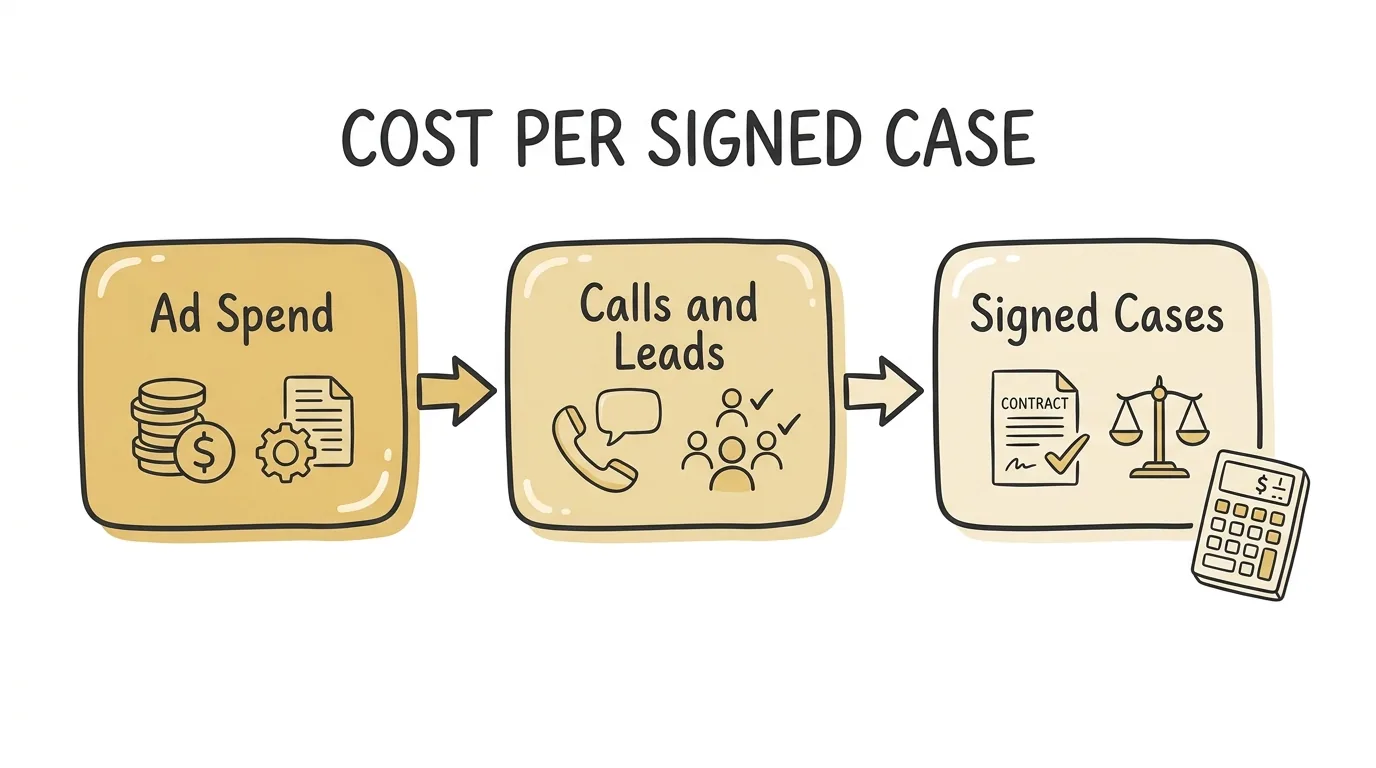
Personal injury lawyer advertising should be compared on cost per signed case: the total you spend on a channel divided by the number of clients who sign a retainer because of it. TV, billboards, radio and digital all look different on a media plan, but this one number puts them on the same scale.
Most firms running personal injury lawyer advertising measure the wrong thing. A billboard produces "impressions," radio produces "reach," and a Google campaign produces "clicks." None of those pay the bills. What pays is a retained case, so the useful question is how many dollars it takes to produce one.
This guide compares the major media for advertising for personal injury lawyers, and for advertising for law firms more broadly. It explains why offline spend is so hard to measure, and shows how to track it anyway. If you want the broader strategy first, start with our personal injury lawyer marketing guide, which covers digital channels, intake and reputation in depth.
The formula, and why blended cost matters
Cost per signed case equals channel spend divided by signed cases from that channel. Here is the math with round numbers, to show the method and not to suggest a benchmark: if a firm spends $10,000 on a billboard and can trace two signed cases to it, the cost per signed case is $5,000. If the same $10,000 on digital produces four traceable signed cases, the cost is $2,500.
The common objection is "I already get cases cheaper from referrals and radio." That may be true, and it is worth testing. But referrals do not scale on demand, and radio only counts if calls are tracked. The honest comparison is your true blended cost per signed case, with every source measured the same way.
TV and Streaming: Big Reach, Blurry Results
Television is the channel most people picture when they think of personal injury lawyer advertising. Its strength is reach and familiarity. A jingle or a recognizable face makes a firm feel established, and that familiarity can lift every other channel, including search, because people recognize the name when they see it.
The weakness is attribution. A viewer sees a spot on Tuesday, searches your firm name on Friday and shows up in your analytics as "branded search" or "direct." The TV buy never gets credit, even if it caused the call.
Streaming TV and connected TV sit between traditional television and digital. They allow tighter geographic and audience targeting than broadcast, and some platforms can report on household-level responses. Treat those reports as directional, not proof, and still verify with your own intake data.
Before buying, price the full cost, including production. Production and media together decide your cost per signed case, and a spot that runs a few weeks rarely teaches you anything. Because of the long production and booking lead times, TV is a poor channel for a firm that cannot yet measure its other sources.
Billboards and Out-of-Home: Reach Without a Click
Billboards and other out-of-home ads, such as bus benches and transit shelters, are the most visible form of personal injury lawyer advertising. They put your name in front of people on the roads where many injury claims begin. The strongest argument for them is simple: a billboard sits next to the place where the problem happens, and a driver stuck in traffic has time to read a phone number.
The weakness is the same as TV, only sharper. Nobody clicks a billboard, so there is no automatic record that it worked. The only trace is a phone call or a later search for your name.
Two practices make billboards measurable:
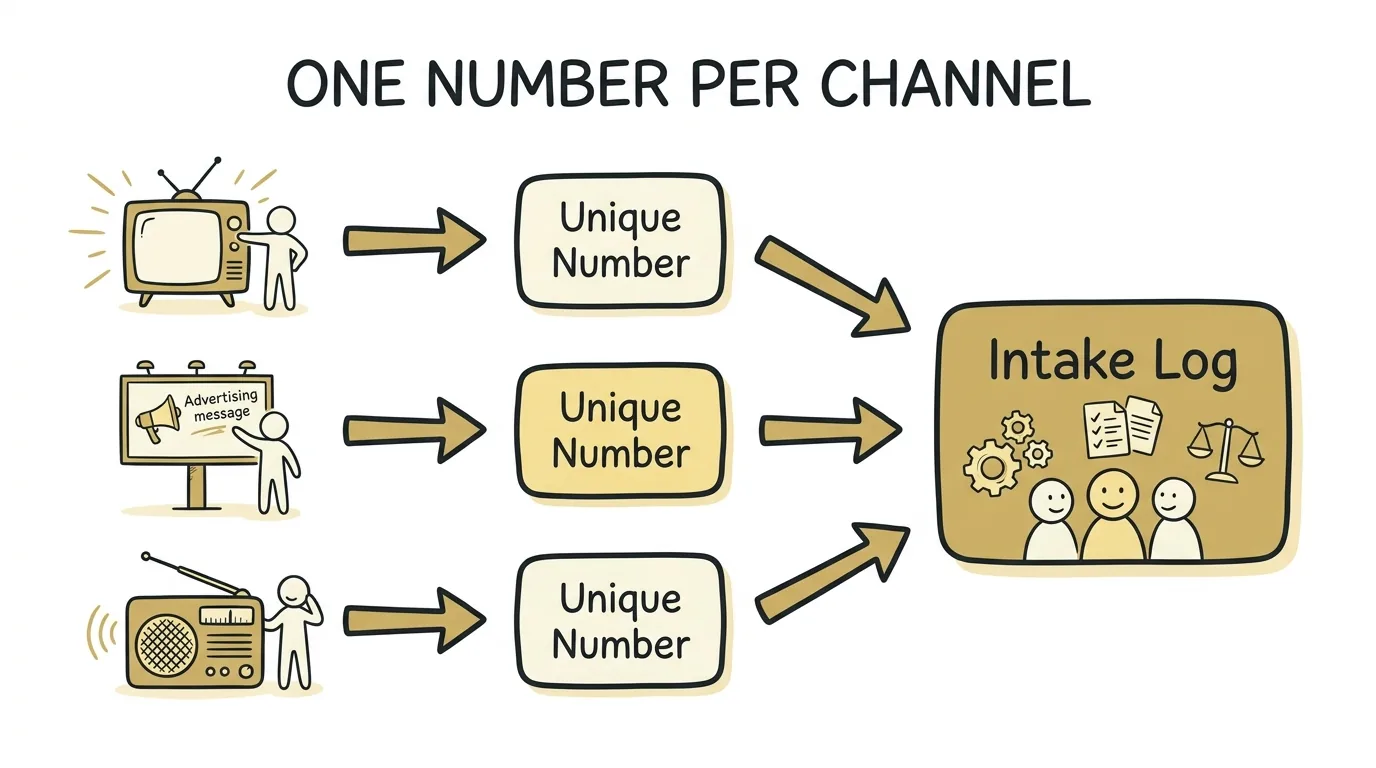
- A dedicated phone number that appears only on that board, so every call to it is a billboard call.
- A simple, short message: the firm name, one claim you can support, and the number. Drivers cannot read paragraphs.
Even then, billboards undercount, because many viewers search your name later instead of calling. Pair the board with a recognizable name that shows up well when people search, and review your branded search volume before and after the campaign starts. Rules apply to outdoor ads too; the compliance section below covers filing and required content.
Radio, Including Spanish-Language Radio
Radio rewards repetition, and it reaches people in cars, at work and at home, often at the moments when they are thinking about an accident. For firms handling motor vehicle accident claims, drive-time slots line up well with the moments people are on the road.
For firms that want to reach Spanish-speaking claimants, radio deserves a serious look. Nielsen and the Hispanic Radio Alliance reported in December 2024 that radio reaches 40 million Hispanic listeners every month, a reach comparable to connected TV devices and smartphones. In the same report, Hispanic adults aged 18 to 34 spent 8 hours 11 minutes per week with AM and FM radio, against 10 hours 56 minutes with live and time-shifted TV.
Those figures show the audience exists. They do not show your cost per signed case, and radio is only as measurable as your tracking. Use a unique number per station, ask callers which station they heard, and make sure the person answering can speak to the caller in their language. Our guide to Spanish-speaking personal injury lawyer marketing covers bilingual creative and channels beyond radio.
Digital: The Only Layer You Can Trace to a Signed Case
Within personal injury lawyer advertising, digital channels differ from the rest because every step leaves a record: the click, the call, the form, and with the right setup, the signed retainer. That record lets you calculate cost per signed case directly instead of estimating it.
The main options are Local Services Ads for lawyers, Google Ads for law firms and Facebook ads for personal injury lawyers. For a ranking of the digital channels by return, see our breakdown of marketing channels ranked by ROI.
Published benchmarks give a sense of the range, but handle them with care. First Page Sage's personal injury report lists an average cost per lead of $442 for Google search ads, $378 for Local Service Ads and $286 for Facebook ads, based on campaigns it ran from January 2022 through December 2024. Other sources publish different figures for the same channels, which is the point: benchmarks vary by market, case type and method.
More importantly, those are costs per lead. A lead is a call or form, not a client. To turn cost per lead into cost per signed case, divide it by the share of leads that sign. Only your own intake data can tell you that, and it is the reason tracking matters more than any benchmark.
How to Track Offline Personal Injury Lawyer Advertising to a Signed Case
Offline channels are not unmeasurable. They are just unmeasured by default. Closing that gap takes three habits.
- Assign a unique tracking number to every channel. One for each billboard, each radio station and each TV flight. Call tracking numbers forward to your main line and log every call with its source.
- Ask every caller how they heard about you. Track this as a required field, not a free-text note. Callers who found you through a search often say "Google" even when a TV spot started the process, so look at the source question and the call log together.
- Connect the log to signed cases. Mark which leads became retained clients in your case management system, then report spend divided by signed cases for each source every month. If your intake is slow, you will lose cases before this math even starts; our guide on speed to lead for personal injury consultations explains why response time matters so much.
Be honest about the limits. Even with all three habits, offline attribution undercounts, because people research before they call. Use it to compare offline channels with each other and to spot clear winners or clear losers, not to claim precision. For digital, we set up full tracking from ad spend to signed case, including Meta Conversion API events, and the firm owns the ads and funnel assets, so you can see exactly what you are paying for.
What to Ask a Media Rep Before You Sign
Media sales reps are good at describing audiences and weak at describing your results. Before you commit money to a TV flight, a billboard contract or a radio schedule, ask questions that force the conversation back to measurable outcomes.
- Where exactly will my ad run, and when? Ask for the actual stations, dayparts or board locations, in writing, rather than a general "market package."
- How will I know it ran? Ask for proof of performance, such as an affidavit of airing, a photo of the posted board or a spot log.
- What is the minimum commitment, and can I exit early? A long contract with no exit is a bet you cannot afford to lose if tracking shows poor results.
- Who handles production, and who owns the finished creative? You want the files, so you can reuse them or move to another vendor.
- Can you support a unique phone number? If the vendor will not let you track calls separately, you will not be able to judge the buy.
Then set a decision rule before the campaign starts: how many tracked calls and signed cases you need to see, over what period, for the channel to stay. Writing that rule down in advance protects you from the two common mistakes, which are quitting too soon and renewing out of habit.
Five Mistakes That Waste Personal Injury Attorney Advertising Budget
Most wasted spend in personal injury attorney advertising comes from a short list of repeat mistakes. Check your own plan against them.
- Measuring cost per lead and stopping there. Leads that never sign are not a bargain at any price.
- Launching several channels at once. You cannot tell what worked, so you cannot repeat it.
- Sending calls to a slow intake process. Advertising creates the opportunity, and intake decides whether you capture it. Our guide on law firm intake optimization covers the process in detail.
- Running English-only creative in a bilingual market. If a large share of the people in your area search and speak in Spanish, an English-only ad leaves those claimants for the firm that speaks to them.
- Copying a competitor's ad without checking the rules. An ad that looks fine on a competitor's channel may still break a rule in your state.
Fixing these five usually improves results faster than increasing the budget.
A Media Mix Decision Table by Firm Stage
Budget size matters less than stage in personal injury law firm advertising. The right mix depends on how well you can measure, how fast your intake team responds and how much risk you can take. Use this table as a starting framework and adjust it with your own numbers.
| Channel | Traceable to signed case? | Best use | Main risk |
|---|---|---|---|
| Local Services Ads | Yes (phone calls logged) | First paid channel for a new firm | Lead quality varies by market |
| Google Ads | Yes (click to call) | Capturing people already searching | High cost per click in competitive markets |
| Meta ads (Facebook, Instagram) | Yes (with proper tracking) | Reaching people who are not searching yet, including Spanish speakers | Needs strong creative and fast follow up |
| Radio | Partly (unique numbers) | Local name recognition, bilingual reach | Undercounts, depends on spots and stations |
| Billboards | Partly (one number per board) | Brand presence near accident corridors | Hardest to attribute |
| TV and streaming | Weakly | Established firms with strong intake and other channels already tracked | High production and media cost, slow feedback |
A practical sequence for most firms:
- Starting out: put money into the digital channels you can trace, and fix intake speed first.
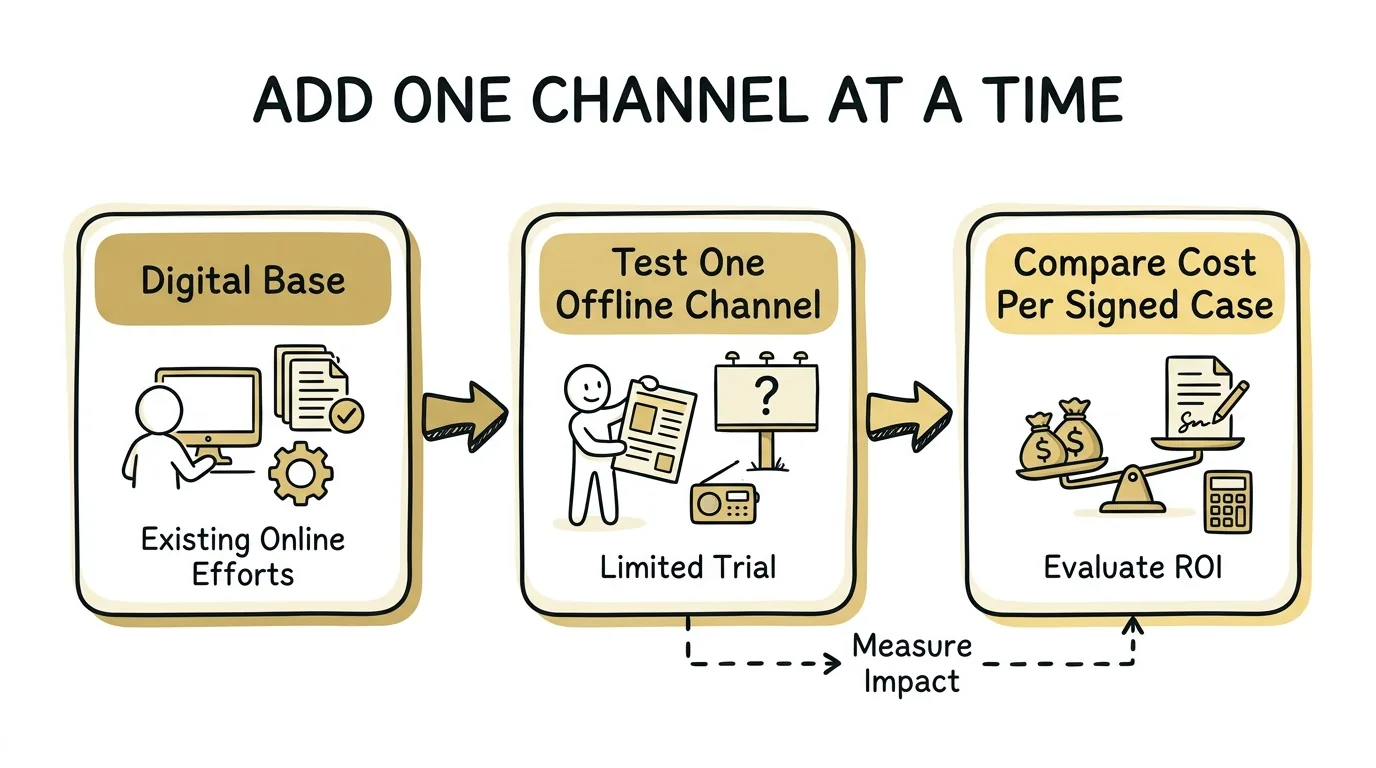
- Established, with solid tracking: add one offline channel at a time, with its own tracking number, for long enough to read the result.
- Large, multi-office firms: layer TV or out-of-home on top of a measured digital base, and judge it on blended cost per signed case.
Add one channel at a time. If you launch radio, a billboard and a new campaign in the same month, you cannot tell which one worked.
State Bar Rules to Check Before You Run Anything
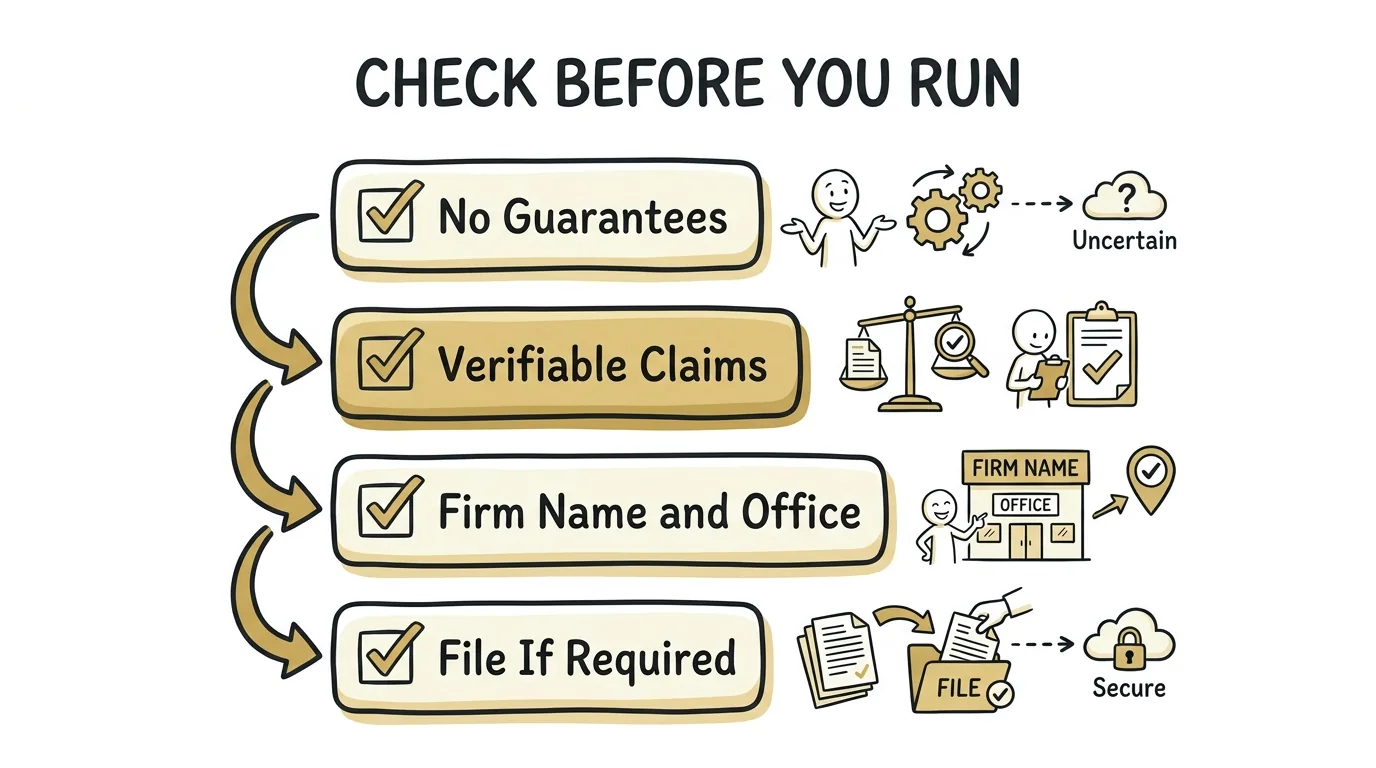
Personal injury lawyer advertising is regulated by each state, and the lawyer advertising rules differ. Most states base theirs on the ABA Model Rules of Professional Conduct, Rules 7.1 and 7.2, but the details, including filing and disclaimers, are state specific. This section shows examples from three states, not legal advice. Check the current rules in every state where you advertise, and confirm any ad with your own ethics counsel or state bar.
Guarantees and misleading claims. California Rule 7.1 says a lawyer must not make a false or misleading communication, that an express guarantee of a result is misleading, and that a truthful statement can still mislead if it leaves out a necessary fact. It also says a "no fee without recovery" message is misleading unless it discloses whether the client is liable for costs.
Results, testimonials and required content. The Rules Regulating The Florida Bar, Rule 4-7.13, lists as deceptive any ad a client could read as a prediction or guaranty of success, any past results that are not objectively verifiable, and testimonials that lack a disclaimer that the client may not get the same results. Rule 4-7.12 in the same document requires the name of a responsible lawyer or firm and the city, town or county of a bona fide office, and requires any required disclaimer to appear in each language the ad uses, which matters for Spanish-language radio and TV.
Filing. Some states require review. Florida requires most ads to be filed with the bar at least 20 days before first use (Rule 4-7.19), and its website content is among the exemptions (Rule 4-7.20). Texas Rule 7.07 requires filing with the State Bar of Texas's advertising review committee before or concurrently with first use, including outdoor ads and a production script for video and audio. That page is a university library copy of the rule, so confirm the current text with the State Bar of Texas.
Brand Dollars Versus Case Acquisition Dollars
Every dollar of personal injury lawyer advertising does one of two jobs. Case acquisition dollars are meant to produce a signed case in the near term, and you judge them by cost per signed case. Brand dollars build recognition that makes every other channel work better, and you judge them by whether branded search, direct calls and conversion rates improve over time.
TV, billboards and much of radio are brand spending by nature. That is not a criticism, because recognition is valuable. It just means they should have a separate budget line, a cap and a review date, instead of hiding inside "marketing."
How do you judge brand dollars without a click? Watch three signals before and after a campaign starts: the number of people searching your firm name (your Google Search Console report shows this), the share of callers who name the campaign when asked how they heard about you, and whether your paid search conversion rate rises. None of these is proof alone, but together they show whether recognition is building. If all three stay flat after a fair test period, the brand spend is not earning its place.
Digital channels can do both jobs, but they are cleanest as case acquisition: you can see the spend, the lead and the outcome. When a firm tells us it is paying too much for leads, the first step is usually to compare channels on cost per signed case, because the cheapest lead is often not the cheapest client.
Price matters too. If a quote sounds too expensive, compare it to what a signed case is worth to your firm and to the cost of the channels you already use. Some firms prefer to buy leads instead of managing ads. We offer more than one model, including raw leads, live transfers and signed retainers, so the firm picks how much risk it wants to carry. See our page on motor vehicle accident leads for how that works.
Where to Start
Pick the one number, cost per signed case, and make every channel of your personal injury lawyer advertising report it. Start with tracking numbers and an intake source question, then add or cut spend based on what the data shows.
If you want a partner who treats measurement as part of the job, our personal injury law firm marketing agency builds the ads, the funnel and the reporting from spend to signed case. You can book a call or reach out through our contact page to talk through your current mix. To see what competitors are running before you decide, read how to spy on competitor ads.
Turn Ad Spend Into Signed Cases
We blend AI-driven testing with proven performance strategy to attract qualified traffic and turn it into revenue—fast, trackable, and scalable.
- PI Lead Generation — exclusive, AI-qualified leads across MVA, slip & fall, med mal, and more.
- Facebook & Instagram Ads — reach customers where they scroll.
- Google Ads — capture people actively searching for you.
- Website Design — turn visitors into buyers with high-converting sites.
- AI Automations — save hours and never miss a follow-up.
- Email Marketing — nurture leads and close sales on autopilot.
- SEO — get found by customers searching for what you sell.
FAQs

About the author
Rafael Hernandez
CEO and Co-Founder of Great Marketing AI
Rafael Hernandez is the Founder of Great Marketing AI and a former Microsoft Engineer. He specializes in performance marketing for personal injury law firms, managing over $10M in ad spend to help attorneys generate signed cases across every PI case type. His strategies focus on exclusive lead generation, AI-powered qualification, and eliminating wasted budget.
About Great Marketing AI
Great Marketing AI: Performance marketing for personal injury law firms
We help personal injury law firms scale with exclusive, AI-qualified leads across every PI case type: MVA, slip & fall, medical malpractice, and wrongful death. Native English and Spanish campaigns, enterprise-grade Meta + Google ad management, and AI lead qualification before every intake.
100% Exclusive Leads
Never shared between firms. Territory-protected.
Native Spanish & English Campaigns
Built by native speakers, not Google Translate.
AI Lead Qualification
Pre-qualified before they ever reach your intake team.