Facebook Ads for Attorneys: What Works Differently Compared to Other Industries
Facebook ads for attorneys operate under state bar rules that most industries never face. Learn the compliance framework, creative restrictions, and ad strategies that actually convert in 2026.

Rafael Hernandez
CEO and Co-Founder of Great Marketing AI


I hope you find this useful. If you want our team to run your law firm's performance marketing, book a strategy call.
Author: Rafael Hernandez | CEO and Co-Founder of Great Marketing AI
Key Takeaways
- Attorney Facebook advertising is governed by state bar rules that restrict testimonials, case result claims, and outcome language that every other industry uses freely.
- ABA Model Rule 7.1 prohibits false or misleading communications about legal services, which means common ad phrases like 'Get the compensation you deserve' require careful legal review before use.
- Facebook ads for attorneys convert at an average of 10.53% for the leads objective, which is above the cross-industry average, but cost per qualified case can exceed $1,500 without proper funnel setup.
- Solo attorneys and small practices face the same compliance burden as large firms but with far less budget for legal review, making a pre-approved ad creative library a practical necessity.
- Combining Facebook ads (awareness and cold traffic) with Google Ads (intent capture) and Local Service Ads (pay-per-lead) creates the highest return on ad spend for personal injury practices in competitive markets.
- California SB 37, effective January 2026, gives consumers the right to sue attorneys for non-compliant advertising, raising the stakes for every solo attorney running Facebook campaigns without a compliance review.
Facebook ads for attorneys convert at a 10.53% average rate for the leads objective, which is one of the highest rates across all industries on the platform, according to LocaliQ's 2025 Facebook Advertising Benchmarks. The challenge is not whether Facebook works for attorneys. The challenge is running campaigns that comply with state bar rules that restrict the ad copy, creative format, and testimonial use that every other industry takes for granted.
A personal injury practice, a criminal defense solo, and a family law boutique can all run profitable Facebook campaigns. But each one operates under professional conduct rules that ban outcome guarantees, restrict testimonials, mandate specific disclaimers, and in 2026, expose the firm to consumer civil litigation in California for non-compliant ads. Understanding what makes facebook ads for attorneys legally and strategically different from every other paid social campaign is the prerequisite for running them profitably.
Key Takeaways
- State bar rules rooted in ABA Model Rules 7.1 and 7.2 restrict ad copy that every other industry runs without scrutiny
- California SB 37, effective January 2026, allows consumers to sue attorneys for advertising violations after a State Bar complaint
- Facebook ads for attorneys convert at 10.53% average for the leads objective, above the cross-industry average
- Solo attorneys face the same compliance burden as large firms, making a pre-approved creative library essential
- Cost per signed case is the only metric that reveals true Facebook ad profitability for legal practices
- The strongest PI practices combine Facebook (awareness), Google Ads (intent), and LSA (verified leads) for full-funnel coverage
The Regulatory Layer That Changes Everything
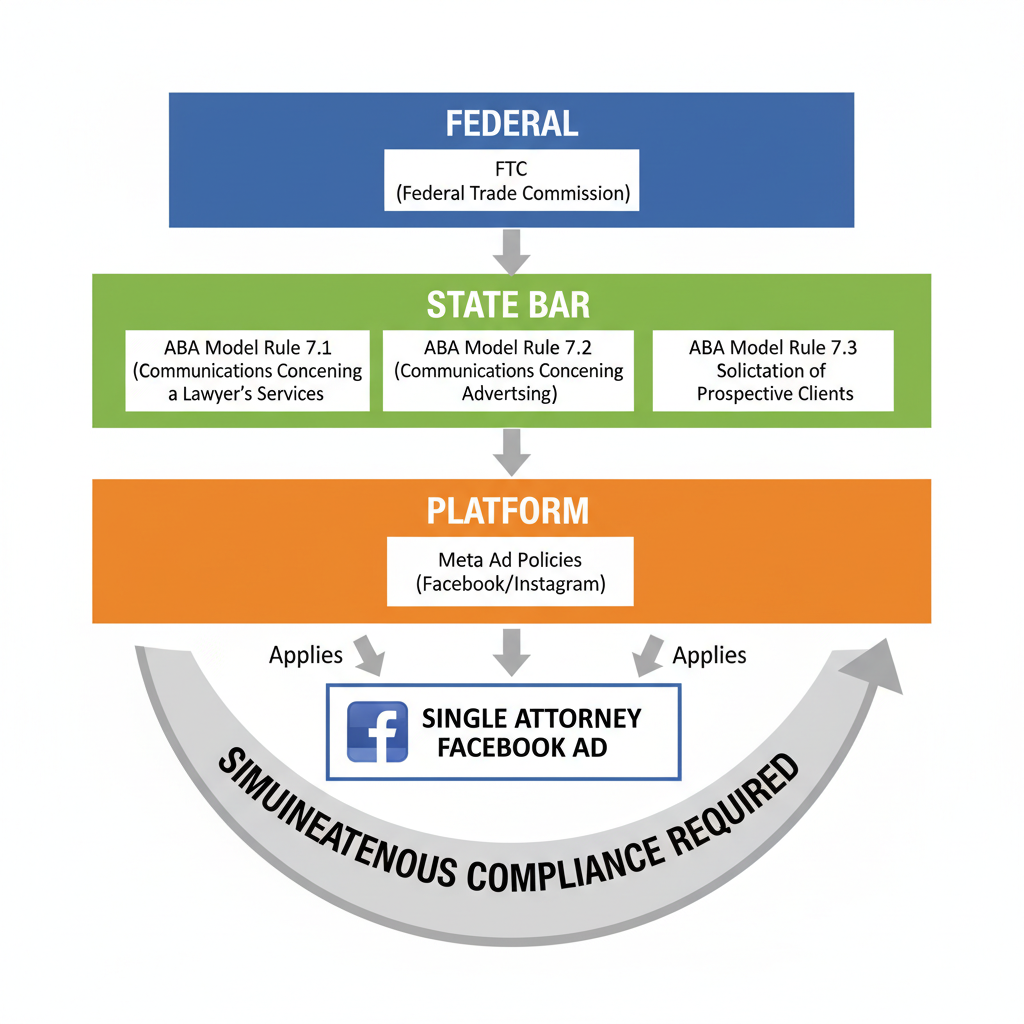
When a SaaS company runs Facebook ads, the creative team asks: does this convert? When a facebook ads for attorneys or facebook ads for lawyers campaign launches, the creative team must also ask: does this comply?
Three separate regulatory layers govern every ad an attorney runs on Facebook. The Federal Trade Commission applies truth-in-advertising standards to all commercial speech. State bar rules of professional conduct, modeled on ABA Model Rules 7.1 through 7.3, impose attorney-specific restrictions that go far beyond the FTC baseline. Meta's own advertising policies add a third layer, including restrictions on ad targeting using sensitive health or legal status information.
ABA Model Rule 7.1 prohibits any communication about legal services that is false or misleading. According to the American Bar Association's interpretive guidance, a statement is misleading not only when it is factually false, but when it creates an unjustified expectation about outcomes. That single rule eliminates headline copy that every direct response advertiser uses: "Get the settlement you deserve," "We win cases," "Maximum compensation guaranteed."
ABA Model Rule 7.3 bars direct solicitation of prospective clients known to need legal services. This has direct implications for audience targeting on Facebook. Using custom audiences built from accident report databases or retargeting users based on hospital visit behavior crosses into solicitation territory that most state bars prohibit. Broad geographic and interest-based targeting is permissible. Targeting based on a known legal need is not.
"The biggest compliance mistake attorneys make on Facebook is copying what they see other industries do," says Rafael Hernandez, Founder and CEO of Great Marketing AI. "Attorneys cannot run the same outcome-driven copy that an e-commerce brand or financial services company runs. The rules are fundamentally different, and violations now carry civil liability in California."
What California SB 37 Means for Every Attorney Running Facebook Ads
California SB 37, effective January 1, 2026, creates a private right of action for consumers who receive non-compliant attorney advertising. After filing a complaint with the State Bar of California, a consumer can bring a civil lawsuit if the attorney fails to withdraw the offending ad within 72 hours of a State Bar finding of substantial evidence of a violation. Statutory damages range from $5,000 to $100,000 per violation.
The practical implication for facebook ads for attorneys running in California or targeting California residents: every ad must include a bona fide office address (not a mailbox address), every testimonial needs written consent on file, and every case result reference needs a "past results do not guarantee future outcomes" disclaimer. The State Bar can act within 21 days of a consumer complaint, which means a non-compliant ad running during a high-traffic period can generate both regulatory and civil exposure simultaneously.
According to Taqtics' 2026 review of state advertising rule changes, eleven states updated attorney advertising rules between 2024 and 2026. Alabama's changes, effective January 1, 2026, removed the general disclaimer requirement but added specific disclaimers for case type claims. Florida's Bar Handbook, updated December 2025, expanded testimonial disclosure requirements to cover influencer-style video content.
The trend across jurisdictions is toward more enforcement, not less. Attorneys running law firm facebook ads without a compliance review process are carrying material legal risk in addition to marketing risk.
How State Bar Rules Reshape Every Part of Ad Creative
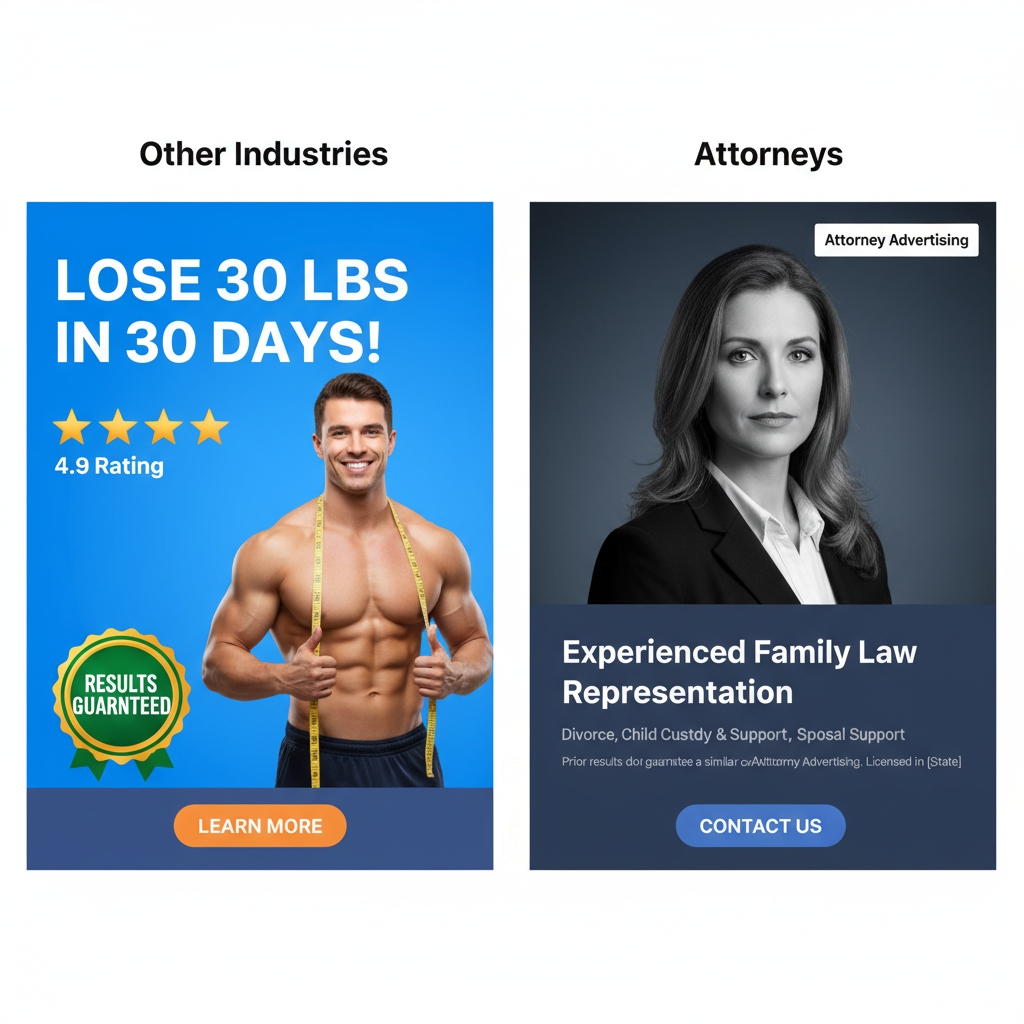
The compliance constraints are not abstract. They reshape every element of facebook ads for attorneys creative.
Headlines and body copy: Outcome language is prohibited in all states. "We win cases" is misleading because it implies a guarantee. "Get the compensation you deserve" sets an expectation that may not be achievable. Compliant alternatives focus on the process and the practice: "Injured in an accident? Our personal injury team offers free consultations." "Over 20 years representing accident victims in Los Angeles."
Testimonials: Client testimonials require written informed consent in every jurisdiction. The testimonial must be from a real client with personal experience. A disclaimer stating "This testimonial does not guarantee similar outcomes" must be visible without requiring the viewer to take any action. Some state bars, including New York, require that testimonials accompanied by case result amounts include the full settlement context, including any liens or attorney fees that reduced the client's net recovery.
Case results: Referencing a specific settlement or verdict requires a "past results do not guarantee future results" disclaimer. Florida requires this disclaimer to be as prominent as the result claim itself, meaning an attorney cannot run a large headline with a $2M settlement figure and a tiny disclaimer in gray text at the bottom of the image.
"Attorney Advertising" labels: New York requires this label on every advertisement. Texas requires "ADVERTISING MATERIAL" prominently displayed. Several other states require identification of the responsible attorney and a physical address in every ad. These requirements apply to the ad text, not just the landing page.
"Best," "top-rated," and superlatives: Unsubstantiated comparative claims like "best personal injury lawyer in Miami" or "top-rated attorney" violate Rule 7.1 unless the claim is based on an objective standard from a recognized organization. Martindale-Hubbell AV ratings, Super Lawyers designations, and certain peer-review awards can support these claims when properly qualified.
For attorneys running law firm facebook ads without a compliance review process, a pre-approved creative library is the most practical solution. Building 8 to 12 compliant ad variations, reviewed by a bar compliance attorney once, gives the media team a library to rotate and test without opening a compliance review for every new creative variant.
Facebook Ads vs. Google Ads vs. LSA for Attorneys: A Direct Comparison
Choosing the right channel depends on what stage of the buying journey the attorney wants to reach. The three primary paid channels serve different intent levels and carry different cost structures.
| Channel | Intent Level | Average Lead Cost | Compliance Burden | Best For |
|---|---|---|---|---|
| Facebook Ads | Low to Medium (passive) | $100-$400 per lead | High (state bar rules apply) | Awareness, cold audiences, solo attorneys in tight markets |
| Google Ads (Search) | High (active search) | $50-$300 per click | Medium (FTC + state bar) | High-intent case types, branded terms, competitive practice areas |
| Google Local Service Ads | Very High (Google-verified) | $131-$250 per lead | Medium (Google verified badge requirements) | Pay-per-lead, top-of-SERP placement, verified trust signals |
Facebook ads operate at the top of the funnel. A potential MVA claimant scrolling Facebook on Tuesday night has not yet decided to hire an attorney. The ad creates awareness and begins the relationship before the active search phase begins. This is where attorney advertising facebook campaigns have an advantage that Google cannot replicate: they reach prospects before competitors can.
Google Ads captures people who have already decided they need a lawyer. Keywords like "personal injury attorney near me" in Los Angeles can cost $200 to $300 per click, according to BigDogICT's 2025 law firm Google Ads cost analysis. The high CPC reflects high intent. Someone clicking that keyword is actively looking for representation.
Local Service Ads sit at the top of Google search results with a "Google Screened" badge, which signals a background-checked, verified attorney. The pay-per-lead model means attorneys only pay when a prospective client calls or messages. According to DMLaw Partners' 2026 comparison, LSA conversion-to-retainer rates average around 34%, roughly seven times higher than standard PPC conversion rates. The trade-off is volume: LSA supply is limited by the Google verification pool in each market.
The highest-performing personal injury practices in competitive markets, including Los Angeles, Miami, and Houston, run all three channels in parallel. Facebook generates cold audience volume and brand recall. Google captures active searchers. LSA closes high-intent leads with verified trust signals. Firms relying solely on one channel leave acquisition volume on the table. Our guide to Facebook ads for law firms covers the lead form vs. landing page decision in detail for practices already running Google or LSA campaigns who want to add Facebook.
The Solo Attorney and Small Firm Advantage on Facebook
Large personal injury firms with media budgets of $50,000 or more per month dominate Google Ads through bid volume. On Facebook, smaller budget advantages level the playing field in ways that make facebook ads for attorneys at the solo and small firm level genuinely competitive.
Facebook's auction is relevance-based, not purely budget-based. An ad with a high relevance score, strong creative, and a well-defined audience outperforms a generic ad from a larger firm running on higher budgets. A solo attorney facebook marketing campaign targeting a specific metro area and a specific case type (rear-end accidents on the 405 corridor, for example) can achieve lower cost per lead than a large firm running broad creative to a statewide audience.
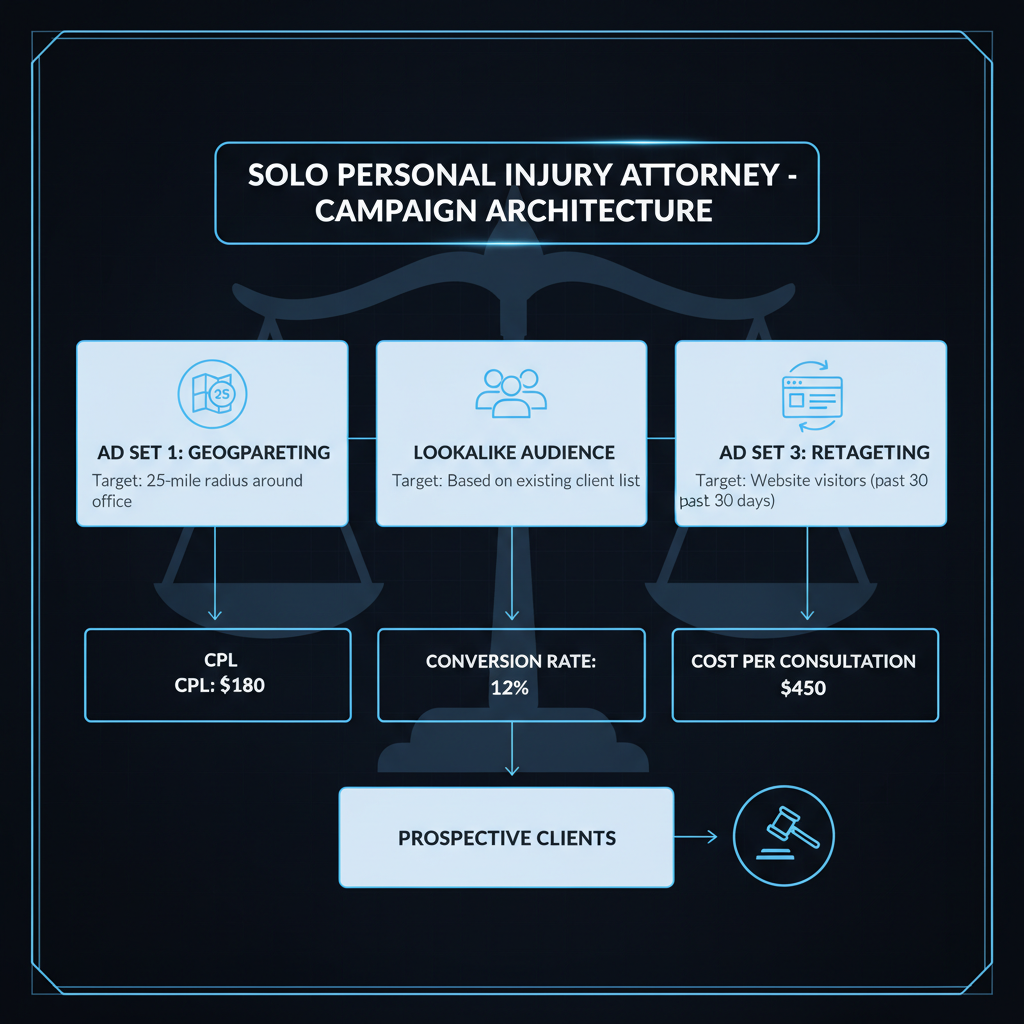
The practical campaign structure for a solo PI attorney on a $3,000 monthly budget:
- Geographic targeting ad set ($1,500/month): 25-mile radius around the office, ages 25-60, interests layered for accident and injury signals. Cold audience. Focus on awareness and lead capture.
- Lookalike audience ad set ($1,000/month): Upload existing client list, create 1-2% lookalike, apply geographic constraints. These audiences typically convert at 30-50% better than cold interest targeting.
- Retargeting ad set ($500/month): Website visitors, video viewers, and lead form openers in the last 30 days. Lowest CPL because they already know the firm. High-intent re-engagement.
This structure mirrors what a personal injury law firm marketing agency runs for larger clients but scaled to a solo practice budget. The compliance requirement remains identical: every ad set running any outcome language, testimonial, or case result requires state bar-compliant copy regardless of the budget size.
The intake process is where solo attorney Facebook campaigns most often underperform. A lead form submission at 10:30 PM on a Friday that does not receive a call until Monday morning loses to a competitor who calls within five minutes. Facebook's native lead forms allow instant SMS or email notification on submission. Pair that with an automated follow-up sequence and a live intake answering service during business hours, and the gap between large firm responsiveness and solo attorney responsiveness closes significantly.
The Compliance-First Creative Framework for Attorney Facebook Ads
Building a compliance-first creative system prevents the common failure mode in facebook ads for lawyers: a media team that writes converting copy without knowing bar rules, and a compliance reviewer who slows every launch. The solution is a pre-approved creative library.
A compliant attorney Facebook ad contains five elements in the right structure:
- Identification: The responsible attorney's name and firm name, visible in the ad copy or the page identity. Not buried in fine print.
- Practice area and jurisdiction: What type of cases and where. "Personal injury cases in California" is specific and verifiable. "All cases everywhere" is not.
- Value proposition without outcome language: What the firm provides, not what result the client will receive. "Free consultations. No fee unless we win" is compliant. "We will get you the maximum settlement" is not.
- Testimonials with proper disclaimers: If used, must include written consent, must be from real clients, and must include a "results vary" disclaimer equal in prominence to the testimonial claim.
- Required labels: "Attorney Advertising" (New York), "ADVERTISING MATERIAL" (Texas), physical address (California SB 37 standard), and any state-specific requirements for the jurisdictions being targeted.
The creative review process for attorney facebook ads compliance should happen at the library build stage, not the individual ad level. Work with a bar-admitted compliance attorney to review 8 to 12 core ad variations covering your primary practice areas and key messages. Once approved, the media team can test images, formats, and placements within those approved copy frameworks without triggering a fresh compliance review for every creative variant.
For personal injury practices specifically, the highest-converting compliant creative types in facebook ads for personal injury lawyers campaigns are professional attorney headshots paired with practice area specificity, short-form video testimonials with on-screen disclaimers, and educational content about the legal process that builds authority without making outcome claims. Check out our detailed guide on Facebook ads for personal injury lawyers for targeting setup and audience structure.
Measuring Attorney Facebook Ad Performance
Standard Facebook metrics (CTR, CPM, CPC) tell you about ad efficiency, not business results. The key differentiator in attorney advertising facebook is tying spend to signed cases. For facebook ads for attorneys, the metrics that actually measure campaign success are:
- Cost per qualified lead: A lead is qualified when the prospective client has a valid case type, is in your jurisdiction, and has indicated they want legal representation. Filter for qualification in your lead form using 2 to 3 screening questions.
- Lead-to-consultation rate: What percentage of form submissions become actual consultations? Industry benchmarks for PI campaigns run between 15% and 35%, with the gap driven primarily by intake speed and follow-up persistence.
- Consultation-to-signed case rate: How many consultations convert to signed retainer agreements? For personal injury, this typically runs 20% to 40% depending on case quality and attorney intake skill.
- Cost per signed case: Divide total monthly ad spend by signed cases. This is the only metric that connects Facebook spend to revenue. Personal injury Facebook campaigns with optimized funnels can achieve cost per signed case of $500 to $1,500 in competitive markets.
Do not optimize for CPL alone. A Facebook campaign achieving $50 CPL on unqualified, out-of-jurisdiction leads is far less valuable than a campaign achieving $250 CPL on qualified, in-jurisdiction leads who convert at 30% to signed cases.
For practices ready to scale beyond Facebook, working with a personal injury law firm marketing agency that understands both paid social compliance and full-funnel attribution ensures that ad spend connects to signed cases, not just lead form submissions.
Putting It Together: The Attorney Facebook Ads System
Facebook ads for attorneys work differently from every other industry because the rules are different, the stakes are different, and the audience psychology is different. A prospective accident victim browsing Facebook is not in the same mental state as someone searching Google for "personal injury attorney near me." They are in passive discovery mode, which requires different creative, different copy, and different nurture sequences than intent-based channels.
The attorneys and practices that run profitable Facebook campaigns in 2026 share three characteristics: they have a pre-approved compliance creative library built in advance, they measure cost per signed case rather than cost per lead, and they combine Facebook with Google Ads and LSA to cover every stage of the acquisition funnel.
For practices targeting Spanish-speaking MVA claimants specifically, Facebook's Spanish-language audience targeting and bilingual ad capabilities create opportunities that English-only campaigns cannot reach. Our team at Great Marketing AI specializes in bilingual Facebook and Google campaigns for personal injury firms targeting motor vehicle accident leads in competitive markets. The compliance framework, audience strategy, and creative development are all handled inside the agency, so the practice can focus on intake and case quality rather than ad platform management.
The compliance layer is real, but it is not a barrier to profitable Facebook advertising for attorneys. It is a framework that, once built, becomes a competitive advantage because most competitors skip it entirely and run campaigns that expose them to State Bar discipline and, in California, civil liability. Build compliance first, then build performance.
Turn Ad Spend Into Signed Cases
We blend AI-driven testing with proven performance strategy to attract qualified traffic and turn it into revenue—fast, trackable, and scalable.
- PI Lead Generation — exclusive, AI-qualified leads across MVA, slip & fall, med mal, and more.
- Facebook & Instagram Ads — reach customers where they scroll.
- Google Ads — capture people actively searching for you.
- Website Design — turn visitors into buyers with high-converting sites.
- AI Automations — save hours and never miss a follow-up.
- Email Marketing — nurture leads and close sales on autopilot.
- SEO — get found by customers searching for what you sell.
FAQs

About the author
Rafael Hernandez
CEO and Co-Founder of Great Marketing AI
Rafael Hernandez is the Founder of Great Marketing AI and a former Microsoft Engineer. He specializes in performance marketing for personal injury law firms, managing over $10M in ad spend to help attorneys generate signed cases across every PI case type. His strategies focus on exclusive lead generation, AI-powered qualification, and eliminating wasted budget.
About Great Marketing AI
Great Marketing AI: Performance marketing for personal injury law firms
We help personal injury law firms scale with exclusive, AI-qualified leads across every PI case type: MVA, slip & fall, medical malpractice, and wrongful death. Native English and Spanish campaigns, enterprise-grade Meta + Google ad management, and AI lead qualification before every intake.
100% Exclusive Leads
Never shared between firms. Territory-protected.
Native Spanish & English Campaigns
Built by native speakers, not Google Translate.
AI Lead Qualification
Pre-qualified before they ever reach your intake team.

%2Fhero.webp&w=3840&q=75&dpl=dpl_Eu4bCVbwr64wGKcDC9CZiMvsLQ6e)