Spanish Facebook Ads for Personal Injury Lawyers: Lower CPL, Higher-Intent MVA Leads
Spanish Facebook ads for PI law firms cost 40-60% less than English. Learn language targeting, transcreated creative, lead forms, and CAPI tracking that signs cases.

Rafael Hernandez
CEO and Co-Founder of Great Marketing AI


I hope you find this useful. If you want our team to run your law firm's performance marketing, book a strategy call.
Author: Rafael Hernandez | CEO and Co-Founder of Great Marketing AI
Key Takeaways
- Spanish Facebook ads for personal injury lawyers win on cost because most firms run English-only campaigns, leaving Spanish ad inventory cheap and the Spanish-speaking MVA market underserved.
- Target Spanish by language and behavior, not Hispanic ethnicity. Ethnicity targeting reaches English-preferring third-generation users; language targeting reaches the first-generation prospects who actually need a Spanish-speaking attorney.
- Transcreate creative, never translate it. A word-for-word Spanish ad sounds robotic and underperforms; copy written the way Spanish-speaking MVA prospects actually talk about a crash converts.
- For cold Spanish Meta traffic, instant lead forms usually beat landing pages on mobile, but only when the form is fully in Spanish and qualifying questions filter out non-signing leads.
- Without the Meta Conversion API, iOS signal loss starves the algorithm and your reported cost per lead lies. Server-side tracking tied to signed cases is what makes Spanish campaigns scalable.
- The leak is rarely the ad. It is sending a Spanish click to an English landing page or an English-first intake team. Match the language end to end or you pay for clicks you cannot convert.
Spanish Facebook ads for personal injury lawyers are the fastest way to add signed motor vehicle accident (MVA) cases at a lower cost than English campaigns, because most firms still run English-only ads and leave the Spanish-speaking market wide open. The model is not a translation layer on top of your existing campaign. It is a separate system: transcreated creative written the way Spanish-speaking prospects actually talk, targeting built around language and behavior instead of ethnicity, a Spanish lead form or landing page, and Meta Conversion API tracking that ties spend to signed cases.
Done right, Spanish Meta campaigns reach first-generation Latino MVA prospects during the consideration phase, before they start searching Google, and they do it inside an auction far less crowded than the English one. The catch is that the advantage only appears when the entire funnel speaks Spanish. This guide covers the four pieces that decide whether a Spanish Facebook campaign produces cheap clicks or signed retainers: targeting, creative, lead capture, and tracking.
Last Updated: June 15, 2026
Why Spanish Facebook Ads Cost Less for Personal Injury Firms
The economics favor early movers, and the reason is competition, not demand. English personal injury keywords are among the most expensive in all of paid media. Google Ads clicks for terms like "car accident lawyer" reach 300 dollars or more in competitive metros, and personal injury sits at the top of the most expensive Google Ads categories according to WordStream's industry benchmarks (WordStream Google Ads benchmarks).
Spanish Meta inventory is a different story. Most firms never build the bilingual creative, Spanish lead capture, and Spanish intake required to convert these prospects, so they avoid the inventory or abandon it after one weak test. That self-selection keeps the Spanish auction less crowded. Meanwhile the U.S. Hispanic population reached roughly 65 million people, about 19 percent of the country, per the U.S. Census Bureau (U.S. Census Bureau Hispanic population), and a large share of MVA-exposed workers in construction, delivery, and food service are first-generation Spanish speakers.
The gap between that demand and the handful of firms competing for it is where the savings live. It is the same structural advantage that drives the 40 to 60 percent lower cost per click documented in our pillar guide on hispanic / spanish-speaking mva marketing. The window is open now and narrows as more firms discover it.
Targeting Latino MVA Audiences by Language, Not Ethnicity
The single most common mistake in Spanish Facebook ads for personal injury lawyers is targeting Hispanic or Latino ethnicity instead of Spanish language. Ethnicity-based audiences pull in second and third-generation Hispanic Americans who often prefer English, not the recently arrived first-generation prospects who specifically need a Spanish-speaking attorney.
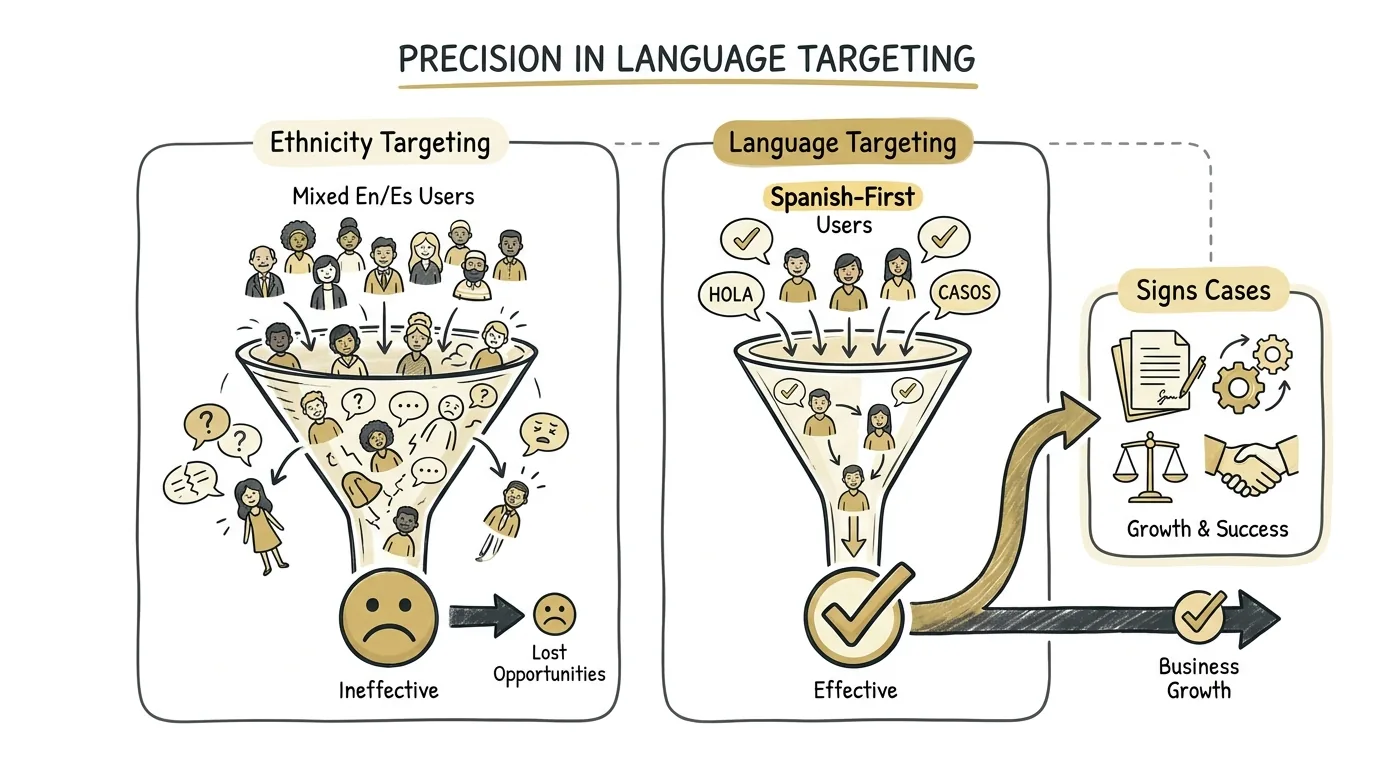
Audience Settings That Work
Build the audience around three layers:
- Language: Spanish. This reaches users who consume Spanish-language content, including bilingual users who default to Spanish for injury-related decisions.
- Geography: zip-code level. Spanish-speaking prospects cluster in specific neighborhoods. A tight radius around dense zip codes outperforms metro-wide targeting and lowers cost per qualified lead.
- Lookalikes from your own clients. Upload your list of Spanish-speaking signed clients and build a 1 percent lookalike. A lookalike of converted Spanish MVA clients beats any cold interest stack.
Why This Beats Broad Targeting
Narrow, language-led audiences feed Meta a cleaner signal about who actually signs, which compounds over time as the algorithm learns. This is the same audience-quality discipline a focused personal injury marketing agency applies before a single dollar of creative goes live. Precision up front is what makes the cost advantage durable rather than a one-month fluke.
Transcreated Creative: How Spanish Ads Should Actually Sound
A translated ad takes English copy and swaps the words. A transcreated ad starts from how Spanish-speaking MVA prospects describe a crash, what builds confianza (trust), and which fears keep them from calling. The difference shows up directly in click-through and conversion rates.
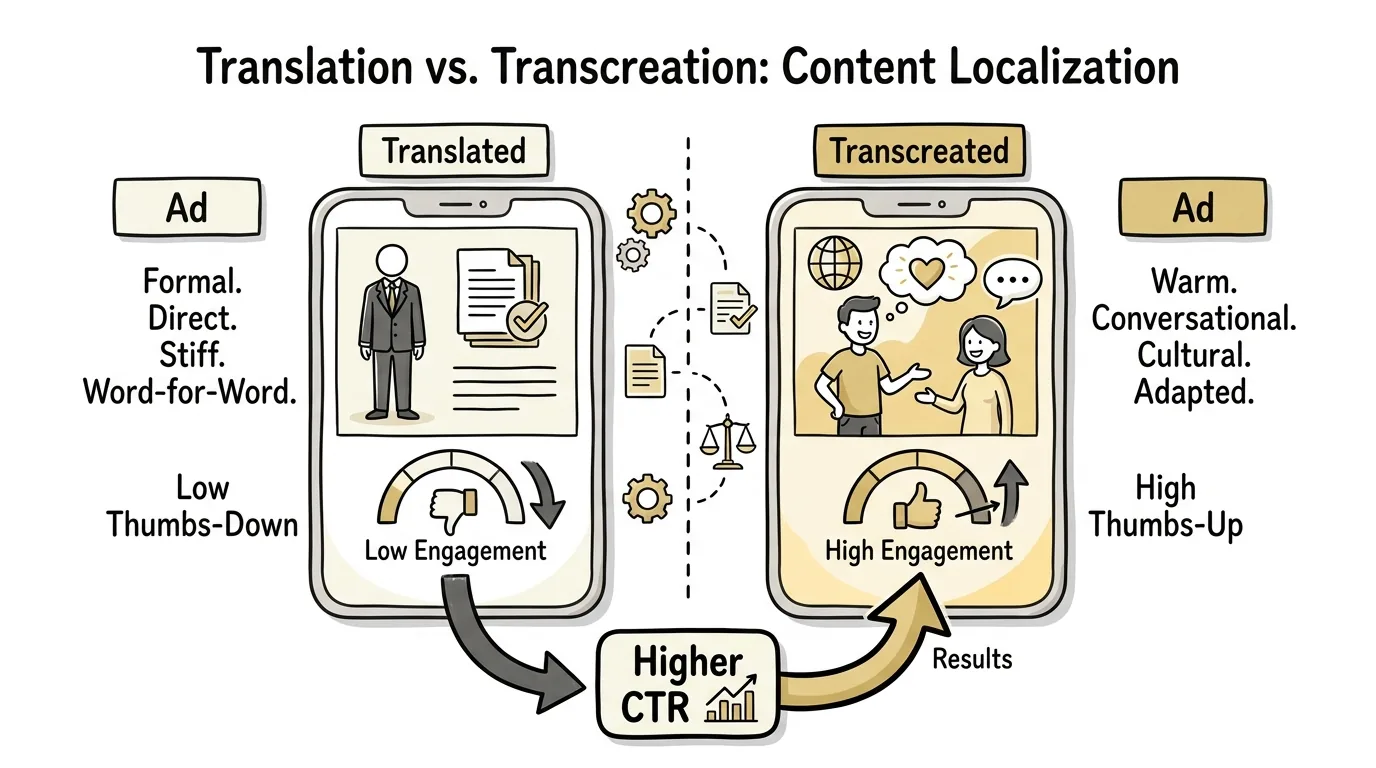
Strong Spanish Meta creative for personal injury follows a few rules:
- Use video, 15 to 30 seconds, with a Spanish-speaking attorney or paralegal talking directly to camera. Community-style, authentic video beats polished studio production in this market.
- Address the viewer as "tu," not "usted." Conversational Spanish signals community membership, which outweighs a formal display of legal expertise.
- Name the specific injury (accidente de auto, accidente de camion, resbalon y caida) so the prospect recognizes their situation immediately.
- Preempt the immigration fear. "Tu estatus migratorio no importa" is one of the highest-converting phrases in this market because it removes the silent reason many prospects never call.
- Close with a low-pressure call to action, such as "Llama ahora, es gratis y sin compromiso."
"The firms that win in Spanish are not the ones with the biggest budgets, they are the ones whose creative sounds like a neighbor, not a billboard," says Rafael Hernandez, Founder and CEO of Great Marketing AI, a personal injury law firm marketing agency that specializes in spanish motor vehicle accident leads. "Transcreation is the cheapest performance lever most firms never pull."
Lead Forms vs Spanish Landing Pages
Once the click happens, the question is where to send it. For cold Spanish Meta traffic on mobile, Facebook instant lead forms usually convert at a higher rate because the form opens inside the app and can pre-fill profile data, which removes friction at the exact moment of intent. The risk is lead quality, so the qualifying questions do the filtering.
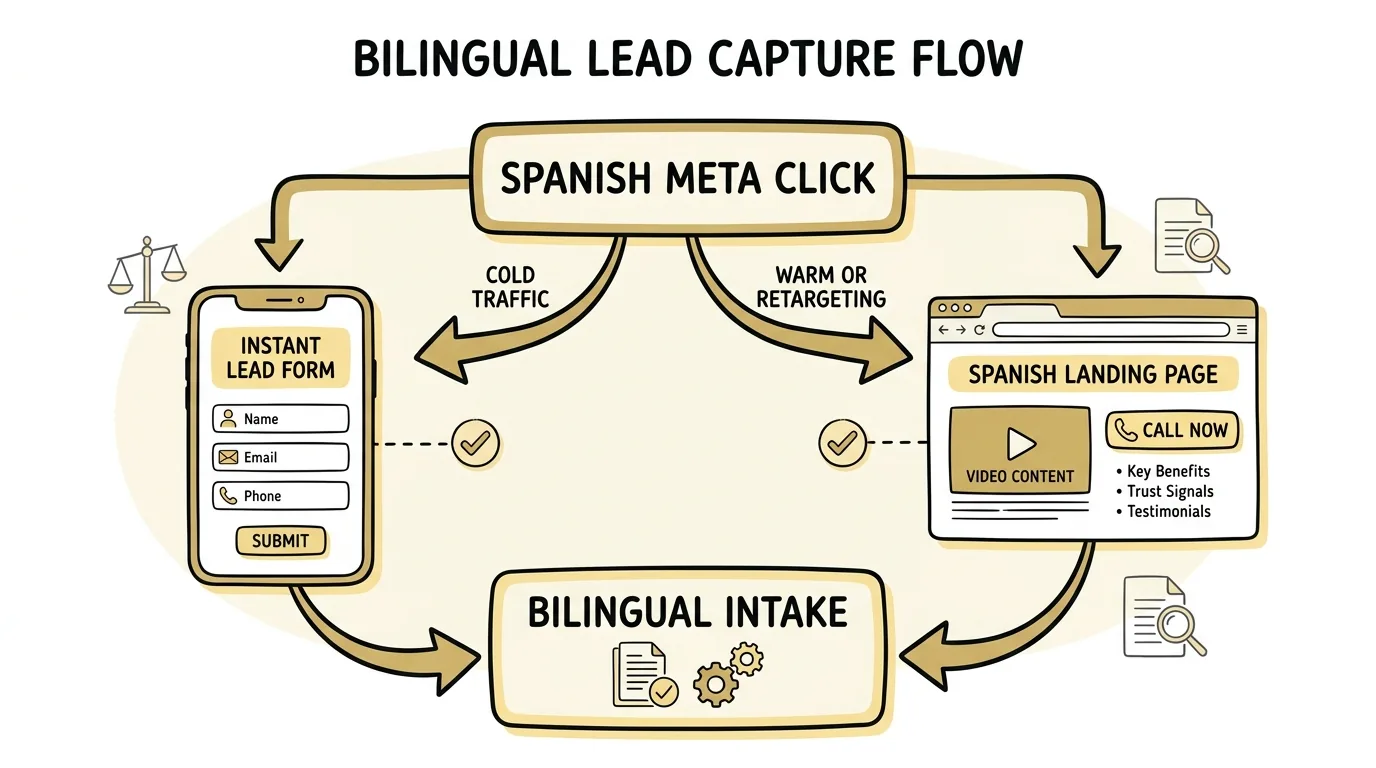
The table below shows when each option fits a Spanish personal injury campaign.
| Factor | Instant Lead Form | Spanish Landing Page |
|---|---|---|
| Best traffic type | Cold prospecting | Retargeting, higher-intent |
| Mobile friction | Lowest (opens in app) | Higher (page load, scroll) |
| Lead quality control | Qualifying questions in Spanish | Form fields plus on-page proof |
| Trust building | Limited | Strong (video, reviews, attorney) |
| Tracking | Native Meta plus Conversion API | Pixel, Conversion API, call tracking |
| Setup effort | Lower | Higher |
Two rules apply to both. First, every field, question, and confirmation must be in Spanish; a Spanish ad that lands on an English form quietly kills your conversion rate. Second, a Spanish landing page should carry the same five elements that convert across the channel: a Spanish headline naming the injury and city, a click-to-call button above the fold, a three-field form, the immigration-status reassurance, and a short video of the attorney speaking Spanish. Firms that run both typically use lead forms to prospect and a Spanish landing page to retarget. For the lead-form-versus-landing-page mechanics across all law firm campaigns, see our Facebook ads for personal injury lawyers service page.
Tracking That Survives iOS: The Meta Conversion API
Most Spanish campaigns that "fail" did not fail at the ad. They failed at measurement. After Apple's App Tracking Transparency changes, browser-based pixel tracking misses a meaningful share of conversions, which both starves Meta's algorithm of optimization signal and makes your reported cost per lead inaccurate (Meta on the Conversions API).
The fix is the Meta Conversion API (CAPI), which sends conversion events server-side so the platform sees qualified-lead and signed-case events even when the pixel cannot. For Spanish campaigns this matters more, not less, because you are optimizing toward a smaller, more specific audience and cannot afford to feed the algorithm half the picture.
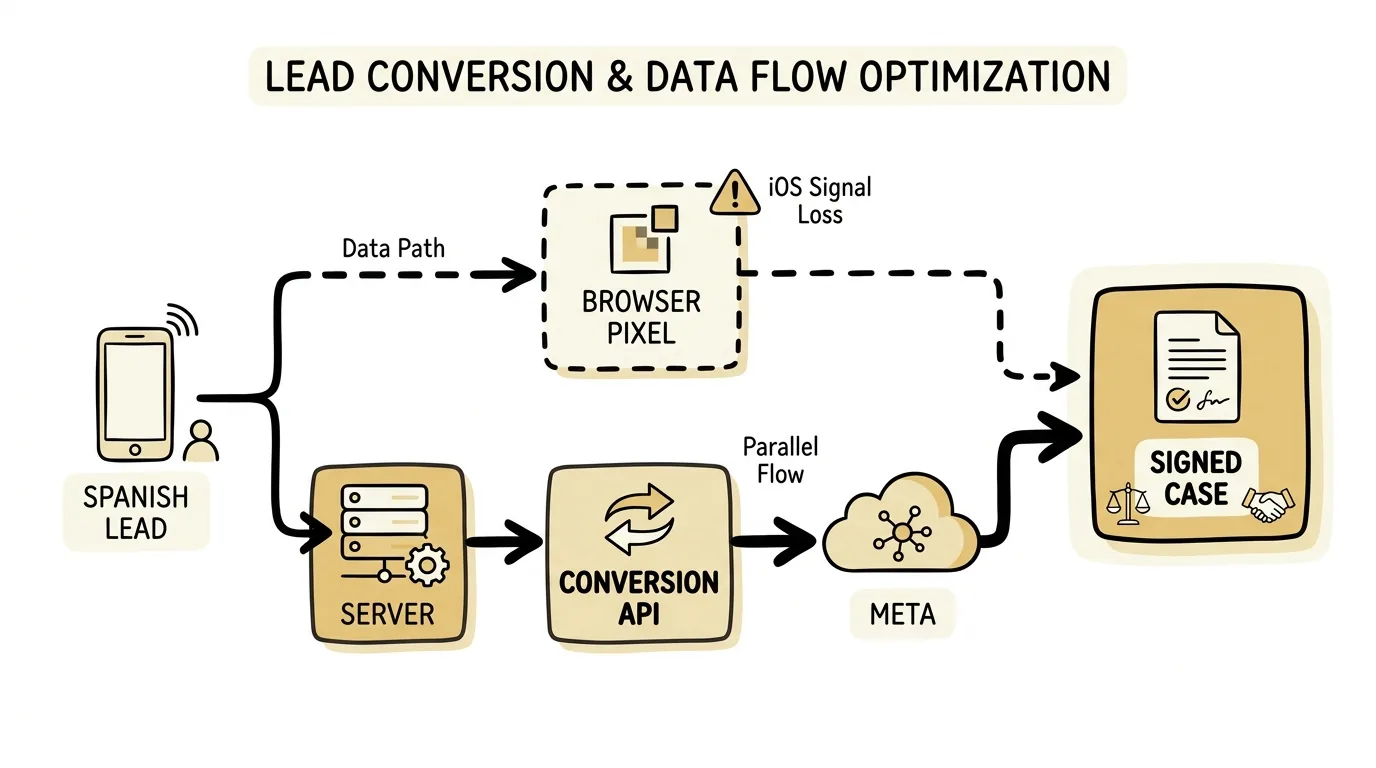
The discipline that separates profitable Spanish campaigns:
- Optimize toward signed cases, not raw form fills. Pass a qualified-lead or retained-case event back through CAPI so Meta chases buyers, not browsers.
- Map the language preference into your CRM at first contact, so follow-up text and intake stay in Spanish.
- Reconcile platform numbers against your CRM monthly. The only honest metric is cost per signed case.
This is also where most "I don't know my cost per case" pain gets solved. Transparent reporting from ad spend all the way to a signed retainer is the difference between a media buy you can scale and one you keep restarting. It is the same tracking architecture our pay-per-lead and managed media-buy clients run, and the firm owns the pixel, the CAPI setup, and the data.
Budget, Scaling, and What Firms Get Wrong
A realistic starting point is a 5,000 dollar test budget over 30 days, enough to validate one or two transcreated creatives against a language-led audience before scaling. Hold spend steady for at least a week so the algorithm exits the learning phase, then scale the winning ad set by 20 percent every few days rather than doubling overnight, which resets learning.
Two failure patterns are worth naming, because they answer the objections firms raise most:
- "The leads don't sign." Usually a qualification and intake problem, not a traffic problem. Tighten the Spanish lead-form questions and answer in Spanish within 60 seconds. Optimizing to signed-case events through CAPI pushes the whole system toward leads that close.
- "I already get cases cheaper through referrals or radio." Referrals do not scale and radio is hard to track. Spanish Meta adds predictable, trackable case flow on top of what already works, and it can run alongside the radio brand-awareness play covered in the pillar.
If the goal is to evaluate whether to run this in-house or with a partner, the deciding factor is whether you can build transcreated creative, Spanish intake, and CAPI tracking as one system rather than three side projects. Firms weighing a specialist can explore our motor vehicle accident leads service, which is built specifically for this model.
How Great Marketing AI Runs Spanish MVA Media Buys
A fair question from any firm owner is how the agency gets paid and what protects the firm's downside. Great Marketing AI runs Spanish Meta campaigns as a transparent media buy: the firm funds the ad spend, the agency manages it for a flat management fee with no hidden markup on clicks, and the firm owns the ad account, the funnel, and the Conversion API tracking.
To match different risk appetites, every engagement presents three models so the firm chooses its exposure: a raw lead at 350 dollars, a live transfer at 1,500 dollars, and a signed retainer at 3,250 to 3,500 dollars. The signed-retainer tier exists specifically for firms that have been burned before and want their downside removed.
The specialization is the point. This is a personal injury and Spanish-MVA focus, not a generalist agency adding a Spanish line item, and campaigns are built around signed cases with Meta Conversion API tracking rather than vanity reach. When you are ready to scope a campaign for your market, talk to an expert and we will map cost per signed case before you spend a dollar.
Conclusion
Spanish Facebook ads for personal injury lawyers are not a niche add-on. In any market with a meaningful Latino population, they are one of the cheapest ways to add signed MVA cases, because the auction is less crowded and the audience is underserved. The advantage is real and measurable, and it belongs to the firms that build the full system: language-led targeting, transcreated creative, a Spanish lead form or landing page, and Meta Conversion API tracking tied to signed cases.
The leak is almost never the ad. It is an English form behind a Spanish ad, or an English-first intake team behind a Spanish form. Match the language end to end, measure cost per signed case, and the math works. The window is open. Build the system now, and if you want it built for you, book a call with a team that does only this.
Turn Ad Spend Into Signed Cases
We blend AI-driven testing with proven performance strategy to attract qualified traffic and turn it into revenue—fast, trackable, and scalable.
- PI Lead Generation — exclusive, AI-qualified leads across MVA, slip & fall, med mal, and more.
- Facebook & Instagram Ads — reach customers where they scroll.
- Google Ads — capture people actively searching for you.
- Website Design — turn visitors into buyers with high-converting sites.
- AI Automations — save hours and never miss a follow-up.
- Email Marketing — nurture leads and close sales on autopilot.
- SEO — get found by customers searching for what you sell.
FAQs

About the author
Rafael Hernandez
CEO and Co-Founder of Great Marketing AI
Rafael Hernandez is the Founder of Great Marketing AI and a former Microsoft Engineer. He specializes in performance marketing for personal injury law firms, managing over $10M in ad spend to help attorneys generate signed cases across every PI case type. His strategies focus on exclusive lead generation, AI-powered qualification, and eliminating wasted budget.
About Great Marketing AI
Great Marketing AI: Performance marketing for personal injury law firms
We help personal injury law firms scale with exclusive, AI-qualified leads across every PI case type: MVA, slip & fall, medical malpractice, and wrongful death. Native English and Spanish campaigns, enterprise-grade Meta + Google ad management, and AI lead qualification before every intake.
100% Exclusive Leads
Never shared between firms. Territory-protected.
Native Spanish & English Campaigns
Built by native speakers, not Google Translate.
AI Lead Qualification
Pre-qualified before they ever reach your intake team.