Law Firm Branding: How to Build a Brand That Signs More Cases in 2026
A 2026 guide to law firm branding for personal injury firms: positioning, visual identity, messaging, trust signals, and the bilingual edge that signs more cases.

Rafael Hernandez
CEO and Co-Founder of Great Marketing AI


I hope you find this useful. If you want our team to run your law firm's performance marketing, book a strategy call.
Author: Rafael Hernandez | CEO and Co-Founder of Great Marketing AI
Key Takeaways
- Law firm branding is the system of positioning, visual identity, messaging, and trust signals that makes a prospect choose your firm before they ever call. For a personal injury firm it is a case-acquisition lever, not a vanity project.
- Consistency is where the money is. Lucidpress and Marq research found consistent brand presentation can raise revenue by up to 33%, and Nielsen reports 59% of consumers prefer brands they already recognize.
- Differentiation is the hardest part. The American Bar Association found 59% of attorneys name standing out as a top marketing challenge, and only about 26% of lawyers feel confident in their branding.
- Trust signals convert paid traffic. Thomson Reuters found 82% of people who found an attorney online relied on reviews, so your brand decides whether the leads you already pay for convert or bounce.
- Bilingual branding is an unfair advantage in personal injury. A native English and Spanish brand built for Hispanic motor vehicle accident claimants wins cases that English-only firms never see.
Law firm branding is the deliberate system of positioning, visual identity, messaging, and trust signals that makes a prospect choose your firm before they ever pick up the phone. For a personal injury practice, it is not a vanity exercise or a logo refresh. It is a case-acquisition lever. When a car accident victim searches for help, they meet a row of firms that all promise the same thing, and they filter you in or out based on how trustworthy, professional, and relevant you look in the first few seconds.
The stakes are concrete. Thomson Reuters research summarized by Clio found that 82% of people who contacted an attorney they discovered online relied on reviews to decide, and Nielsen reports that 59% of consumers prefer brands they already recognize. In personal injury, where a single click can cost more than 100 dollars in competitive markets, branding is what turns that expensive click into a signed case instead of a bounce. A strong brand converts the leads you already pay for at a higher rate, which lowers your cost per signed case without spending another dollar on ads.
This guide covers what law firm branding actually involves for personal injury firms: how to position your practice, build a consistent visual identity and message, layer in trust signals that convert, and use bilingual branding as a differentiator most competitors ignore. Treat legal branding as a revenue system tied to signed cases, and it pays for itself.
Key Takeaways
- Law firm branding is the system of positioning, visual identity, messaging, and trust signals that makes a prospect choose your firm before they ever call. For a personal injury firm it is a case-acquisition lever, not a vanity project.
- Consistency is where the money is. Lucidpress and Marq research found consistent brand presentation can raise revenue by up to 33%, and Nielsen reports 59% of consumers prefer brands they already recognize.
- Differentiation is the hardest part. The American Bar Association found 59% of attorneys name standing out as a top marketing challenge, and only about 26% of lawyers feel confident in their branding.
- Trust signals convert paid traffic. Thomson Reuters found 82% of people who found an attorney online relied on reviews, so your brand decides whether the leads you already pay for convert or bounce.
- Bilingual branding is an unfair advantage in personal injury. A native English and Spanish brand built for Hispanic motor vehicle accident claimants wins cases that English-only firms never see.
What Law Firm Branding Actually Is
Law firm branding is the perception a prospect forms about your firm, and the deliberate system you build to shape it. It is not your logo alone. A logo is a single sign on a building; the brand is the whole building. The system has five parts: positioning (who you serve and why you are different), messaging and tone (what you say and how you say it), visual identity (logo, colors, typography, photography), trust signals (reviews, results, credentials), and the consistency that ties all of it together across every place a prospect meets you.
For personal injury firms, this distinction is the whole point of law firm branding, because the temptation is to spend on a pretty logo and stop there. A great mark on a generic, inconsistent firm signs few cases. A clear position backed by consistent messaging and real proof signs cases even with a modest logo. When you treat legal branding as a system rather than a symbol, it becomes the most durable lever in your law firm marketing strategy, because competitors can copy your ads overnight but not your reputation.
Why Branding Is a Case-Acquisition Lever, Not a Vanity Metric
Personal injury is among the most expensive advertising categories in the United States, with click costs frequently above 100 dollars in major metros. When dozens of firms bid on the same keywords and run nearly identical ads, branding for lawyers is what breaks the tie. Two firms can spend the same and get the same traffic, yet one signs twice as many cases because prospects trust it more, and that gap is what good law firm branding is built to close.
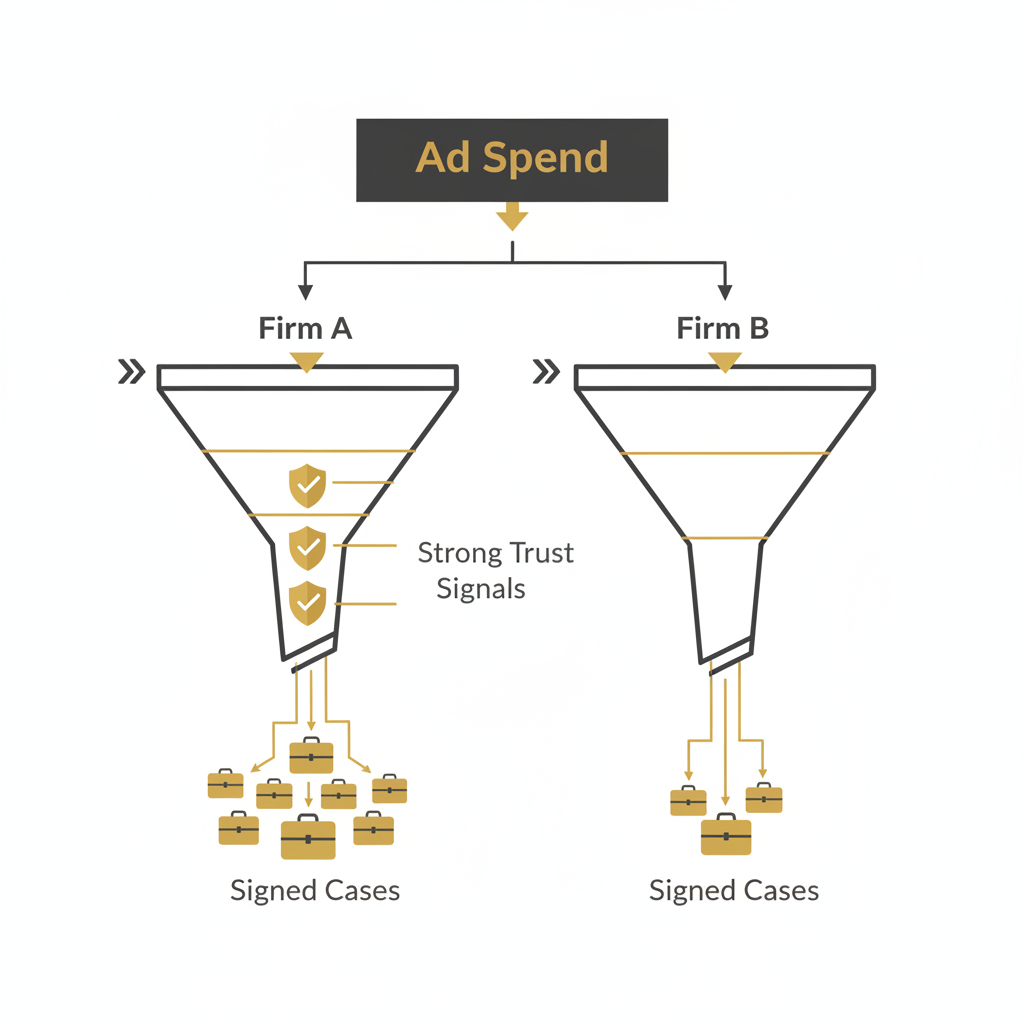
The economics are straightforward. Branding does not add clicks; it raises the rate at which clicks become clients. If law firm branding lifts your lead-to-signed-case conversion from 8% to 12%, you sign 50% more cases on the same budget. That is why we measure branding by cost per signed case, the same metric we use for every channel. According to a study covered by PR Newswire, consistent brand presentation can increase revenue by up to 33%, which in a firm is simply the compounding effect of converting more of the traffic you already buy. To go deeper on the firms that win this game, see how the biggest law firms in New York built recognizable brands.
Step 1: Nail Your Positioning and Differentiation
Positioning is the single hardest and most valuable part of legal branding. As Rocket Matter reports, the American Bar Association found that 59% of attorneys cite differentiation as a top marketing challenge, and a LexisNexis study found only about 26% of lawyers feel confident in their branding. That gap is your opportunity. Most firms say the same things: experienced, aggressive, no fee unless we win. When everyone sounds identical, the prospect cannot tell you apart, so they default to whoever looks safest or shows up first.
Strong positioning answers three questions in plain language: who exactly do you serve, what specific outcome do you deliver, and why are you the obvious choice for that person. A firm that positions itself as the go-to motor vehicle accident practice for Spanish-speaking families in its market will out-convert a generalist firm that serves everyone and stands for nothing. Narrow beats broad in personal injury because the prospect feels understood. Once your position is clear, every other branding decision, from colors to copy, becomes easy because you have a north star to test against.
Step 2: Build a Consistent Visual Identity and Message
Once positioning is set, build the visible layer of law firm brand identity: logo, color palette, typography, photography style, and a clear message architecture (your core promise, supporting proof points, and tone of voice). The objective is recognition and trust, not artistic awards. Pick a palette and type system that feel credible and human for your audience, then document them so every asset matches.
Consistency is where most firms leak value. The Lucidpress and Marq State of Brand Consistency research, based on surveys of more than 400 organizations, links consistent presentation to revenue gains of 10 to 20% and up to 33% in stronger cases. In practice that means your website, Google ads, Facebook ads, intake scripts, email signatures, and social profiles all look and sound like the same firm. A prospect who sees your ad, clicks to your site, then reads your reviews should feel one continuous experience. Consistent attorney branding is also how you compound brand recognition over time, which Nielsen confirms drives preference: 59% of consumers favor brands they already know.
Step 3: Layer In Trust Signals That Convert
Trust signals are the proof that turns interest into action, and in personal injury they are the most underrated part of branding for law firms. As Clio's branding research notes, 82% of people who contacted an attorney they found online relied on reviews, and 40% said reviews were their primary deciding factor. Your brand promise is only as strong as the evidence behind it.
This is the part of law firm branding that most directly affects revenue. The trust signals that move personal injury prospects are concrete: a high and recent Google review rating, real case results stated within ethics rules, recognizable credentials and bar memberships, professional photography of real attorneys rather than stock images, and clear contact and intake options. Each one reduces the perceived risk of choosing you. Reviews deserve special attention because they compound, which is why we treat lawyer reputation management as a core branding discipline rather than an afterthought. According to BrightLocal consumer review research, roughly 98% of consumers read reviews before choosing a local business. A firm with a clear position, consistent look, and strong proof signs cases that an equally-funded but trust-light competitor never will.
Step 4: Use Bilingual Branding as Your Unfair Advantage
The single most powerful branding move available to most personal injury firms is one almost no one executes well: building a genuinely bilingual brand. The Hispanic and Spanish-speaking population is large, growing, and disproportionately affected by motor vehicle accidents, yet most firms either ignore it or translate their English ads word for word, which reads as inauthentic to native speakers.

A true bilingual brand has a Spanish voice, Spanish-native visual cues, and trust signals tailored to the community, not a translated afterthought. This is exactly where a specialist agency earns its keep, and it is the foundation of our motor vehicle accident leads program. As Rafael Hernandez, Founder and CEO of Great Marketing AI, puts it: "In personal injury, a brand that speaks to Spanish-speaking families the way they actually talk and trust is the closest thing to an unfair advantage. It signs cases your English-only competitors never even see." Bilingual branding is durable because it is hard to copy and it compounds: every satisfied Spanish-speaking client becomes a referral engine inside a tight-knit community. For the deeper playbook, see our guide on marketing to Hispanic personal injury clients.
Law Firm Branding Approaches Compared
Not every branding approach delivers the same return for a personal injury firm. The table below compares the three paths most firms consider, scored on what actually matters: cost, speed to results, and impact on signed cases.
| Approach | Upfront Cost | Time to Impact | Differentiation | Effect on Cost Per Signed Case |
|---|---|---|---|---|
| DIY logo and template site | Low | Fast | Very low | Minimal, often raises it |
| Generalist branding agency | Medium to high | Moderate | Low to medium | Modest improvement |
| PI specialist with bilingual brand | Medium | Moderate | High | Strong reduction |
| No deliberate branding | None | None | None | Highest, you compete on luck |
The pattern is clear. A polished logo from a template does little if your positioning and trust signals are generic. A generalist agency improves the visuals but rarely understands personal injury or the Spanish-speaking market. The strongest return comes from a specialist that builds positioning, consistency, trust signals, and bilingual capability as one system tied to signed cases. If you are weighing whether to build this in-house or hire help, our guide on how to choose a marketing agency walks through the trade-offs, and you can also reach our team directly through Great Marketing AI when you are ready to map your brand to a case-acquisition plan.
Conclusion: Brand for Signed Cases, Not Applause
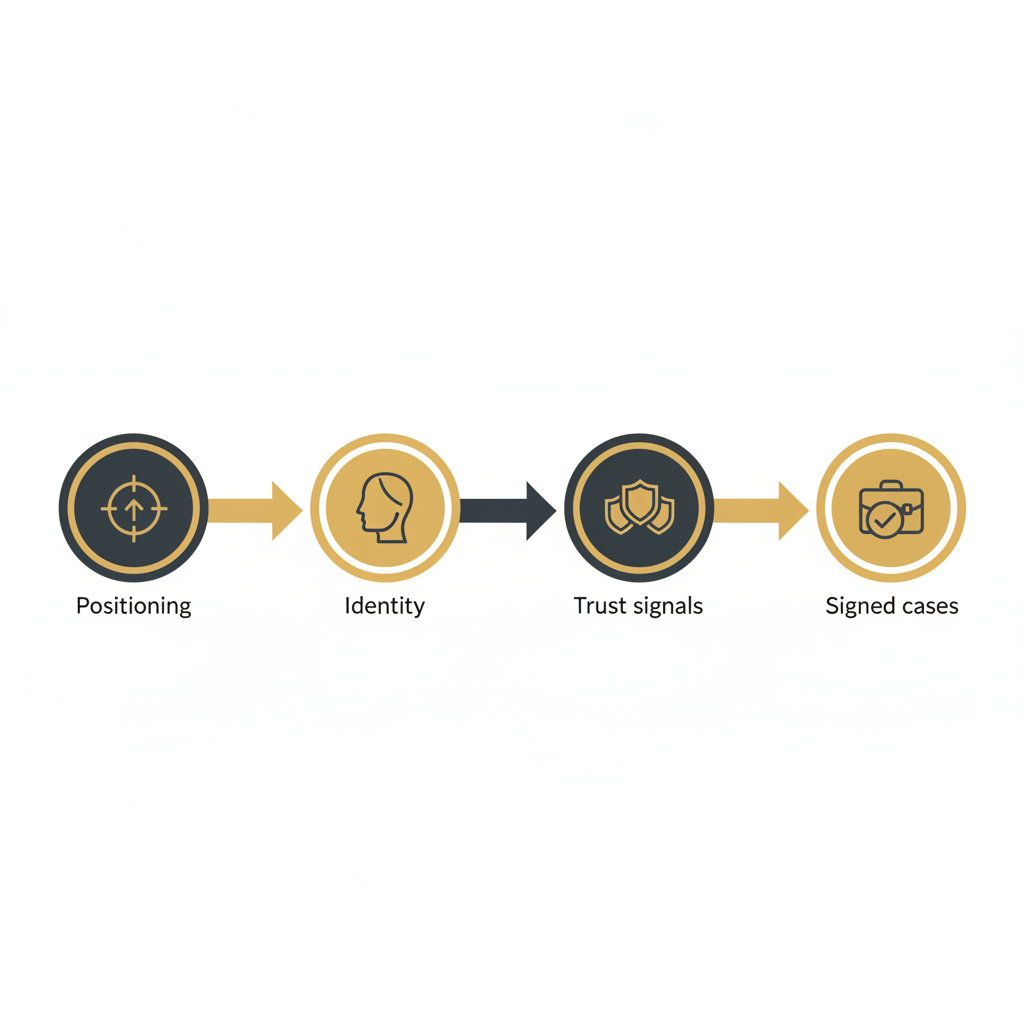
Law firm branding works when you treat it as a revenue system, not a design project. Start with sharp positioning that makes you the obvious choice for a specific client, build a consistent visual identity and message that compounds recognition, layer in the trust signals that convert expensive clicks into clients, and, if you serve Hispanic communities, build a genuinely bilingual brand that competitors cannot copy. Measure all of it the way you measure every channel: by signed cases and cost per signed case.
The firms that win in 2026 are not the ones with the prettiest logos. They are the ones whose brand makes a prospect feel understood and safe in the first few seconds, then backs that feeling with proof. When you build legal branding as a system rather than a symbol, every advertising dollar you already spend works harder, and your brand becomes the durable advantage no competitor can outbid. When you are ready to turn your brand into signed cases, book a call with our team and we will map your positioning, identity, and trust signals to a measurable plan.
Turn Ad Spend Into Signed Cases
We blend AI-driven testing with proven performance strategy to attract qualified traffic and turn it into revenue—fast, trackable, and scalable.
- PI Lead Generation — exclusive, AI-qualified leads across MVA, slip & fall, med mal, and more.
- Facebook & Instagram Ads — reach customers where they scroll.
- Google Ads — capture people actively searching for you.
- Website Design — turn visitors into buyers with high-converting sites.
- AI Automations — save hours and never miss a follow-up.
- Email Marketing — nurture leads and close sales on autopilot.
- SEO — get found by customers searching for what you sell.
FAQs

About the author
Rafael Hernandez
CEO and Co-Founder of Great Marketing AI
Rafael Hernandez is the Founder of Great Marketing AI and a former Microsoft Engineer. He specializes in performance marketing for personal injury law firms, managing over $10M in ad spend to help attorneys generate signed cases across every PI case type. His strategies focus on exclusive lead generation, AI-powered qualification, and eliminating wasted budget.
About Great Marketing AI
Great Marketing AI: Performance marketing for personal injury law firms
We help personal injury law firms scale with exclusive, AI-qualified leads across every PI case type: MVA, slip & fall, medical malpractice, and wrongful death. Native English and Spanish campaigns, enterprise-grade Meta + Google ad management, and AI lead qualification before every intake.
100% Exclusive Leads
Never shared between firms. Territory-protected.
Native Spanish & English Campaigns
Built by native speakers, not Google Translate.
AI Lead Qualification
Pre-qualified before they ever reach your intake team.