Law Firm PPC Strategy: How to Get Personal Injury Cases from Paid Search in 2026
A complete law firm PPC strategy for personal injury firms. Budget allocation, PI keyword targeting, negative keywords, CPL math, and bidding tactics that sign cases.

Rafael Hernandez
CEO and Co-Founder of Great Marketing AI


I hope you find this useful. If you want our team to run your law firm's performance marketing, book a strategy call.
Author: Rafael Hernandez | CEO and Co-Founder of Great Marketing AI
Key Takeaways
- A winning law firm PPC strategy starts with PI-specific keyword segmentation. Injury-type keywords (car accident attorney, slip and fall lawyer) convert at 2 to 4 times the rate of broad practice-area terms.
- Your acceptable cost per lead comes from case value math, not industry benchmarks. A firm settling cases at $75,000 average can profitably spend $500 to $800 per lead.
- Negative keyword lists are the single highest-ROI action in law firm PPC. A comprehensive list built in week one saves 20 to 40 percent of wasted spend before it leaves your account.
- Budget allocation for a $10,000 monthly PPC for lawyers budget should favor Google Search (60 percent), Local Service Ads (25 percent), and Display/Remarketing (15 percent).
- Intake speed is the hidden conversion lever. Responding within 5 minutes increases contact rate by 900 percent compared to a 30-minute response, per Velocify research.
Last Updated: June 23, 2026
A law firm PPC strategy is the structured system a personal injury firm uses to acquire paid search traffic, convert it into signed cases, and generate a positive return on ad spend. It covers which keywords to target, how to bid, how to allocate budget across Google Search and Local Service Ads, and how to calculate the maximum cost per lead your practice can sustain profitably.
In 2026, PI firms spend an estimated $1.2 billion annually on Google Ads, making legal services one of the most competitive PPC verticals in the US. According to 2026 legal CPC benchmark data from ROA Marketing, top US metros routinely see $250 to $400 per click for terms like "personal injury lawyer near me" and "car accident attorney." Firms that profit from this environment win on precision, not budget size.
In short: A law firm PPC strategy succeeds when you calculate your acceptable CPL from case economics, build a three-tier PI keyword architecture, run negative keywords from day one, and align your bidding phase to campaign maturity. The five steps below cover each element.
Step 1: Calculate Your Acceptable CPL Before You Spend a Dollar
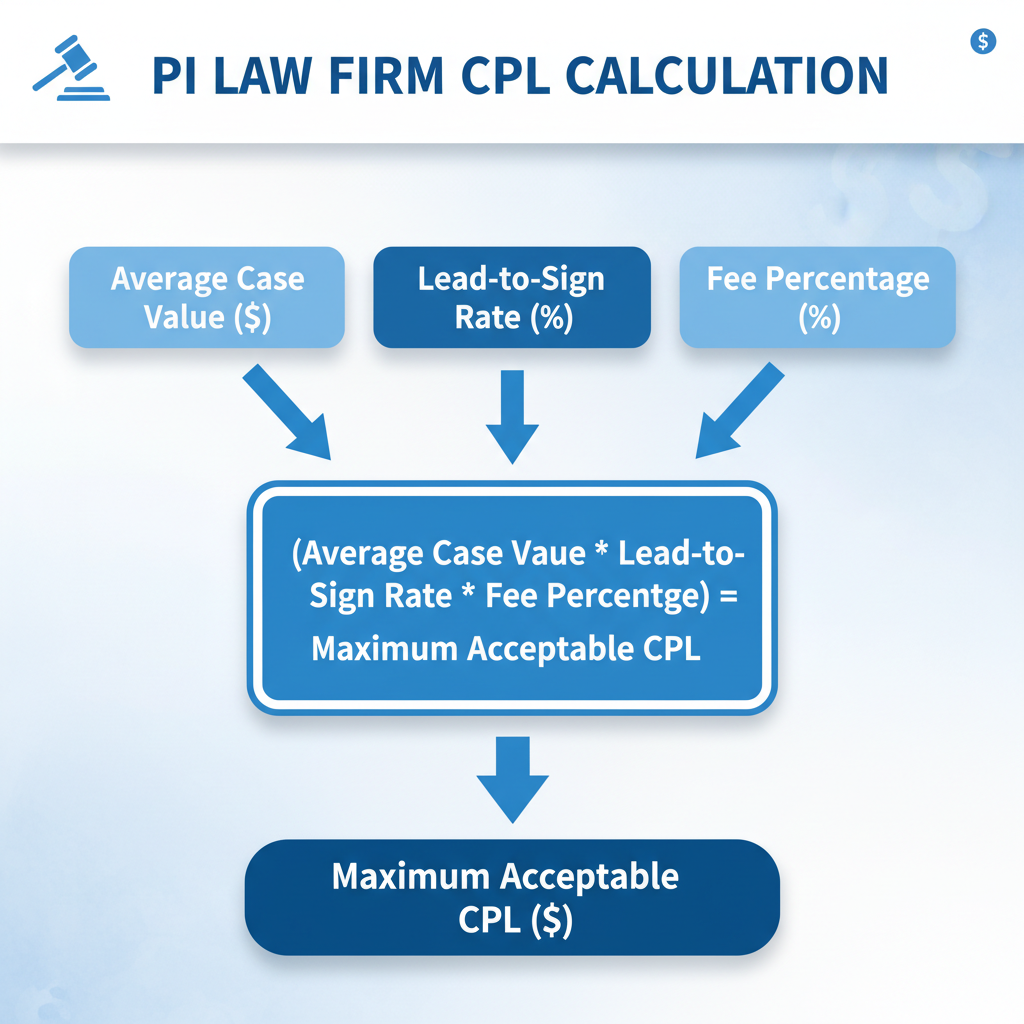
Most law firm ppc campaigns fail because firms set CPL targets by copying industry averages instead of calculating from their own case economics. The correct formula is:
Acceptable CPL = Average Case Value x Close Rate x Fee Percentage
A real example: Average settlement $85,000, close rate 8 percent, contingency fee 33 percent. Revenue per lead: $85,000 x 0.08 x 0.33 = $2,244. At a 10:1 ROAS target, your acceptable CPL is $224.
Well-run personal injury campaigns in mid-size markets typically achieve a cost per signed case between $1,500 and $3,000 when CPL is controlled and intake speed is high. Campaigns above that range are typically losing on keyword selection, intake speed, or landing page alignment, not on bid strategy.
Running campaigns for PI firms across California, Texas, and Florida, the most common failure I see is applying a $200 CPL target to markets where CPL sits at $350. Once firms recalculate from case value rather than benchmarks, profitable campaigns often already exist at current spend levels.
Step 2: PI-Specific Keyword Segmentation
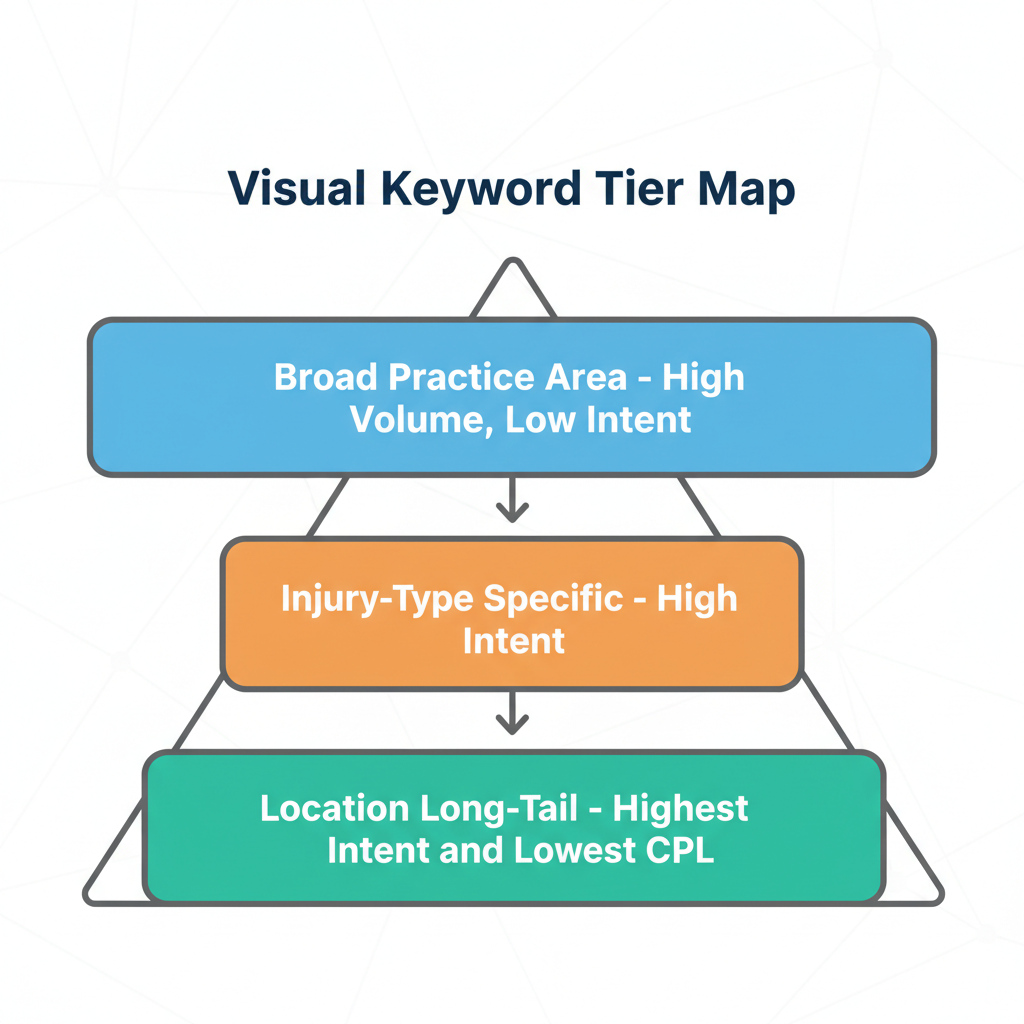
Google ads for law firms covering personal injury require a different keyword architecture than generic PPC guides describe. Segment PI keywords into three tiers and bid accordingly.
Tier 1: Injury-Type Specific (Highest Priority) Car accident attorney [city], truck accident lawyer [city], slip and fall attorney [city], motorcycle accident lawyer [city]. These convert at 2 to 4 times the rate of practice-area terms because the searcher already knows what happened and is ready to hire.
Tier 2: Location-Modified Practice Area (Medium Priority) Personal injury lawyer near me, personal injury attorney [city], best personal injury lawyer [city].
Tier 3: Commercial Modifier Long-Tail (Selective) Top rated car accident attorney [city], free car accident lawyer consultation [city].
Use exact match for Tier 1, phrase match for Tier 2, and exact match for Tier 3. Run Tier 1 in separate campaigns from Tier 2 so you can control bidding independently. Injury-type keywords consistently outperform broad practice-area terms on both click-through rate and conversion rate. When the searcher has already identified what happened to them, every element of the ad, from headline to landing page headline, can be tailored to that specific incident, which drives higher quality scores and lower CPCs across the entire account.
"The firms that scale PI paid search profitably are the ones that give every injury type its own campaign before they spend a dollar. Generic campaigns cannot optimize to the conversion signal of a specific injury, and the quality score penalty bleeds into every keyword in the account," says Rafael Hernandez, CEO and Co-Founder of Great Marketing AI.
For a comprehensive Google Ads strategy for law firms, the pillar guide covers budget tiers, smart bidding, and ROI tracking in full detail.
Step 3: Build Your Negative Keyword List First
Negative keywords are where law firm ppc campaigns win or lose in the first 90 days. Build negatives in four universal categories:
Job Seeker and Education Terms (Day 1): law school, paralegal jobs, attorney salary, how to become a lawyer, bar exam, LSAT
DIY Legal Research Terms (Day 1): free legal advice, how to sue, small claims court, legal forms, pro se, do I need a lawyer
Unrelated Practice Areas (Day 1, based on your firm): criminal defense lawyer, divorce attorney, bankruptcy attorney, immigration lawyer if you practice PI only
Research Intent Modifiers (Week 2): what is, definition of, history of, wikipedia, documentary, book about
After Day 30, review your Search Terms report and add non-converting queries weekly. Most PI firms add 200 to 400 negatives in the first 90 days. Legal PPC analysts at Negator estimate that most personal injury firms waste 30 to 40 percent of their ad budget on research queries that never convert, and weekly Search Terms audits eliminate the majority of this waste within the first 90 days.
A law firm digital marketing agency managing PPC accounts daily catches wasted queries far faster than firms reviewing campaigns monthly. Negative keyword iteration speed directly determines how quickly campaigns reach target CPL.
Step 4: Platform Comparison and Budget Allocation
For PI firms running ppc for lawyers across multiple paid channels, understanding the trade-offs between Google Search, LSA, and Display determines whether your budget works as a system or as isolated, competing campaigns.
| Platform | Pricing Model | Best For PI Firms | Typical CPL | Control |
|---|---|---|---|---|
| Google Search Ads | Pay-per-click | High-intent injury keywords, retargeting | $150-$500 | High |
| Google Local Service Ads | Pay-per-lead | Google Screened badge, local searches | $100-$300 | Low |
| Google Display / Remarketing | Pay-per-click | Re-engaging site visitors | $300-$800 | Medium |
| Microsoft/Bing Ads | Pay-per-click | Older demographic, 30-40% lower CPC | $80-$250 | High |
Recommended allocation for a $10,000 monthly PI PPC budget:
- Google Search Ads: $6,000 (60 percent) - highest intent, most direct path to signed cases
- Google Local Service Ads: $2,500 (25 percent) - pay-per-lead pricing protects against click fraud
- Display / Remarketing: $1,500 (15 percent) - recaptures visitors who did not convert
Google Local Service Ads offer pay-per-lead pricing and a Google Screened badge, making them a strong complement to Search Ads for high-intent local queries. The platform guide covers LSA setup, verification, and bid management in detail, including how to optimize your Google Screened profile for higher call volume.
Step 5: Bidding Strategy and Intake Alignment
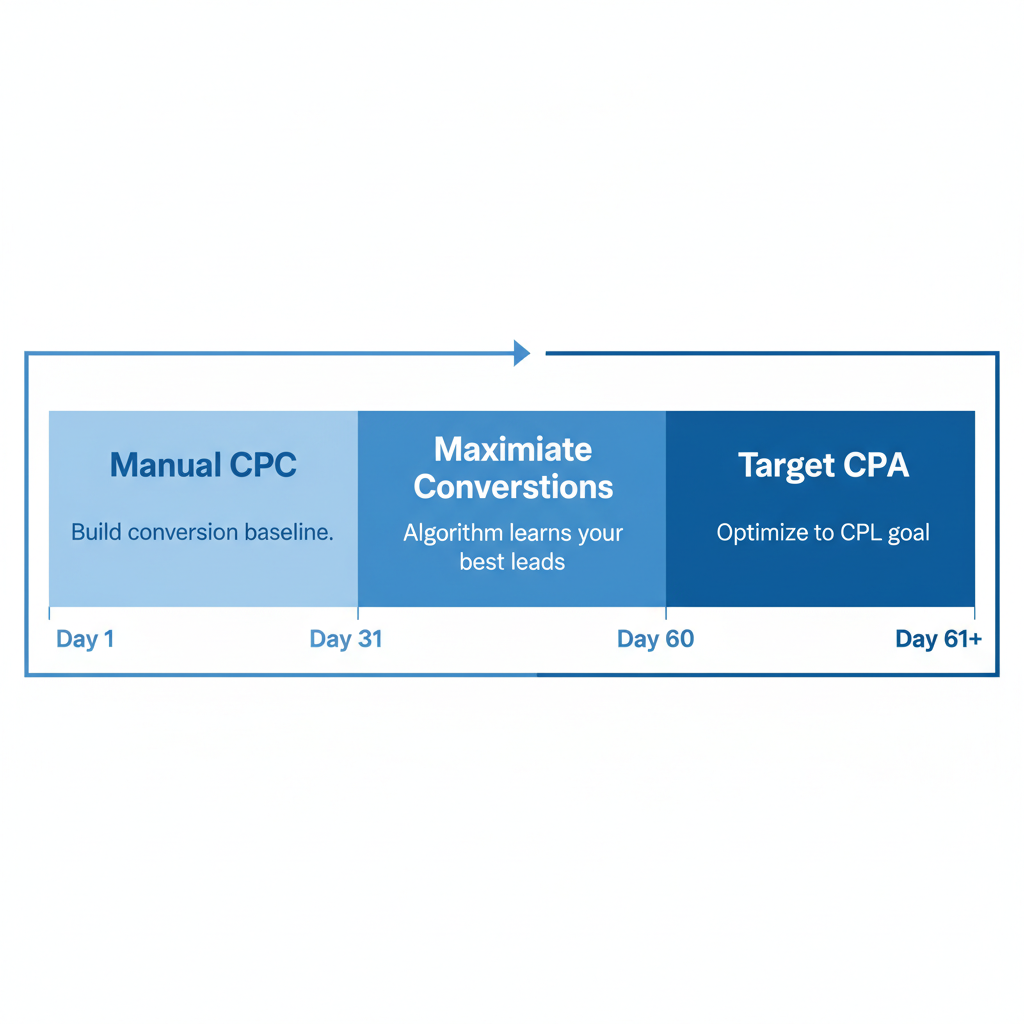
Ppc for lawyers benefits from a phased bidding approach that matches Google's algorithm needs at each campaign maturity stage.
Phase 1 (Days 1 to 30): Manual CPC. New campaigns lack the conversion tracking data automated bidding requires. Use Manual CPC to establish baseline CPCs, cap bids, and identify which keywords produce leads.
Phase 2 (Days 31 to 60): Maximize Conversions. Once you have 30 or more conversions, switch to Maximize Conversions. This automated strategy uses RLSA signals (device, time, location, behavior history) that manual bidding cannot evaluate. Expect CPL to decrease 15 to 25 percent in this phase.
Phase 3 (Day 61 Onward): Target CPA. Set a target CPA at 10 to 15 percent above your Phase 2 average. This gives the algorithm flexibility while protecting against runaway costs. Tighten incrementally every 30 days.
Landing page alignment matters as much as bidding. A visitor who clicked "car accident attorney Los Angeles" must see those exact words in the headline. Match types mismatches between ad and landing page cause immediate bounces and lower quality scores, inflating CPCs across every keyword in your account.
Intake speed is the variable most PI firms overlook entirely. Velocify research found that contacting a lead within 5 minutes of submission increases contact rate by 900 percent compared to responding after 30 minutes. Call tracking and call extensions are essential for measuring whether your intake team is actually reaching the leads your campaigns generate.
For deeper motor vehicle accident lead generation strategy beyond paid search, including Spanish-language campaigns for the Hispanic PI market, the landing page quality standards and audience targeting approaches differ significantly from English-language campaigns.
A profitable law firm ppc strategy is a system built on case economics, PI-specific keyword architecture, and intake speed, not generic Google Ads tactics borrowed from other industries. Firms that calculate acceptable CPL from case value, build negative keyword lists before spending, and align intake speed to their campaign conversion goals consistently outperform larger-budget competitors.
If you want a team that manages Google Ads for personal injury lawyers with this level of precision, including Spanish-language campaigns in competitive markets, schedule a free consultation to see how a managed campaign compares to running one in-house.
Turn Ad Spend Into Signed Cases
We blend AI-driven testing with proven performance strategy to attract qualified traffic and turn it into revenue—fast, trackable, and scalable.
- PI Lead Generation — exclusive, AI-qualified leads across MVA, slip & fall, med mal, and more.
- Facebook & Instagram Ads — reach customers where they scroll.
- Google Ads — capture people actively searching for you.
- Website Design — turn visitors into buyers with high-converting sites.
- AI Automations — save hours and never miss a follow-up.
- Email Marketing — nurture leads and close sales on autopilot.
- SEO — get found by customers searching for what you sell.
FAQs

About the author
Rafael Hernandez
CEO and Co-Founder of Great Marketing AI
Rafael Hernandez is the Founder of Great Marketing AI and a former Microsoft Engineer. He specializes in performance marketing for personal injury law firms, managing over $10M in ad spend to help attorneys generate signed cases across every PI case type. His strategies focus on exclusive lead generation, AI-powered qualification, and eliminating wasted budget.
About Great Marketing AI
Great Marketing AI: Performance marketing for personal injury law firms
We help personal injury law firms scale with exclusive, AI-qualified leads across every PI case type: MVA, slip & fall, medical malpractice, and wrongful death. Native English and Spanish campaigns, enterprise-grade Meta + Google ad management, and AI lead qualification before every intake.
100% Exclusive Leads
Never shared between firms. Territory-protected.
Native Spanish & English Campaigns
Built by native speakers, not Google Translate.
AI Lead Qualification
Pre-qualified before they ever reach your intake team.