Breakthrough Leads Optimization: Train Meta for Buyers
Master leads optimization on Meta. Stop chasing vanity metrics and train the algorithm to find buyers using our proven framework for high-ticket sales.

Rafael Hernandez
CEO and Co-Founder of Great Marketing AI

I hope you find this useful. If you want our team to run your law firm's performance marketing, book a strategy call.
Author: Rafael Hernandez | CEO and Co-Founder of Great Marketing AI
Key Takeaways
- Effective attorney lead generation on Meta is not about collecting form submissions; it is about training the algorithm to find prospective clients who will actually show up.
- Meta's pixel learns from whatever conversion event you assign; shallow events like form fills produce shallow results and high ghost-lead rates.
- Law firms that switch from lead form optimization to schedule optimization typically see show-up rates jump from under 50% to over 70%.
- Law firm lead generation requires a tighter funnel: go from ad to short sales page to calendar booking page, with qualifying questions built in.
- Properly routing booked consultations across attorneys using lead distribution software ensures no qualified prospect falls through the cracks after scheduling.
Why Law Firm Meta Ads Produce Ghost Leads
The most common mistake in law firm advertising on Meta is optimizing for leads and then being surprised when those leads never answer the phone. This is not a targeting problem. It is a conversion event problem.
Here is how most legal marketing funnels fail. A firm runs a free case evaluation ad. It generates leads at $8 to $12 each, which looks fantastic on paper. But only 10% of those leads schedule a consultation. Of those, fewer than half actually show up. Out of 100 leads, you end up with five consultations and two clients. Your real cost per client is now $600, not $10.
The attorney lead generation problem is not your ad creative or your audience targeting. It is that you trained Meta to find the cheapest people willing to submit a form, not people committed to a 45-minute legal consultation. Meta's advertising documentation confirms that the platform optimizes delivery based on whatever conversion signal you assign. Feed it shallow data, it finds shallow prospects.
The Intent Ladder: A Framework for Law Firm Lead Generation
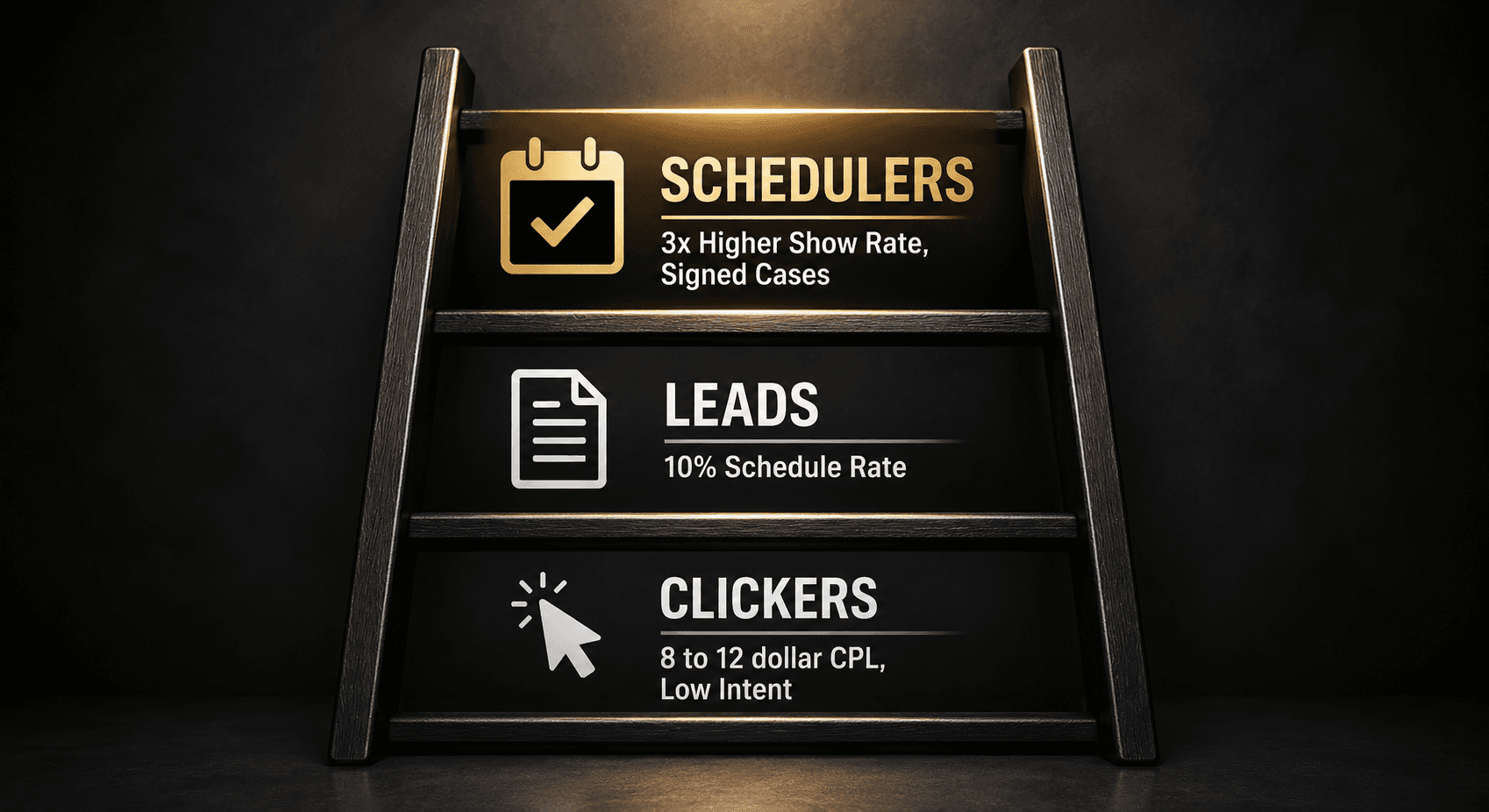
To fix this, we use a model called the Intent Ladder. Understanding this model is the foundation of effective law firm lead generation.
There are three levels of intent on this ladder:
-
Clickers: These are browsers who tap your ad and skim the landing page. They have zero commitment and represent the majority of cheap lead form submissions.
-
Leads: They provide a name, phone number, and email. They are somewhat interested but rarely ready to act. Most attorney lead generation strategies stop optimizing here.
-
Schedulers: They pick a time, fill out a qualification form, and confirm a case evaluation appointment. These are your actual prospective clients.
The revenue in legal practice lives at level three. Your funnel, your Facebook pixel, and your entire campaign structure must be trained for schedulers, not clickers.
Two Tactical Fixes for Better Attorney Lead Generation
Implementing the Intent Ladder in your facebook ads for lawyers campaigns requires two concrete changes to how your Meta account is structured.
Fix 1: Change the Conversion Event
Stop optimizing for the standard "Lead" event. Instead, set your conversion objective to the "Schedule" standard event on your Meta pixel. If your intake software or calendar booking tool does not fire a native Meta event, create a custom conversion that triggers only after a confirmed booking. This is the most critical pixel signal change in modern attorney lead generation.
This single change instructs the algorithm to find people who have a behavioral history of following through on professional appointments. For law firm lead generation, this means Meta starts finding prospective clients who are serious about getting help, not just clicking ads.
Fix 2: Tighten the Funnel Structure
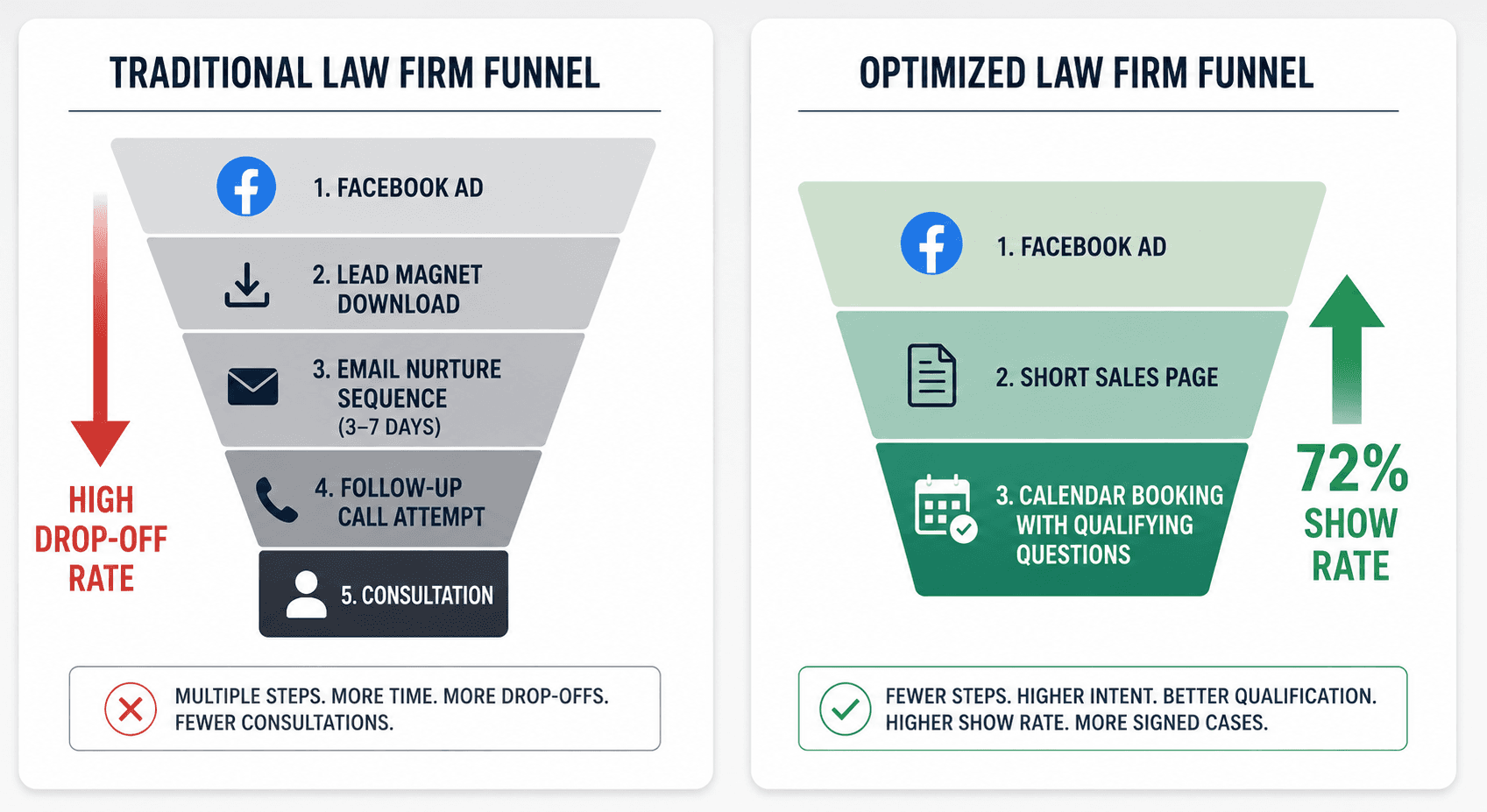
Traditional lead conversion strategies for law firms use a long sequence: lead magnet, nurture email series, then a call. For high-intent legal services, this kills momentum. A person looking for a personal injury or family law attorney is often in distress and needs a fast path to expert help.
Instead, restructure your funnel: ad to a short sales page that explains who the firm is, what the free consultation covers, and what the client will walk away with. Then directly to a calendar booking page with three to five qualifying questions. No free PDF download. No nurture delay. According to HubSpot research, leads contacted within 5 minutes of form submission are 400% more likely to qualify than those contacted later. For facebook ads for lawyers, shortening the path to consultation is a revenue decision.
Real Law Firm Results: The Math Behind Switching
The most common objection to schedule-based attorney lead generation is that Cost Per Lead will increase. This is true. And it is the best thing that can happen to a legal marketing budget.
Here is a real example from a law firm client that made this switch. They were running Meta campaigns at $11 per lead. Their schedule rate was 7%, and their show-up rate was 48%. Their effective cost per consultation was $171.
After switching the conversion event to a confirmed calendar booking and removing the lead magnet from the funnel, their Cost Per Lead rose to $32. But the schedule rate tripled and the show-up rate jumped to 72%. Their cost per consultation dropped to $96. Every call was now with a self-qualified, self-scheduled prospective client who had already filled out a qualification form.
This is the core math behind effective law firm advertising: a $40 lead that shows up for a case evaluation is worth more than four $10 leads that ghost your intake team. Firms that understand this math will dominate their practice areas.
Advanced Strategies: Disqualifying the Wrong Cases
Strong attorney lead generation also means actively filtering out the wrong prospects before they ever reach your intake team.
Match the ad creative to the consultation. Your ad must sell the case evaluation itself, not a free guide or generic legal tip. Explain what the consultation covers, what expertise the attorneys bring, and why the prospective client needs to act now. Think of your ad as the preview for the consultation: if it does not accurately represent what happens on the call, your show-up rate will suffer.
Add qualifying questions to the booking form. Use the calendar booking page to pre-screen case inquiries. Ask about practice area, brief description of the situation, location, and timeline. This friction filters out browsers and pre-frames serious prospective clients. Adding three to five qualifying questions typically reduces no-shows by 20 to 30%.
Track confirmed bookings, not thank-you pages. Use calendar software that fires a Meta pixel event on confirmed booking submission, not just a page visit. This gives the algorithm clean signal data for optimizing your facebook ads for lawyers toward real prospective clients.
Once you start generating properly qualified consultations, routing each one to the right attorney matters as much as lead quality itself. Using lead distribution software to automatically route booked consultations by practice area, attorney availability, or case type ensures every qualified prospect reaches the right person immediately. Speed of response on pre-booked consultations is one of the strongest predictors of a signed retainer.
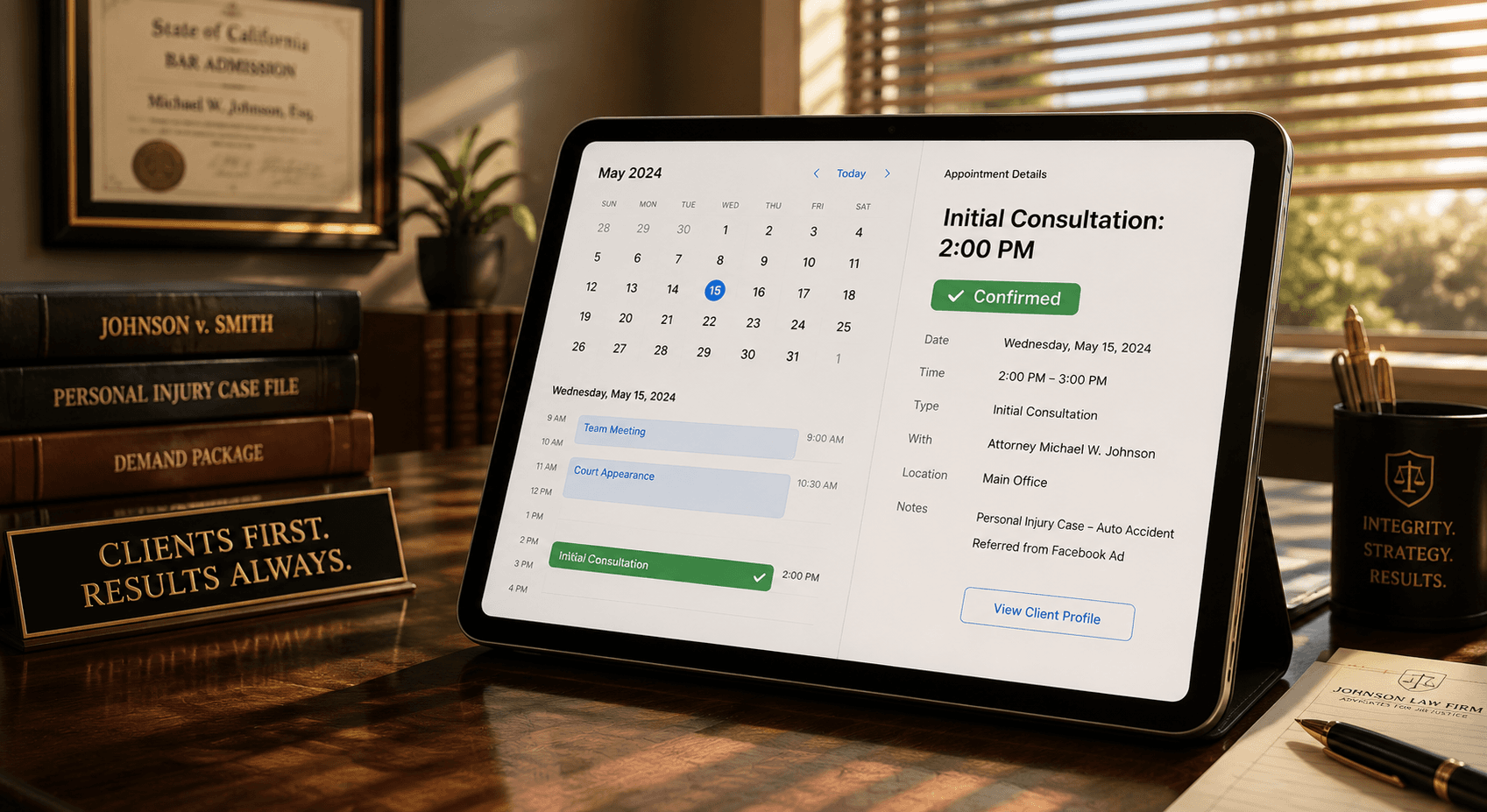
Have you ever looked at your Meta Ads dashboard and felt something was off? Your cost per lead looks incredible, the algorithm says you are crushing it, but your consultation calendar is empty. For law firms, this disconnect is not a data error; it is a structural problem in how your campaigns are set up. Effective attorney lead generation requires more than volume. It requires intent. And Meta's algorithm can be trained to find it.
The hard truth is that Meta does not care about your caseload. It cares about signals. When you optimize your law firm advertising campaigns for cheap form submissions, the algorithm hunts for the easiest targets: people who click anything and commit to nothing. A $10 lead that never answers the phone is not a lead. It is a waste of your intake team's time.
This framework, drawn directly from our work running Meta campaigns for law firms, will show you how to shift from ghost leads to confirmed consultations, and why that change is the single most important investment you can make in your attorney lead generation results.
Fix 1: Change the Conversion Event
Fix 2: Tighten the Funnel Structure
FAQs
Will switching to schedule optimization make my law firm's Meta ads too expensive?
Your cost per lead will appear higher on the Meta dashboard after the switch, but your cost per signed case will typically decrease. This is the core principle of smart attorney lead generation: instead of paying for ghost leads that never show up, you pay for confirmed consultations with self-qualified prospective clients. Most law firms see a 30 to 50% reduction in their effective cost per client within 60 days of making this conversion event change.
Why do the Meta leads I generate for my law firm never answer the phone?
The issue is almost always the conversion event assigned to your campaign. When Meta optimizes for the "Lead" event, it finds the cheapest people willing to fill out any form, not people specifically seeking legal help. Switching your law firm lead generation conversion event to a confirmed "Schedule" event trains the algorithm to find users who have a behavioral history of booking and attending professional consultations, not just clicking ads.
How many qualifying questions should I add to my consultation booking form?
Three to five questions is the practical range for effective lead conversion strategies in legal marketing. Ask what your intake team genuinely needs to determine case viability: practice area, brief description of the situation, geographic location, and whether the prospective client has spoken with other attorneys. Fewer than three provides insufficient pre-qualification. More than five creates excess friction that drops your booking rate without a proportional quality improvement.
What calendar software works best for firing Meta pixel events after a law firm booking?
Calendly, Acuity Scheduling, and HubSpot Meetings all support custom redirect pages after a confirmed booking, allowing placement of a Meta pixel event on the confirmation page. For advanced tracking, use software that integrates with your CRM so confirmed bookings simultaneously trigger a custom conversion in Meta Ads Manager. This gives the algorithm the clean, reliable data it needs for accurate attorney lead generation optimization.
Does this framework apply to practice areas other than personal injury?
Yes, the Intent Ladder applies to every practice area that relies on consultation-based law firm advertising: family law, criminal defense, immigration, estate planning, and employment law all benefit from switching to schedule optimization. Any area where a potential client must commit time and share sensitive case details rewards high-intent targeting over volume. The funnel structure may vary slightly by practice area, but the core principle of training Meta for schedulers rather than clickers remains constant.
Conclusion
The era of generating cheap leads and hoping your intake team converts them is over for law firms running Meta campaigns. Effective attorney lead generation today means training the algorithm with the right signals: calendar bookings, confirmed consultations, and qualified case evaluations, not form fills. By switching your conversion event and removing friction at the wrong stages while adding it at the right ones, you change who Meta finds for you entirely.
The firms winning right now are not spending more on law firm lead generation. They are spending smarter by showing Meta what a real client looks like. Stop optimizing for browsers. Start optimizing for clients who show up ready to sign. If you want to build this system for your law firm and finally see predictable case flow from paid social, the team at Great Marketing AI builds these exact frameworks every day.

Turn Ad Spend Into Signed Cases
We blend AI-driven testing with proven performance strategy to attract qualified traffic and turn it into revenue—fast, trackable, and scalable.
- PI Lead Generation — exclusive, AI-qualified leads across MVA, slip & fall, med mal, and more.
- Facebook & Instagram Ads — reach customers where they scroll.
- Google Ads — capture people actively searching for you.
- Website Design — turn visitors into buyers with high-converting sites.
- AI Automations — save hours and never miss a follow-up.
- Email Marketing — nurture leads and close sales on autopilot.
- SEO — get found by customers searching for what you sell.
FAQs

About the author
Rafael Hernandez
CEO and Co-Founder of Great Marketing AI
Rafael Hernandez is the Founder of Great Marketing AI and a former Microsoft Engineer. He specializes in performance marketing for personal injury law firms, managing over $10M in ad spend to help attorneys generate signed cases across every PI case type. His strategies focus on exclusive lead generation, AI-powered qualification, and eliminating wasted budget.
About Great Marketing AI
Great Marketing AI: Performance marketing for personal injury law firms
We help personal injury law firms scale with exclusive, AI-qualified leads across every PI case type: MVA, slip & fall, medical malpractice, and wrongful death. Native English and Spanish campaigns, enterprise-grade Meta + Google ad management, and AI lead qualification before every intake.
100% Exclusive Leads
Never shared between firms. Territory-protected.
Native Spanish & English Campaigns
Built by native speakers, not Google Translate.
AI Lead Qualification
Pre-qualified before they ever reach your intake team.